

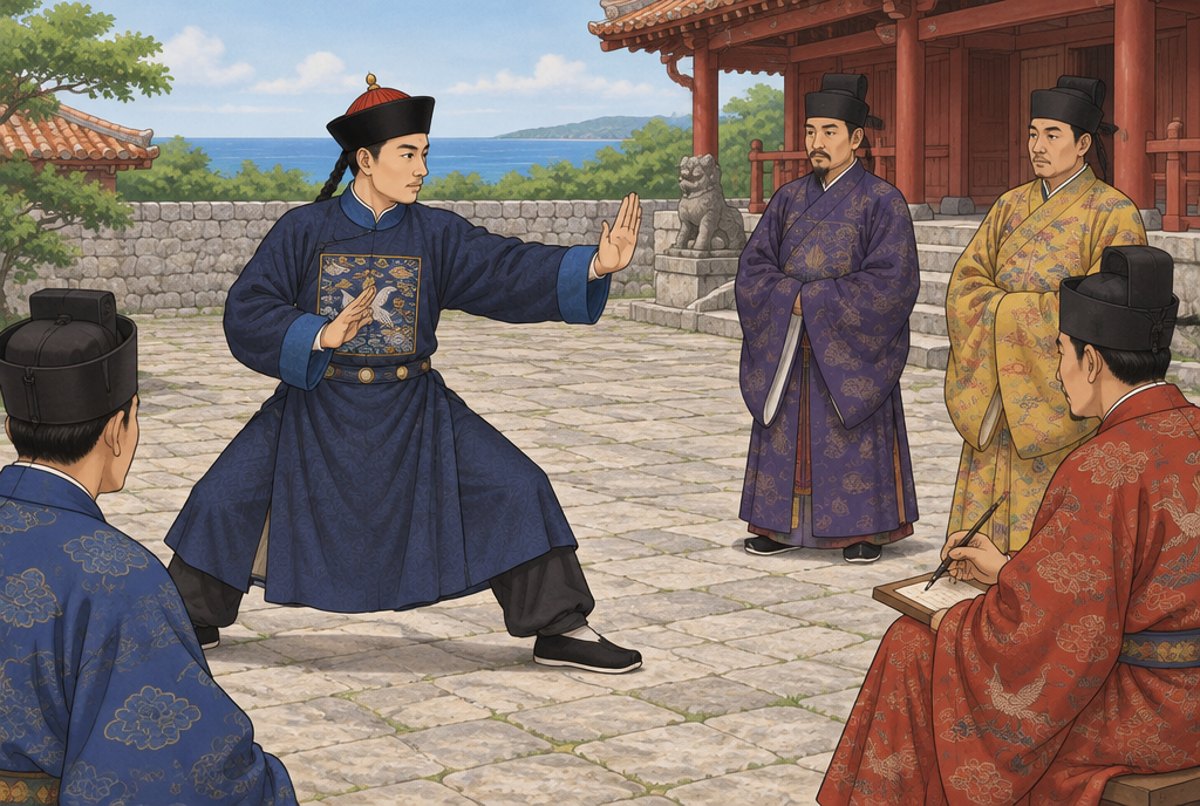
KusankuPartly legend
A Chinese officer who visited Okinawa around 1756
One account of where karate began starts with his visit.
- Karate students still learn routines of moves named after him: Kusanku, and in the Shotokan style, Kanku.
The empty hand art from Okinawa: its people, its kata, and how it reached a hall near you.
Karate is a striking art of punches, kicks, blocks and open hand strikes, with throws and locks still present in its older forms. 1,4 It grew up in the Ryukyu Kingdom, today's Okinawa in Japan, from a local method called te, meaning "hand", mixed with Chinese martial arts brought by envoys, traders and students. 1
It moved to mainland Japan in the 1920s, took the white uniform, the coloured belts and the kyu and Dan grades from judo, and changed the meaning of its name from "Chinese hand" to "empty hand". After the Second World War it spread round the world, reached Britain in 1956, and made its one Olympic appearance at Tokyo 2020. 1
A class is usually built from three parts: kihon, basic techniques practised in lines; kata, set forms practised alone; and kumite, partner work from set drills to free sparring, done with control. 1,4,41 Classes begin and end with a bow, and many clubs count and give commands in Japanese. 73
There is no single karate. Several styles, and many independent associations within each, teach their own kata order, belt colours and grading rules. 1,4,17 Where they differ, each version is shown side by side with its owner.
The same true story, told two ways. Pick the one for you.
For younger readers
Ages 8 to 11, read aloud if you like. 6 short chapters, each with a Listen button.
Drag along the line, or tap a dot, to meet the people of each time.
1756 to 1867
Okinawa, then the Ryukyu Kingdom
Okinawa was then an island kingdom between Japan and China, and its people had their own way of fighting, called te, which simply means hand. Through the 1800s a style from China spread alongside it, and slowly the two mixed into what became karate.
KusankuPartly legend
A Chinese officer who visited Okinawa around 1756
One account of where karate began starts with his visit.
Kanga Sakugawa1786 to 1867
An Okinawan who trained in China
A later teacher, Anko Asato, linked the Chinese style to him.
Or browse every karate club by town.
Every page can be read aloud by your device. Tap Listen at the bottom of a chapter.
Written from checked sources, listed on the sources page. Pictures are drawn, with computer help, under our direction; none shows a real child. Recorded chapters are read by a computer voice; Hear it on a word uses your device's own voice.