

Every club runs things a little differently, so in many places the honest advice is "ask the club".
Before you go
- Contact the club first. Instructors normally invite newcomers to watch or join a session. 72
- Trial sessions are common. The EGKA says most of its dojos do not charge for the first few lessons. 72 In the KUGB, insurance covers a new member for up to three sessions while their licence is applied for. 64 Arrangements differ elsewhere; ask.
- No kit needed at first. A loose T-shirt and tracksuit bottoms are fine; karate is done barefoot. 72
- Take off jewellery and watches (or tape over anything that cannot come off), and keep finger and toe nails short. Clubs ask this to avoid hurting training partners. 85,86
- Tell the instructor about any health problem or injury. The EGKA advises anyone with a health condition to check with a doctor first. 72
When you arrive
- Shoes come off before the training floor, in line with Japanese custom. 39,85
- Bow when entering and leaving the training area. 85,86
- Arrive a few minutes early. If you are late, wait at the edge until the instructor invites you in. 85,86
- Calling the instructor (teacher) is usual. 44,85
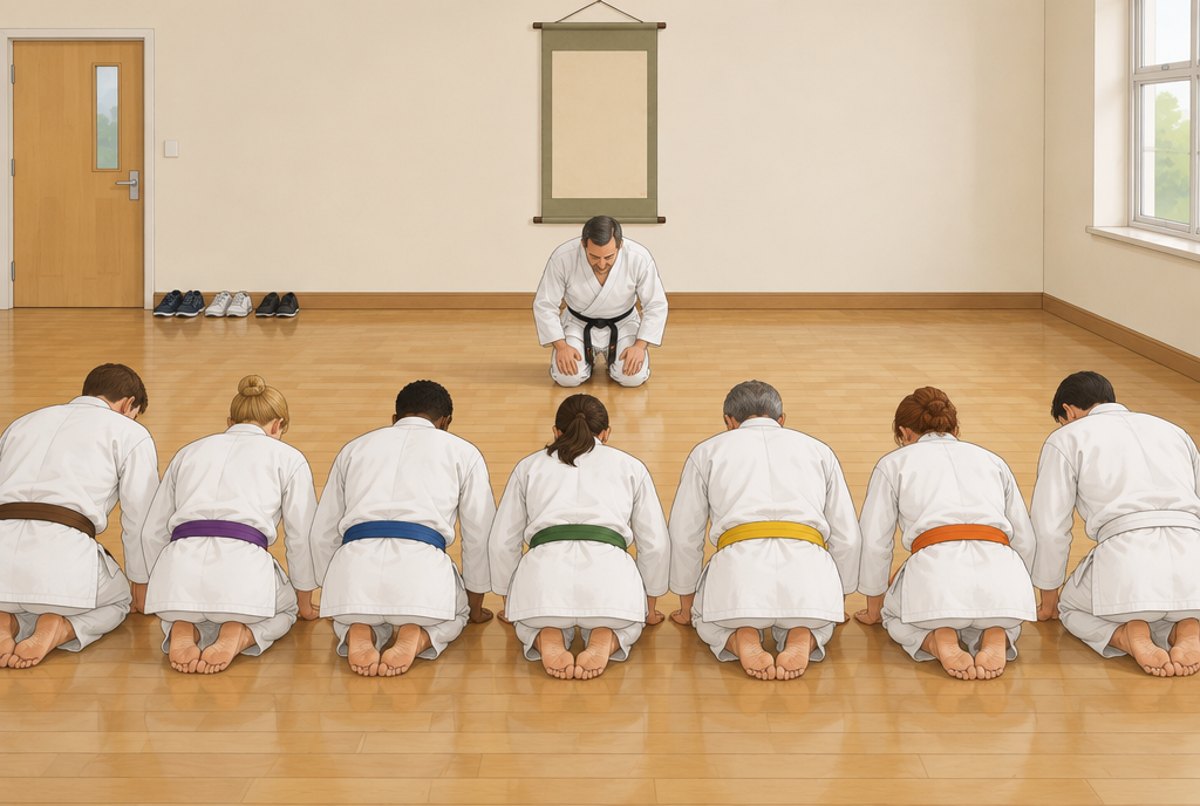
What a class usually looks like
The exact order varies, but most classes contain these parts. 1,73,85,86
- Line up and bow in. Students line up (in many clubs in grade order, senior grades first), kneel in , close their eyes briefly (), then bow to the front, to the instructor and to each other. Common words: (line up), seiza (kneel), mokuso (settle the mind), (bow), ("please teach me"). 73,85,86
- Warm up (). 73
- : basic stances, punches, blocks and kicks, often done together in lines. 1
- : practising set forms. 1
- or partner work: set drills for beginners, free sparring for higher grades. 1,4
- Line up and bow out, often thanking the instructor (). Some clubs recite the at this point. 34,73
Two practical points. Kneeling in seiza can be hard on the knees, particularly for older or injured people; it is fine to tell the instructor. 40 And many clubs count and give instructions in Japanese; the glossary page has the words.
Kit, later on
- Uniform: a (gi), usually white; some clubs use other colours for instructors. It is lighter than a judo uniform. 37
- Belt: everyone starts on a white . 9 See the belts and grades page for what comes next.
- Licence: associations usually require an annual licence, which includes insurance. The KUGB's licence, for example, covers member to member, public liability and professional liability. 63,64
- Protective kit for sparring: for WKF style competition this means mitts, gum shield, body or chest protector, shin and foot pads, and a groin guard for males; under 14s also wear a helmet. 51 Clubs set their own rules for training; ask what is needed and when.
- Women and girls: some clubs allow a plain white T-shirt under the gi. 85
Questions families commonly ask
What age can children start?
There is no single answer. The KUGB says insurers will not cover children under 4, so its clubs cannot take them; some KUGB clubs set an older minimum, often 7 or 8. 63 The KUGB gives two different minimum ages, 3 and 4, so ask the club. 61 The EGKA says people can start at any age and many start in their early teens; adults in their forties and fifties also start. 72 Competition age groups begin young: IFK knockdown rules have junior categories from 8 years, and the WKF's youngest international category is under 14 (12 to 13). 50,76
How much does it cost?
How often should we train?
The KUGB requires students to train on average twice a week to grade. 61 The EGKA recommends at least three sessions a week, especially before senior gradings, while warning against overtraining. 72
How long to black belt?
Usually several years. The EGKA says at least three and a half years for juniors and four or more for most adults. 72 On the KUGB's minimum waiting times, the fastest possible route is about two years and eight months: a minimum, not a typical time. 61
Do I need to be fit?
No. The EGKA says lessons are adapted to each student's level. 72
Is it safe?
- Most karate clubs train sparring with control rather than full force, and many use protective kit. 41,51
- Injuries still happen: the EGKA lists sprains, dislocations, black eyes and nosebleeds as possible. 72
- Full contact styles such as Kyokushin spar harder. Many Kyokushin clubs use gloves and shin pads in training, and children often wear headgear. 8
- Safeguarding: the NSPCC's Child Protection in Sport Unit suggests five questions to ask any club: have the staff been checked, does the club have a safeguarding policy, what happens if there is an accident, who can you talk to, and what training is there. 91
- The Safeguarding Code in Martial Arts is a scheme that recognises clubs with good safeguarding practice and has a find a club map. 90 Many associations also publish a safeguarding contact, for example the KUGB. 64
Do we have to compete?
No. Some organisations do not compete at all: Karate-do Shotokai does not take part in sport competition, and British Wadokai stays out of sport and all styles bodies. 67,82 Others run regular championships. See the competition page.
Which style is best?
No style is "best"; they differ in emphasis. Shotokan uses long, deep stances and strong straight line technique; Wado-ryu stresses evasion and fluid movement; Goju-ryu mixes hard and soft with close range work and breathing; Shito-ryu and Shukokai have large kata syllabuses and fast, upright fighting; Kyokushin is full contact. 4,5,6,7,8,9 The club and the teacher usually matter more to a beginner's experience than the label, which is why watching a class first helps.
What if we move to another club?
Grades do not automatically transfer between associations. 14 Ask the new club how it treats grades from elsewhere. In the KUGB, grades are never taken away after a break in training. 63