

The one thing every family should know: there is no single karate belt order. Each association sets its own colours, number of grades, kata and waiting times. 1,4,38 The examples below are real, published orders, shown side by side so the differences are visible.
Where the system came from
The and system was first used in a martial art by Jigoro Kano, the founder of judo, who awarded the first Dan grades in 1883. Kano had his Dan grades wear black belts from 1886, and in 1907 introduced the white training uniform with white belts below Dan grade and black above. 14 Gichin Funakoshi adopted the system, and the uniform, for karate in 1924. 1,4 Okinawa took it up later, by one account in 1960. 11
Funakoshi's original karate belts were just white for 8th to 4th Kyu, brown for 3rd to 1st Kyu, and black for the Dan grades. Many Shotokan schools kept this pattern and added colours. 4
How the numbers work
- Kyu grades count down. A beginner starts at a high number, often 9th or 10th Kyu, and works down to 1st Kyu. 1,5
- Dan grades count up. 1st Dan (, "first step") is the first black belt; grades then rise to 10th Dan. 1,52
- People below black belt are , "without dan"; black belts are , "holders of dan". 1,14
- The dan names: shodan (1st), nidan (2nd), sandan (3rd), yondan (4th), godan (5th), rokudan (6th), nanadan or shichidan (7th), hachidan (8th), kudan (9th), judan (10th). 8,52,73
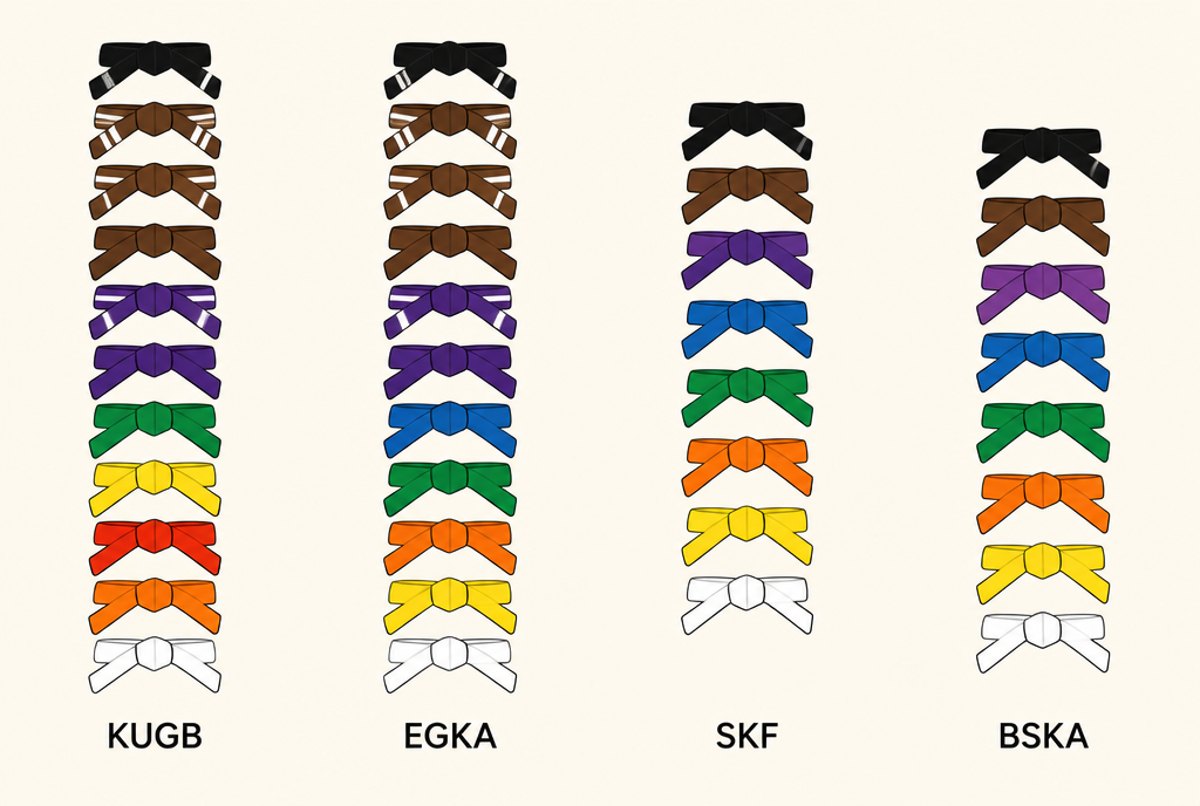
Belt colours: real examples
The colour is the belt worn at that grade. "Stripe" means a stripe or tag on the belt.
| Kyu | KUGB, Shotokan 61 | EGKA, Goju-ryu adult 70 | SKF, Shukokai 80 | BSKA, Sankukai 84 | Funakoshi's original 4 |
|---|---|---|---|---|---|
| Start | White (novice) | White with stripes (10th) | White | White (9th) | White |
| 9th | Orange | Yellow | Yellow | White | White |
| 8th | Red | Orange | Orange | Yellow | White |
| 7th | Yellow | Green | Green | Orange | White |
| 6th | Green | Blue | Blue | Green | White |
| 5th | Purple | Purple | Purple | Blue | White |
| 4th | Purple and white | Purple, white stripe | Purple | Purple | White |
| 3rd | Brown | Brown | Brown | Brown | Brown |
| 2nd | Brown, one white stripe | Brown, one stripe | Brown | Brown | Brown |
| 1st | Brown, two white stripes | Brown, two stripes | Brown | Brown | Brown |
| Dan | Black | Black | Black | Black | Black |
Notes on the table:
- The SKF publishes its colours as steps ("yellow to orange" and so on) rather than Kyu numbers; they are lined up here to compare. 80
- Kyokushin groups mostly use orange for 10th and 9th Kyu, and a few use red; the UK's BKK groups beginners as "red and blue belts" in its tournament rules, so its order may differ; ask the club. 8,75
- The EGKA's FAQ says it has nine official Kyu grades while its syllabus page lists a 10th Kyu starting point; the 10th is probably a beginner step; ask the club. 70,72
- The colours that vary most are red, a beginner grade in some systems and a senior grade in others, and orange, yellow and green, which swap places between associations. 38
- Many clubs add extra stripes or "tag" grades for children between the main Kyu grades. 5,72
Dan grades and titles
In most styles the black belt is plain for all Dan grades. Some styles add stripes or gold bars to show grade or title; Wado-ryu practitioners tend not to. 5,14 Normally the first five or six Dan grades are tested by examination; higher grades are given for long service or contribution and are often called honorary. 1,5 Some styles award teaching titles, renshi, kyoshi and hanshi; assistant instructor (shidoin) is often around 3rd Dan and full instructor (shihan) around 5th Dan, though this varies. 14 Some organisations have a probationary black belt, shodan-ho, before full 1st Dan. 9 The KDS (Shotokai) caps grades at 5th Dan. 82
Minimum ages and waiting times differ by body
| Grade | WKF regulation, for WKF national federations 52 | KUGB, Shotokan 61 |
|---|---|---|
| 1st Dan | At least 15 and 3 years of training | No age limit; at least 6 months at 1st Kyu |
| 2nd Dan | At least 17; 2 years after 1st Dan | No age limit; 2 years after 1st Dan |
| 3rd Dan | At least 20; 3 years after 2nd Dan | At least 21; 3 years after 2nd Dan |
| 4th Dan | At least 24; 4 years | 4 years after 3rd Dan |
| 5th Dan | At least 29; 5 years | 5 years after 4th Dan |
| 6th Dan | At least 35; 6 years | 8 years after 5th Dan |
| 7th Dan | At least 42; 7 years | On the Technical Committee's recommendation |
| 8th Dan | At least 50; 8 years | As above |
| 9th and 10th Dan | For exceptional lifetime achievement | As above |
The WKF only certifies grades up to 8th Dan through national federations; higher grades are national awards or, rarely, given by the WKF board. 52
What a grading usually involves
What is common, with the caveat that each association sets its own rules: 1,61
- The student performs in front of an examiner or panel. 1
- The content is usually some mix of (basics), kata, (kata applications) and (sparring drills or free sparring), and in some styles self-defence or board breaking. 1
- Some gradings test everything learned so far, others only the new material. 1
- Minimum time in grade, and often a minimum age, apply. 1,52,61
A UK example, from the KUGB: the student needs a current licence and record book, the senior club instructor's permission, and on average two training sessions a week; novices may grade after two months, then at least three months between each Kyu grade; at dan gradings, chest guards for girls and women and groin guards for boys and men are compulsory from age 12. 61 On those minimum intervals the fastest possible route from first lesson to 1st Dan is about two years and eight months: a minimum, not a typical time. 61 Another, from the EGKA: most dojos grade every four months, a junior needs at least three and a half years of steady training to reach black belt, and most adults take four years or more. 72
Questions families ask
Does a grade carry over if we change club? Not automatically. Ranks are specific to a school or style and do not necessarily translate between them. 14 Whether a new association accepts an old grade is its own decision, so ask the new club.
Do you lose your belt after a break? In the KUGB, no: grades are never taken away, and the instructor helps you return safely. 63 Other associations set their own rules; ask.