

Exact shapes differ between styles and clubs; where a style is known to differ, it is noted. Most karate training is built from three parts: (basics), single techniques and short combinations, often practised as a group in lines; (forms), set sequences that join techniques together; and (sparring), using the techniques with a partner, from set drills to free sparring. 1,4 Early grades focus mainly on stance, balance and coordination; speed and power are added as students progress. 1,11
Stances (dachi)
A stance is how you stand and move. It gives the technique its base. 46
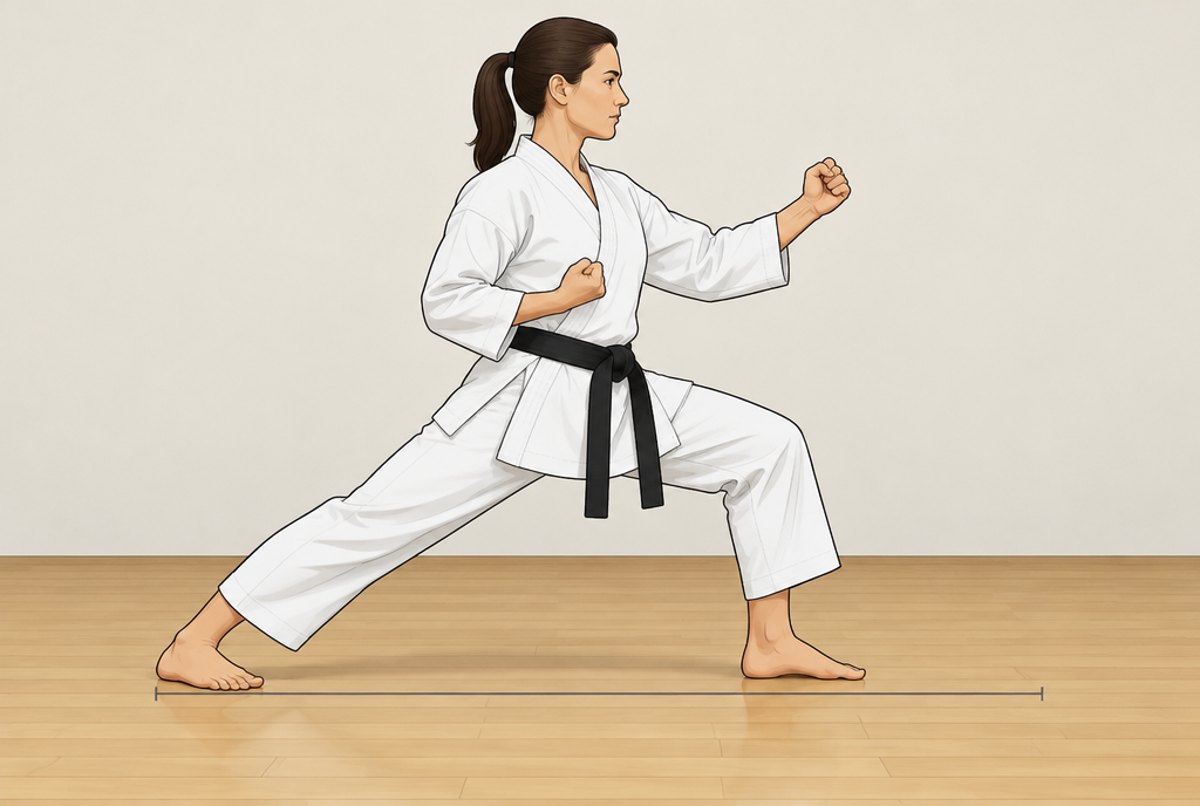
| Stance | What it looks like | Where you meet it |
|---|---|---|
| Heels together, toes turned out; the formal standing position for bowing | Start and end of class and kata 33,73 | |
| (also hachiji dachi) | Natural ready stance, feet about shoulder width | Ready position (yoi) 33,73 |
| (front stance) | Like a long lunge: front knee bent, back leg straight, hips facing forward. Shotokan uses a longer, deeper version than some styles | Most basic punching and blocking lines; Heian kata 4,46 |
| (back stance) | The mirror of front stance: most weight on the bent back leg, body turned side on, head facing forward | First met in Heian Shodan in Shotokan 33,46 |
| (horse stance) | Wide, feet parallel, knees bent as if riding a horse | Tekki kata; leg strengthening 33,43,46 |
| Like horse stance but toes and knees turned out about 45 degrees, often lower | Goju-ryu and other Okinawan based styles 46,73 | |
| A short, gripping, inward turned stance held with tension | Sanchin kata; the base stance of Uechi-ryu and of many Goju-ryu kata 43,46 | |
| (cat stance) | Almost all weight on the back leg, front foot resting lightly | Goju-ryu (first in Gekisai Dai Ni), Shotokan and others 6,33,73 |
Style note: Wado-ryu and Shukokai generally use higher stances than Shotokan, for speed and mobility. 5,9
Punches (tsuki or zuki)
In Japanese "tsuki" often becomes "zuki" after another word, as in gyaku-zuki; both forms mean the same thing. 33,73
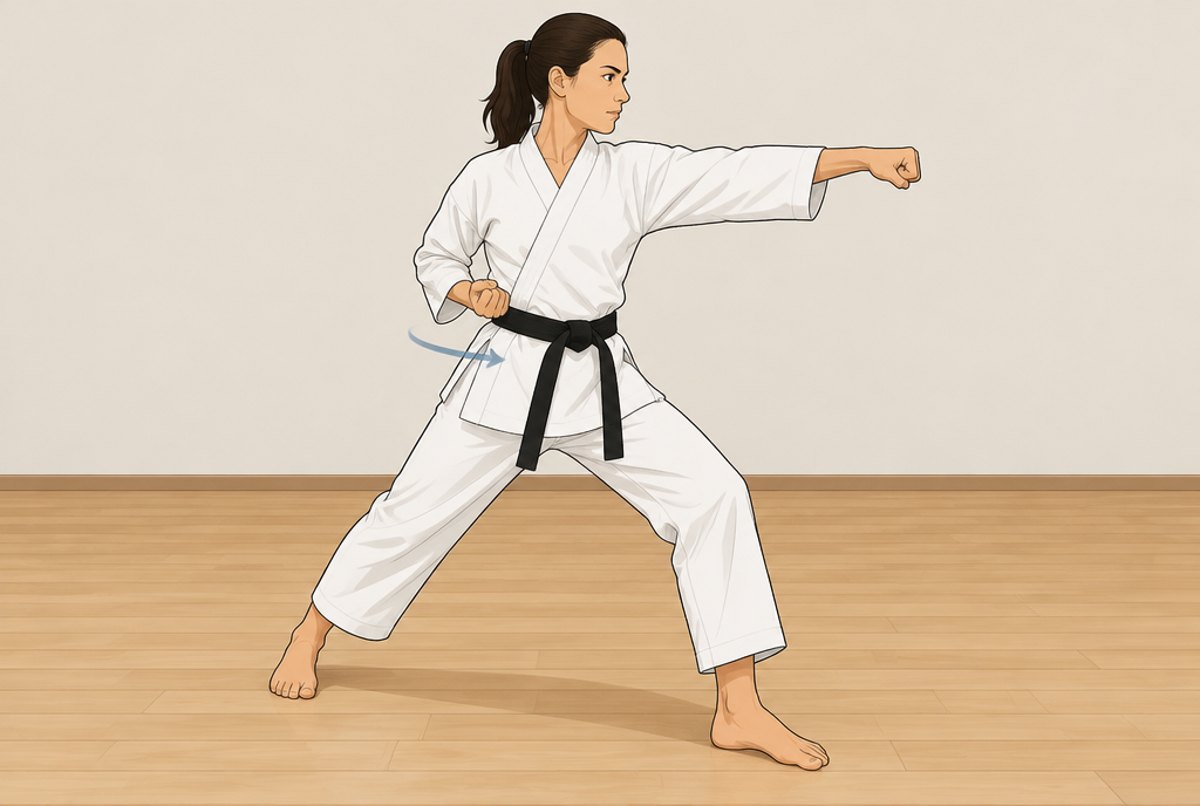
| Technique | What it is |
|---|---|
| (stepping punch) | Step forward and punch with the hand on the same side as the front foot 33,73 |
| (reverse punch) | Punch with the hand on the opposite side to the front foot, turning the hips into it 33,73 |
| (jab) | A quick punch with the front hand, like a boxer's jab 33,46,73 |
| A straight punch 33,73 | |
| A short punch with the palm turned up, similar to an uppercut 33,46 |
In WKF competition a punch to the head or body that meets the scoring criteria is worth one point (). 51
Blocks (uke)
"Uke" is usually translated "block", but many styles think of it more as receiving, deflecting or redirecting an attack. Wado-ryu, for example, parries and deflects rather than blocking hard. 5,7
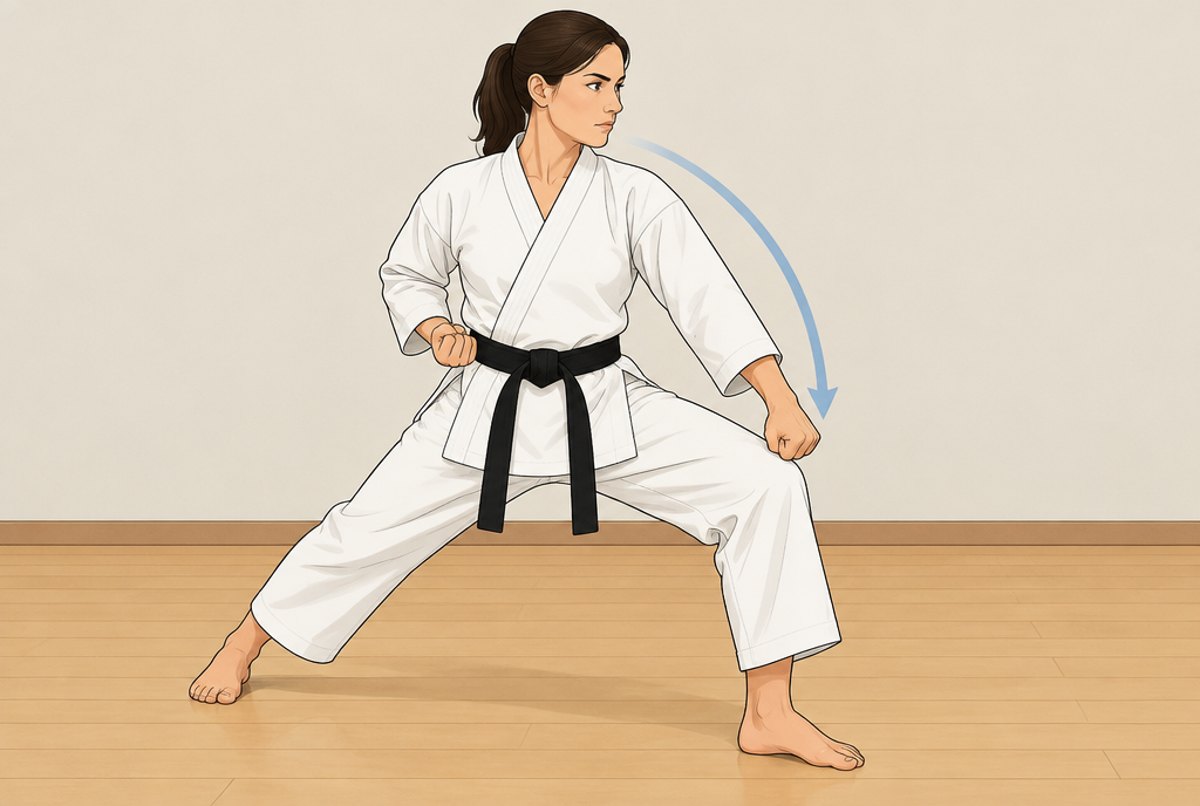
| Technique | What it is |
|---|---|
| A downward sweep of the forearm to clear a low attack. In Shotokan it is the block in the very first kata, Taikyoku Shodan, paired with oi-zuki 4,33,73 | |
| A rising forearm block to protect the head 33,73 | |
| and | The two middle level forearm blocks, travelling across the body in opposite directions. Clubs do not all use the two names the same way, so go by what your instructor calls them 33,73 |
| A block with the edge of the open hand 33,46 | |
| A forearm block with the other hand supporting it 33 |
Kicks (geri)
"Keri" becomes "geri" after another word, as in mae-geri. 33,73
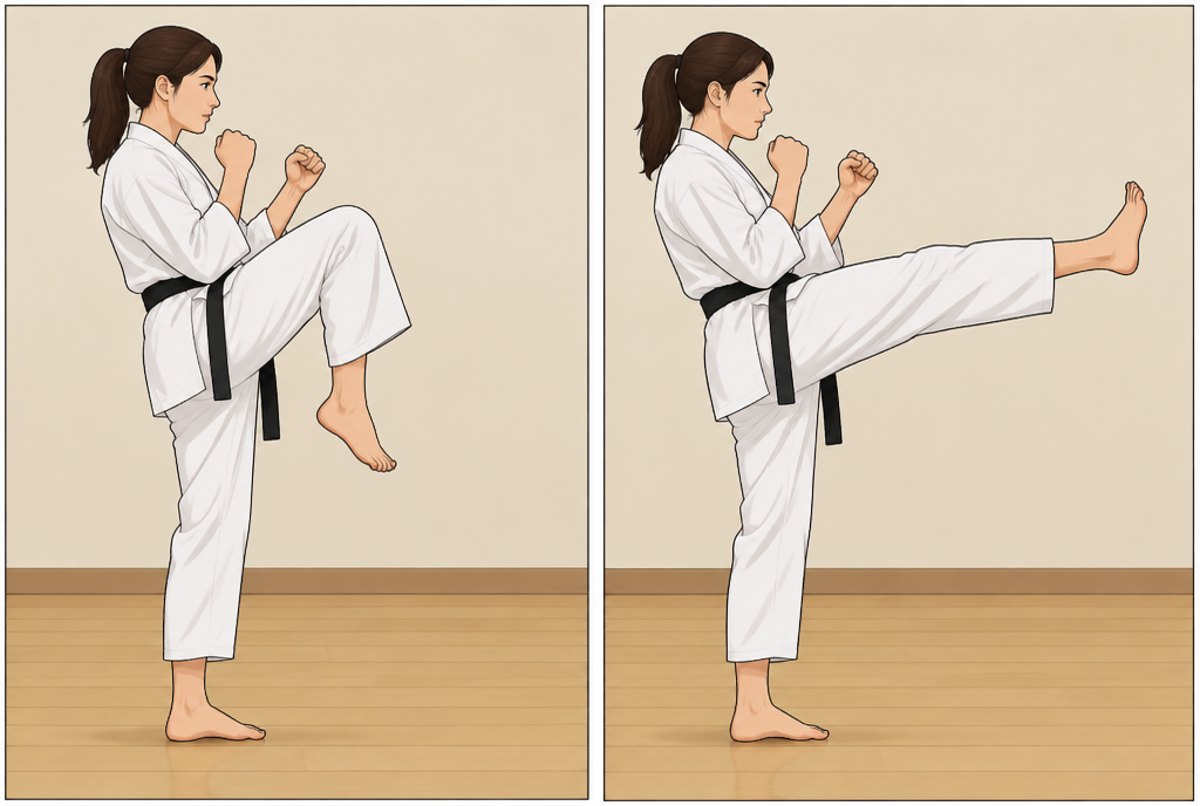
| Technique | What it is |
|---|---|
| (front kick) | Lift the knee, straighten the leg forward to strike, and pull the leg back at once 33,46 |
| (roundhouse kick) | Lift the knee, turn the supporting foot and body, and swing the leg round to strike with the shin, instep or ball of the foot 33,46 |
| (side kick) | A kick to the side, either snapped (keage) or thrust (kekomi), striking with the heel or the outer edge of the foot 33,46 |
| (back kick) | A kick straight backwards with the heel 33,46 |
| A knee strike 33,73 | |
| (crescent kick) | The leg swings in an arc; used in Heian Sandan as a kicking block in Shotokan 33,46 |
In WKF competition a kick to the body scores two points () and a kick to the head three (). 51
Open hand and other strikes (uchi)
| Technique | What it is |
|---|---|
| (back fist) | A flick of the back of the fist 33,73 |
| uchi (knife hand) | A strike with the little finger edge of the open hand, the "karate chop" 33,46 |
| or hiji (elbow) | Elbow strikes, forward, upward, sideways or backward 33,73 |
| (hammer fist) | A strike with the bottom of the clenched fist 33,73 |
| (palm heel) | A strike with the base of the palm 33,46 |
| (spear hand) | A strike with the fingertips 33,46 |
Moving the body
- Stepping and group work: kihon is typically practised by the whole group together, in unison, in stances. 1,4
- : moving the whole body out of the line of an attack, central to Wado-ryu and Sankukai. 5,84
- Turning: kata teach turning to face new directions; the pattern each kata follows on the floor is its . 4
Three ideas beginners hear a lot
- : a short, sharp shout as a technique lands. It is a sound, not usually the word "kiai" itself. 35
- : a split second of focus and tension at the moment a technique finishes. 45
- : staying alert after a technique, not switching off or turning away. The WKF counts this as one of its six criteria for a score. 36,51
Early partner work
Beginners usually start with set drills: in (five step) the attacker steps in five times and the defender steps back blocking, countering after the last block; sanbon (three step) and (one step) follow. 4,41 Free sparring, , comes later; in many Shotokan schools one step sparring starts around purple belt. 4
Control matters more than power. In WKF sport rules, head techniques for adults must stop within 5 cm (kicks) or 2 cm (punches), with at most a light skin touch, and for under 16s the margin is wider (10 cm and 5 cm). 51 Many clubs limit targets (no joints, throat or groin, and often no face contact for lower grades) and use mitts, shin pads and gum shields. 41,51 Kyokushin is different: it trains for knockdown sparring with hard body contact, though usually without punches to the head. 8
A note for families: technique pages are for understanding what is being taught. Techniques are learned from an instructor, in a class, with a partner who knows the drill.