

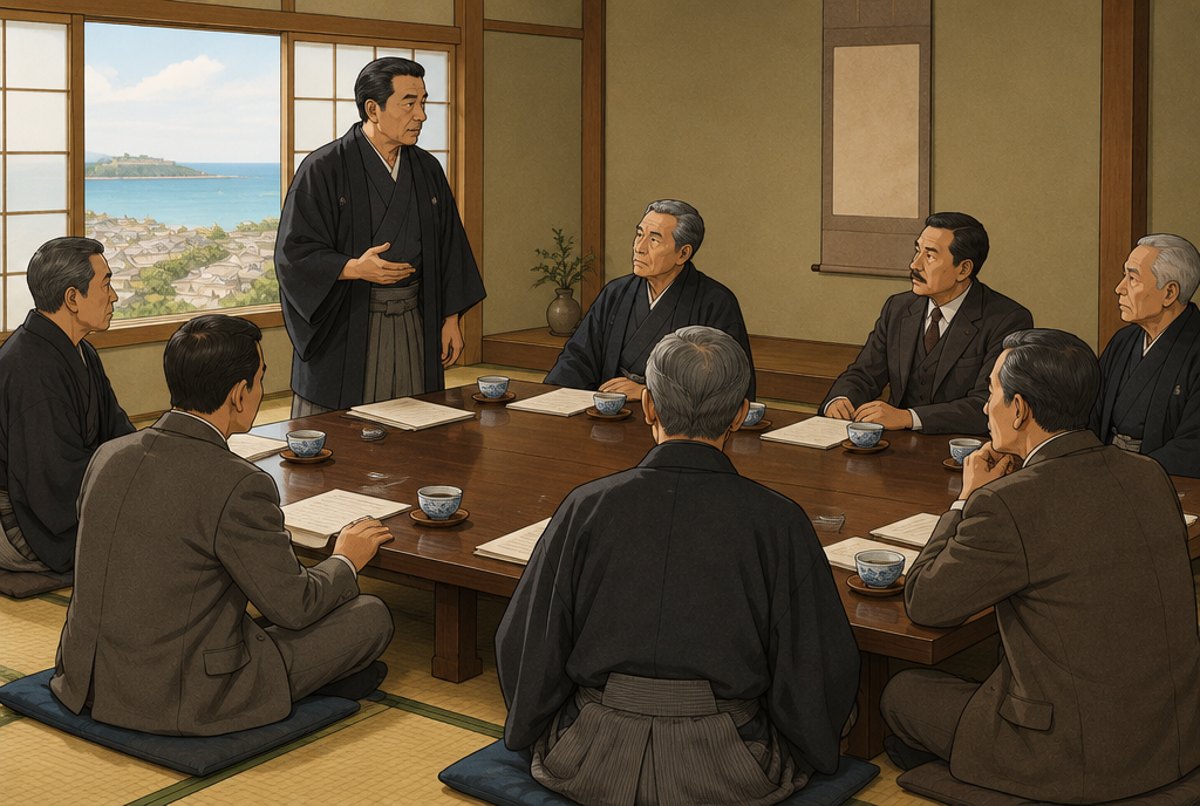
In May 1922 Gichin Funakoshi, born in Shuri in 1868 and now in his fifties, brought karate to a physical education exhibition in Tokyo, as pictures on two hanging scrolls. 1,3 The next month he was invited to the Kodokan, the judo school of Jigoro Kano, and showed it there in person, in front of Kano and other judo experts. 1,3 That same year he published the first book ever written on karate. 1,3
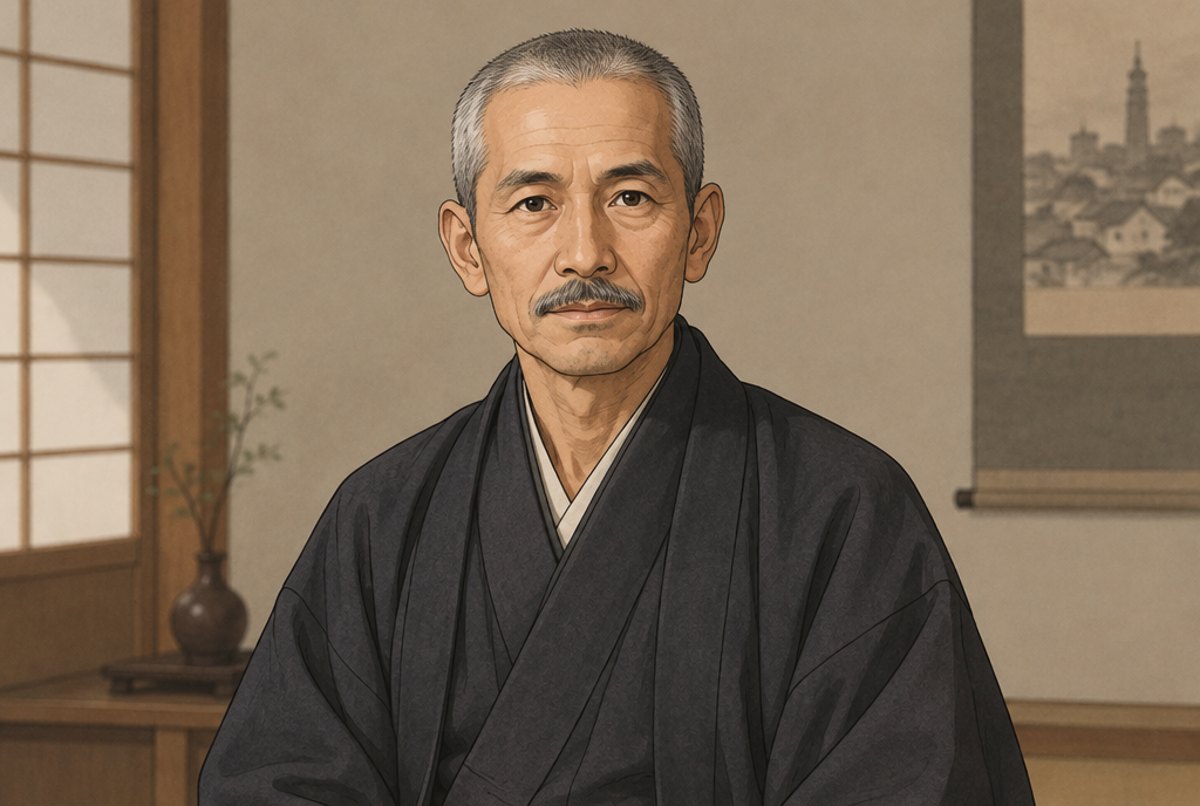
The man watching
Kano was not a stranger to the art. In 1908 pupils from an Okinawan school had demonstrated karate at the Butokuden in Kyoto, and Kano had been in the hall. 1 By 1922 he had built what karate lacked: a grading system of and , first awarded in 1883, with black belts for Dan grades from 1886 and a white training uniform from 1907. 14
Funakoshi's was not the only karate Japan saw that year. In 1922 another Okinawan, Choki Motobu, beat a foreign boxer in Kyoto, and a big national magazine wrote it up; that fight, more than any demonstration, made karate widely known. 1 Two very different men had put the art in front of the public in one year, one with a book and a demonstration, the other with a fight. 1,3
Funakoshi stayed in Tokyo and taught at university clubs. 3 Through the 1920s and 1930s other Okinawan teachers followed him to the mainland: Kenwa Mabuni, Chojun Miyagi, Kanken Toyama and Kanbun Uechi. 1 One of his first mainland students was Hironori Otsuka, a jujutsu teacher who trained under him from 1922 and was assisting him by 1927. 5
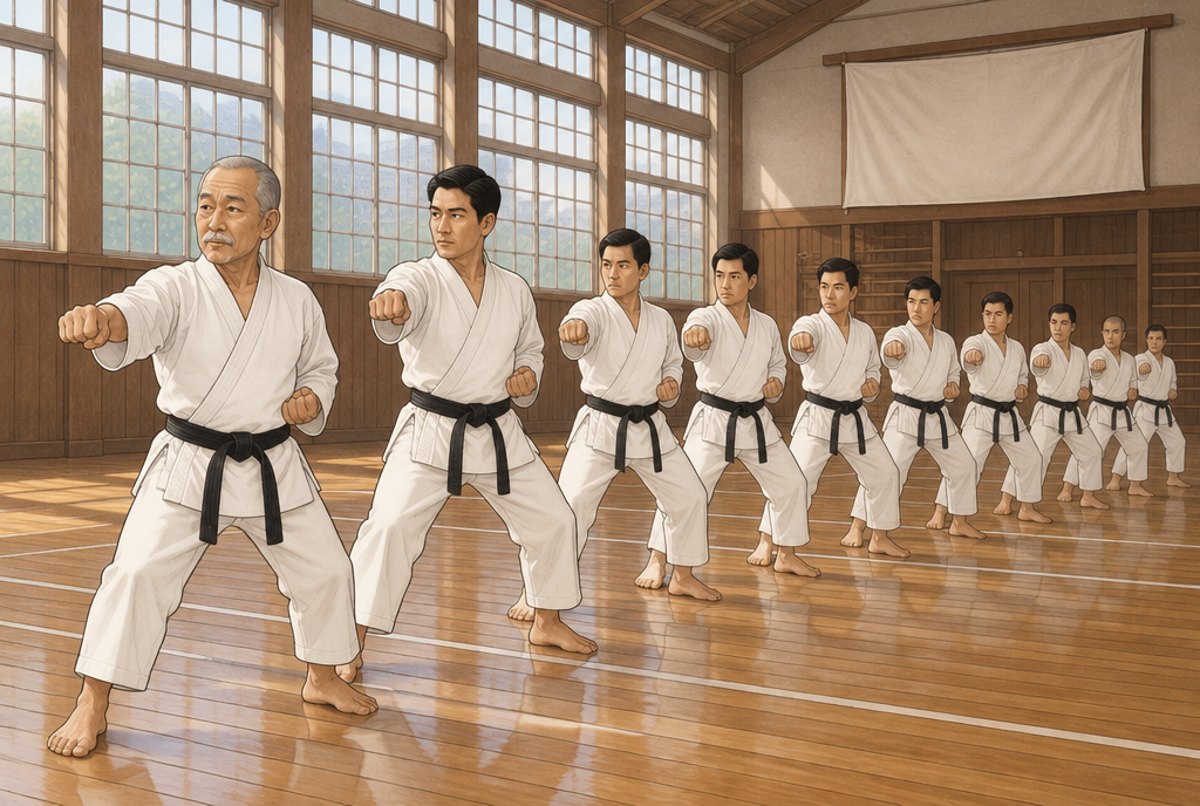
1924: the belts
In 1924 Funakoshi adopted Kano's kyu and Dan grades and the training uniform for karate. 1,4 His belts were plain: white from 8th Kyu to 4th Kyu, brown from 3rd to 1st, black for the Dan grades. 4 Among the first black belts he awarded, that year, was Otsuka. 5
Many Shotokan schools kept that pattern and added colours, and every association since has chosen its own. 4 Okinawa itself took the system up much later, by one account in 1960. 11
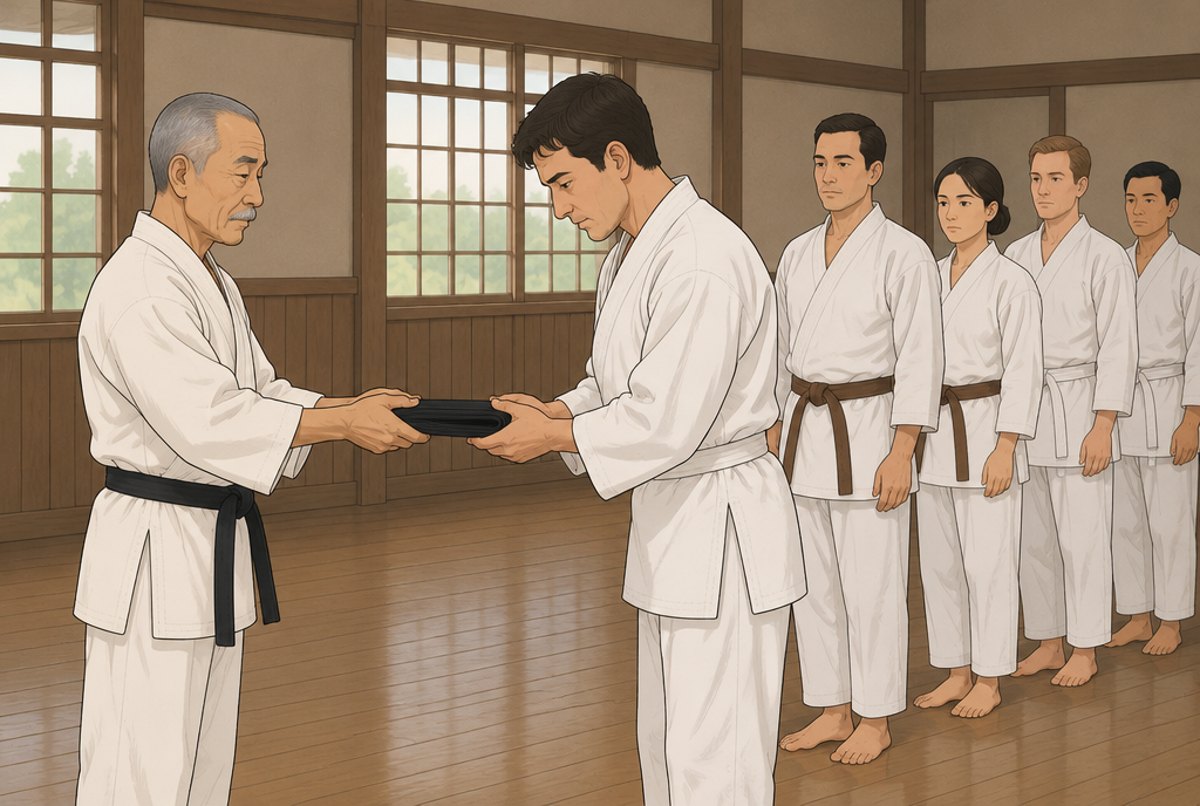
The name
Karate had a problem in its own name. The first character, kara, was the character for Tang, meaning China, so karate read as "Chinese hand". 1 Writers had begun using a different character, pronounced the same but meaning "empty": Chomo Hanashiro in 1905, the Keio University club in 1929. 1 Funakoshi himself renamed many Okinawan kata to make them easier to say and more acceptable in Japan at the time: Pinan became Heian, Naihanchi became Tekki, Kusanku became Kanku. 5,13,43
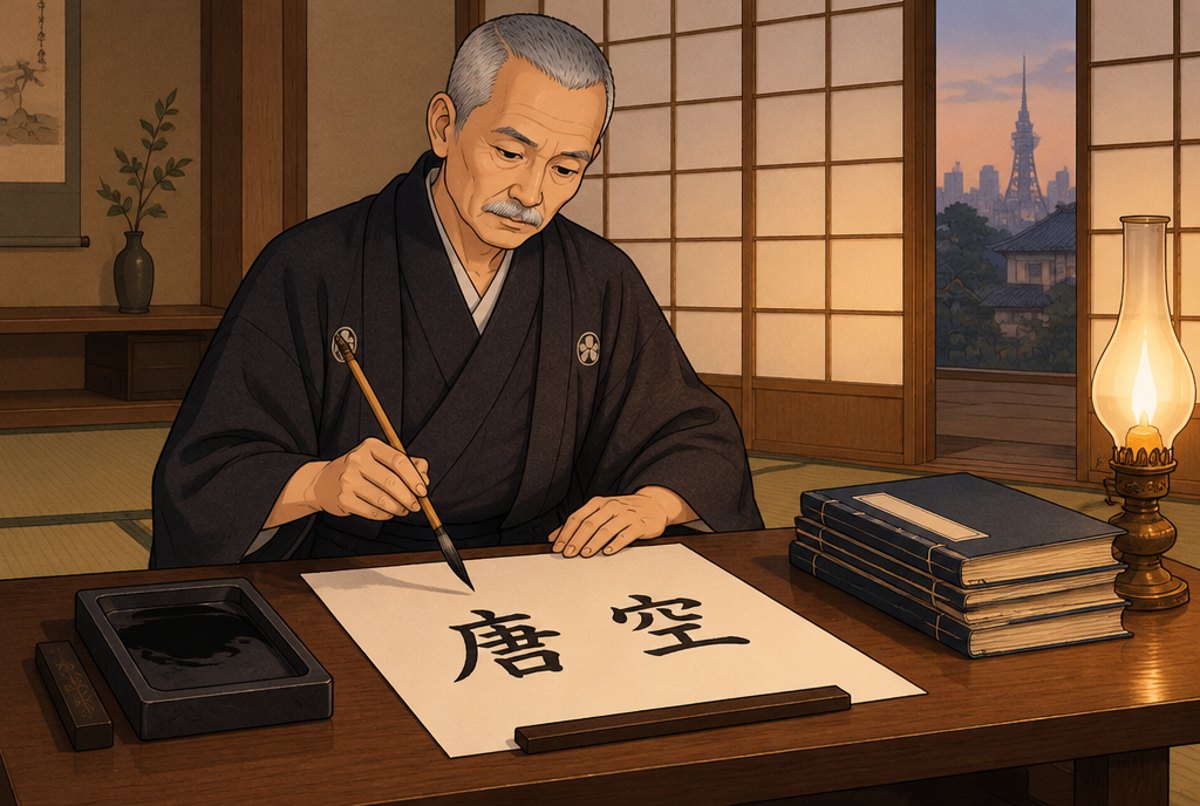
On 25 October 1936 a meeting of Okinawan masters in Naha formally agreed on "empty hand". 1 In the same period teachers added , "way", to make , a word that says karate is meant as personal development as well as fighting. 1 In 2005 the Okinawa Prefectural Assembly made 25 October "Karate Day". 1 Three years before the Naha meeting, in 1933, the Dai Nippon Butoku Kai had recognised karate as a Japanese martial art, at first under its jujutsu section. 1
Why the masters chose it, in their own words, nobody recorded. 1
1939: the sign over the door
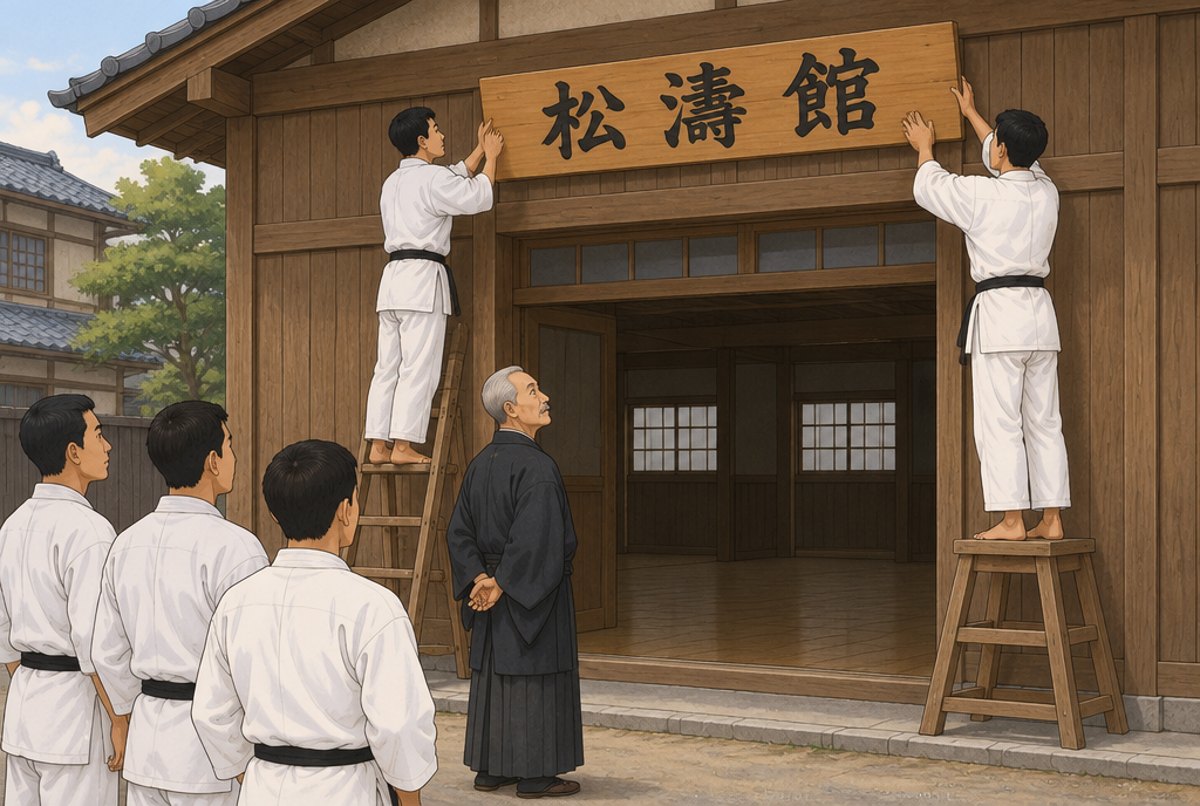
In 1939 Funakoshi's first official , or training hall, was built in Tokyo, at Zoshigaya. 97 His pen name was Shoto, "pine waves". His students hung a sign over the door reading Shotokan, the hall of Shoto, and the style came to be known by that name. 1,4
Funakoshi himself never named a style. He just called it karate. 4
His son Yoshitaka, who lived from 1906 to 1945, is credited with much of the modern style and with the Taikyoku kata, built on the Heian Shodan floor pattern. 4,43 Funakoshi's association, founded in 1930, took the name Dai Nippon Karate-do Shotokai in 1936. 3,12
He wrote more books, among them Karate-do Kyohan, and 20 guiding principles, the niju kun. 3 The second is usually translated "there is no first attack in karate". 3 The Shotokan , five lines about perfecting character, sincerity, effort, courtesy and self control, is recited at the end of class in many dojos today. 4,34
The disagreement
Early mainland karate was almost all kata. 1 Under pressure from judo and kendo practitioners, younger men including Otsuka and Yasuhiro Konishi developed set and free sparring in the 1930s, which became today's . 1 Funakoshi did not follow them there. He wrote that there are no contests in karate. 1,12
After the war the occupation authorities banned many martial arts, but the notice did not name karate, so it restarted earlier than the others. 1 Among those who came to train directly under Funakoshi after the war was Mitsusuke Harada, from 1945; in 1956 Funakoshi gave him 5th Dan, and Harada would carry Funakoshi's own line to Britain. 24
In 1949 Funakoshi's senior students formed the Japan Karate Association, with Masatoshi Nakayama as chief instructor, and Nakayama formalised kumite training and set a syllabus of 26 kata. 3,4,17 That list ran from the five Heian through Bassai, Kanku, Jion and Enpi to Unsu and Gojushiho; with Taikyoku Shodan it is 27. 4 Funakoshi died in 1957. 3 That year the JKA held the first All Japan Championships, and the JKA and his own Shotokai split, partly over whether karate should have contests at all. 3,12,17
Both sides kept his karate, and both would reach Britain within a few years of each other. 1,24 But first, the men who had followed him across the sea each built something of their own. 1