

Judo's contest rules change every few years, so every rule here carries its date. The current rules are the IJF Sport and Organisation Rules, version of 14 August 2026, which replaced the versions of 21 January 2026 and 24 July 2026. For anything that matters, check the rulebook itself, linked on the sources page; that link always opens the newest version. 60
Who makes the rules
- The IJF writes the rules for all its events, including the Olympic Games, and recommends them to national federations. 60
- The current cycle. On 13 December 2024 the IJF announced new refereeing rules for the cycle up to Los Angeles 2028, first used at the Paris Grand Slam in February 2025 and reviewed after the June 2025 World Championships. 61 On 6 January 2026 it said the rules would stay "largely unchanged", with some clarifications, and would be frozen from the Ulaanbaatar Grand Slam until the Los Angeles 2028 Games. 62
- National bodies adapt them. British Judo runs IJF rules with its own additions for young and low graded players. 97
How the rules have changed
- 1899: Kano chairs the Dai Nippon Butoku Kai committee that writes the first contest rules: 15 minute contests, won by two ippons. 1
- 1900: the Kodokan adopts its own version, banning joint locks for Kyu grades and wrist locks for Dan grades. 1
- 1916 and 1925: further bans, including ashi-garami, neck locks and do-jime. 1
- 1986: Anton Geesink proposes the blue judogi for top level contests, so that one judoka wears white and one blue. 1
- Date not confirmed: the smallest score, , is removed. 1
- January 2013: golden score loses its time limit, and the judges' decision, , is removed. 1
- 2017: yuko is removed and its throws counted as waza-ari; two waza-ari stop making ippon for about a year, until 2018; the third shido, not the fourth, becomes hansoku-make. 1,28
- 2025, from the Paris Grand Slam: yuko returns as a third score, with yuko for a five second hold; head use allowed except in cadet events; all jacket grips allowed, and gripping below the belt down to the top of the inner thigh, but leg grabbing still penalised; 30 seconds to attack after gripping; bear hugs allowed unless the hands are clasped; reverse seoi-nage allowed except for cadets. 61
- 2026: three successive versions of the rulebook, on 21 January, 24 July and 14 August; the August version adds, for example, that yuko is not given if both elbows, arms or hands touch the mat with the buttocks or side. 60,62
Under the 2026 rules a shido cannot decide a drawn contest. 60
The contest, as of 14 August 2026
All from the IJF rules unless another source is named. 60
Time. Four minutes of real contest time for seniors, juniors (under 21) and cadets (under 18). Each athlete is entitled to 10 minutes' rest between contests.
Scores in standing (tachi-waza):
- wins the contest: a recognised throw with speed, force, a landing on the back, and control to the end of the landing. Deliberately "bridging" on the head after being thrown is also scored ippon, to protect the neck.
- : landing more than 90 degrees past the shoulder line but not flat on the back, or a throw missing one of the four ippon elements. Two waza-ari make ippon, .
- : lesser landings, for example on the side, the upper back, one buttock or the neck. Yuko scores are counted but never add up to waza-ari.
Scores in groundwork, once the referee has called for a hold down:
- Ippon: a hold of 20 seconds, or the opponent submits (taps twice or says ), or loses consciousness from a hold, strangle or lock.
- Waza-ari: a hold of 10 to 19 seconds.
- Yuko: a hold of 5 to 9 seconds.
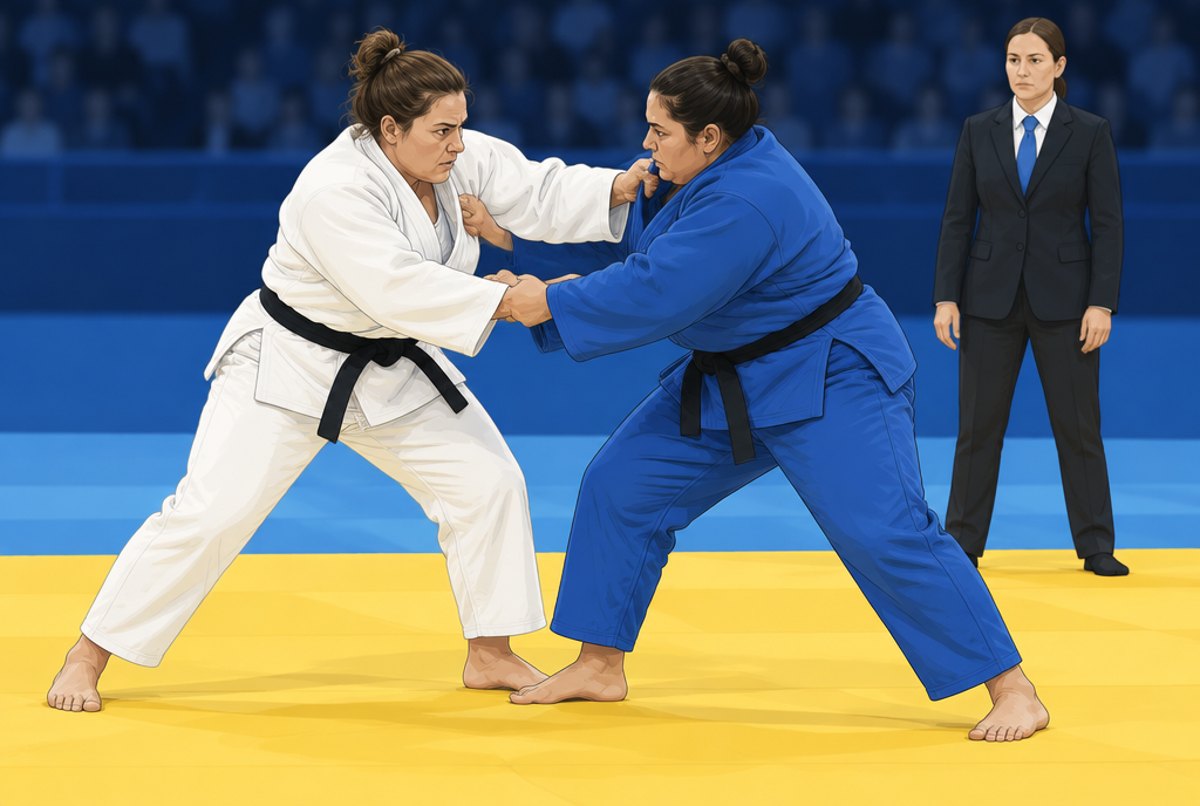
Winning. In the four minutes a contest is won by a score (yuko, waza-ari or ippon) or by the opponent's disqualification (), non appearance () or withdrawal (). The judoka with the higher score wins at the end of time.
Golden score. If neither has scored, or the scores are equal, the contest goes straight into , whatever the number of shido. Golden score has no time limit; earlier scores and shido carry over, and the first score or a disqualification wins. A hold down that starts in golden score ends the contest with yuko after five seconds.
Penalties.
- ("guidance") is given for minor infringements: being too defensive, false attacks, illegal grips such as grabbing the legs or the trousers, untidy kit or hair, and many more. Two shido are warnings; the third is hansoku-make, and the athlete loses the contest but may continue in the event, for example in repechage. A shido never gives the other athlete a score, and a contest cannot be decided by shido short of hansoku-make.
- Direct hansoku-make for dangerous techniques such as diving head first (the athlete may continue in the event), or for acts against the spirit of judo such as kawazu-gake, kani-basami, do-jime, locks on joints other than the elbow, or dangerous neck actions (the athlete may not continue).
Cadets (under 18). Using the head to throw or to defend, and reverse seoi-nage, are penalised with shido; a cadet who loses consciousness from a strangle may not continue in the event. 60,61
Video review. The IJF's CARE system reviews decisions that end a contest, and IJF referee supervisors can confirm or change the referee's call. Where there is no video system, two side judges and a majority of three may be used.
Judogi. White or blue, IJF approved, and checked for size with a measuring tool, the . Women must, and men may, wear a short sleeved white T-shirt underneath.
Ages and weights, as of 14 August 2026
Ages, by calendar year: 60
- No one under 15 may compete in any IJF event or IJF sanctioned event.
- Cadets (under 18): 15, 16 and 17. Juniors (under 21): 15 to 20. Seniors: 15 and over, with no upper limit.
- Veterans: from 30, in five year bands up to 70 and over; contests last three minutes, two and a half from 60, and strangles are not allowed from 60.
- For younger ages the IJF only recommends: three minute contests at 13 to 14, two minutes at 11 to 12, and no competition for 9 to 10 year olds, leaving the details to each national federation.
Senior and junior weight categories: 60
- Women: under 48, 52, 57, 63, 70 and 78 kg, and over 78 kg.
- Men: under 60, 66, 73, 81, 90 and 100 kg, and over 100 kg.
Cadets have eight categories each, women from under 40 kg to over 70 kg and men from under 50 kg to over 90 kg. Mixed team events use three women's categories (under 57, under 70 and over 70 kg) and three men's (under 73, under 90 and over 90 kg); at the Olympic Games each team member must also have qualified in a matching individual category. 60
Medals. Gold, silver and two bronzes, through elimination draws with a repechage, a second chance for those beaten by the finalists, or round robins for small numbers. 30,60
Para judo and adaptive judo
- Visually impaired judo is run internationally by the International Blind Sports Federation (IBSA), with IJF rules plus adaptations. 32,70
- Two classes: J1 for athletes who are blind or almost blind, marked with a red circle on the back number and guided to the centre by the referee, and J2 for partially sighted athletes. 32,70 The change from three classes to two is thought to date from 1 January 2022; not confirmed.
- Key differences: contests start with both judoka already gripping, and J1 athletes are not penalised for leaving the area unless they do it on purpose; the referee calls near the edge. 70
- Paralympic Games: men since Seoul 1988, women since Athens 2004. At Paris 2024 the events were split by class for the first time: eight events each for men and women. 1,32
- Adaptive judo in the UK: British Judo also runs adaptive judo for people with other disabilities, including intellectual disabilities, with its own contest rules, in a 2026 edition, and a British Adaptive and VI Championships. 95,97
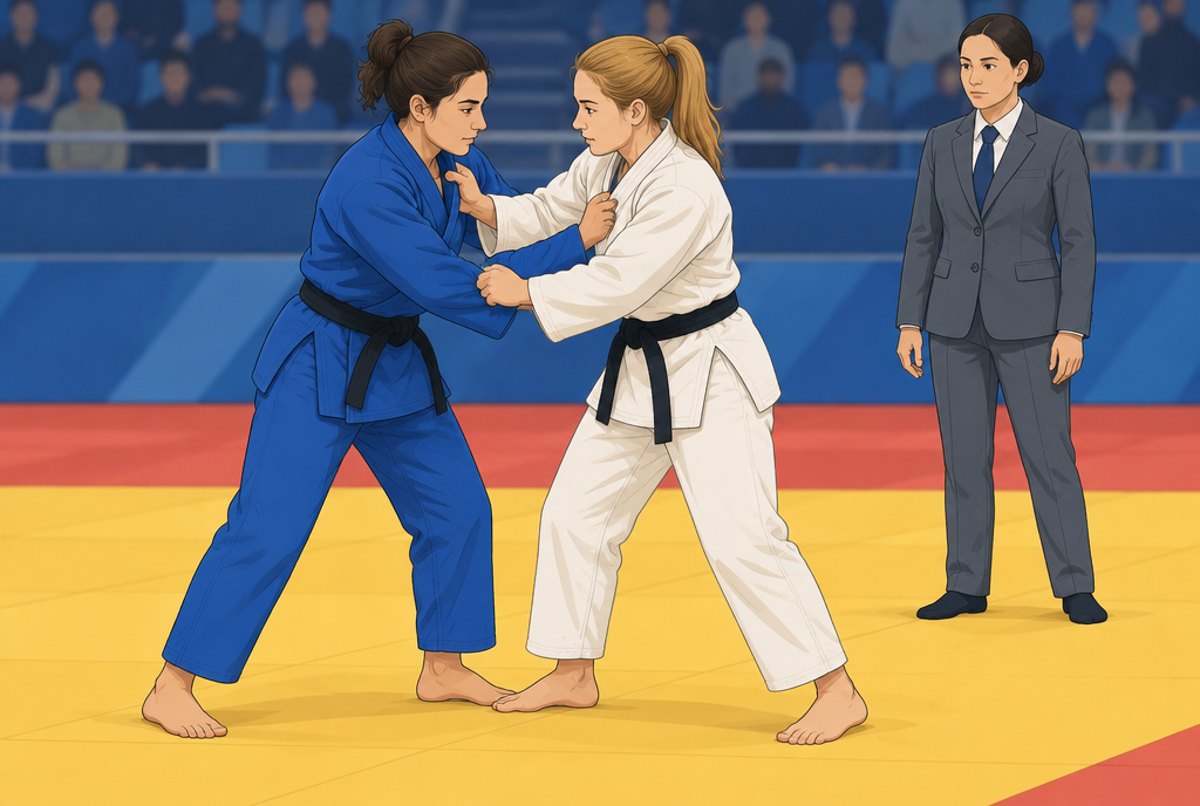
Competition in the UK
From British Judo's Tournament Handbook, October 2023 edition. 97
Levels.
- One: beginners' first contests, at club or local level; every competitor gets a medal.
- Two: players with some Level One experience.
- Three: experienced players; area events. Dan grade points can be scored at approved Level Three and above events. 86
- Four: national and ranking events, for players aiming to represent their country.
- International events under EJU or IJF licence sit outside British Judo's own levels.
British age bands. British Judo changes age bands on 1 September; the IJF changes them on 1 January. 97
- Minors, 8 to 11: three minutes.
- Pre-Cadets, 12 to 13: three minutes.
- Cadets, 14 to 16: four minutes.
- Juniors, 14 to 19: four minutes.
- Seniors, 14 and over: four minutes.
- Masters, 30 to under 80: three minutes.
Some events use simpler under 12 and under 16 bands. Under 8s may not compete at all, only take part in Under 8 Judo Festivals. Open categories mixing all ages from 8 to 17 are not allowed. 97
Safety rules in British events. 97
- Strangles, armlocks and kata-sankaku are not allowed in any category that could include a player under 14; cadet, junior and senior categories must allow them. A minimum grade of green belt is recommended for cadet events.
- Masters aged 60 and over may not use strangles.
- Technical restrictions apply to all under 12s, and to under 16s at yellow belt and below (certain techniques banned, and special contest endings); under 16s up to orange belt keep the contest ending rules only.
- A different tie rule. Where these restrictions apply, a contest level on score is decided on penalties, and golden score lasts three minutes, after which the referees decide. This differs from the IJF rule that shido never decides a contest. 60,97
- At least six minutes' rest between contests (ten at international events).
National events. 97
- British Championships: Pre-Cadets, Cadets, Juniors and Seniors; the top Level Four event, with seniors qualifying through British Judo's ranking lists.
- English, Scottish, Welsh and Northern Ireland Opens: the four home country ranking tournaments.
- British Schools Championships: a Level Three development event using school years, which the top British players may not enter.
- British Minors, Masters, National Team, Kata, and Adaptive and VI Championships.
The BJC and AJA run their own events too, such as AJA area championships. 121,130
Olympic and Paralympic judo now
- Judo has been an Olympic sport since 1964, except 1968, and a Paralympic sport since 1988. 30,32
- Olympic programme today: seven weight categories for each sex plus the mixed team event. 30,60
- Mixed team, since Tokyo 2020: three women and three men from the six mixed team categories; each bout won scores one point and a team needs four to win; at three each, a deciding bout is drawn by lot. 30
- Paris 2024 Olympics: France won the most judo medals, 10, and Japan the most golds, three; Great Britain won none. 31,150
- Paris 2024 Paralympics: for Great Britain, Dan Powell won silver (J1, under 90 kg) and Chris Skelley bronze (J2, over 90 kg). 101
- Youth Olympic Games: judo since the first edition, in 2010. Commonwealth Games: a core sport since 2022. 1
The IJF's own rules explainer video, linked from its January 2026 news and listed on the sources page, covers the current rules. 62,71