

The one thing every family should know: in the UK the belt a judoka wears depends on their age and on which body their club belongs to. British Judo, JudoScotland, the British Judo Council and the Amateur Judo Association all use kyu and Dan grades, but their junior systems, their first belt colour and their rules for black belt differ. 81,82,110,123,131 British Judo is the largest, so it is the baseline here, followed by where the others differ.
Where the system came from
- Judo invented the Kyu and Dan grades now used across the martial arts. Kano gave the first Dan grades to Tsunejiro Tomita and Shiro Saigo in 1883. 1,21
- At first only white and black belts were worn. Coloured belts for the grades below black are recorded at London's Budokwai at its 1926 display and in its June 1927 committee minutes, and Mikinosuke Kawaishi is usually credited with spreading them in France. 1,17,21
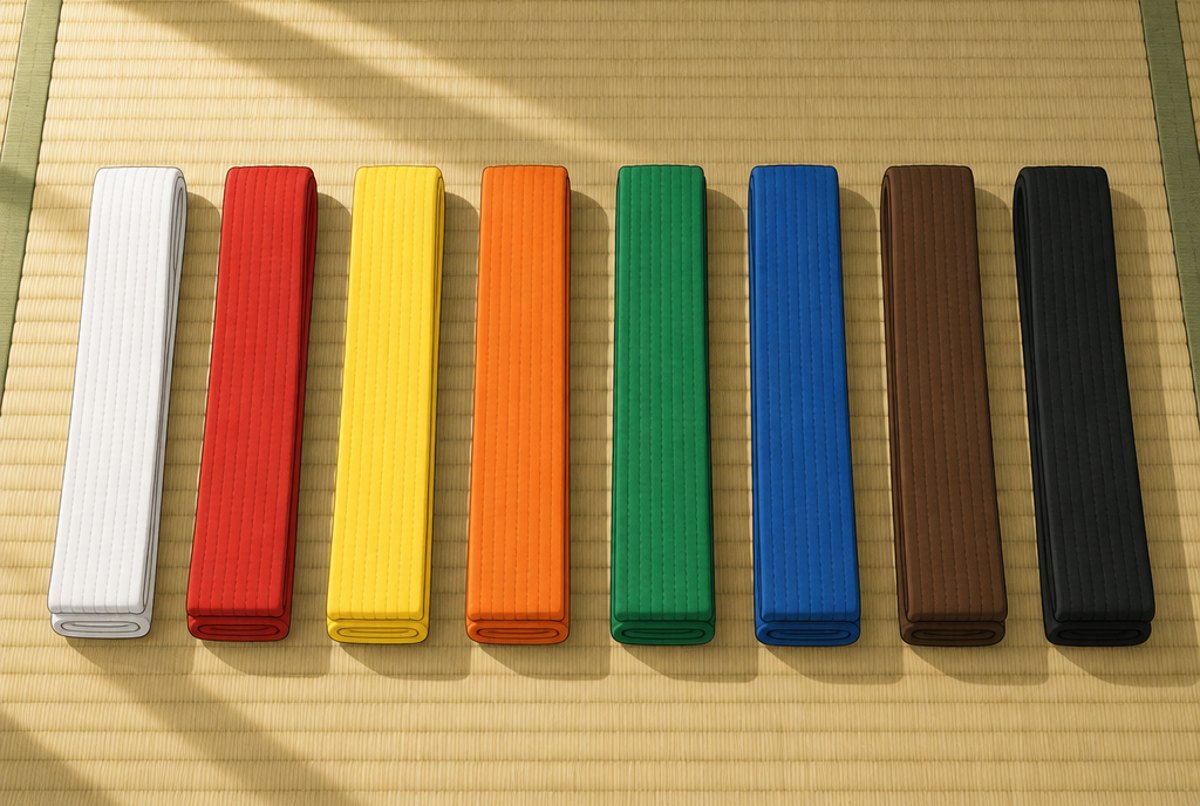
- Japan's own system today is said to have six Kyu grades: light blue for 6th Kyu, white for 5th and 4th, and brown for 3rd to 1st, with purple for juniors. 21
How the numbers work
- Kyu grades count down towards 1st Kyu. Dan grades count up from 1st Dan. 21,81,86
- The Dan grades in Japanese: (1st), nidan, sandan, yondan, godan, rokudan, shichidan, hachidan, kudan and judan (10th). 86
- Those below black belt are ; black belts are . 21
- 10th Dan is the highest grade in practice. Only 15 people have been made 10th Dan by the Kodokan itself. 21
British Judo: four schemes by age
British Judo grades people on different ladders by age. 80,91
- Judo Tots, 3 to 4: a membership type (£5 a year), with no grades described. 92
- Sho awards, 5 to 7: nine awards inside "Judo Kids" club sessions, built on fun, movement skills, breakfalls and social skills. Each award brings a certificate and a sticker. 83
- grades, 8 to 17: 18 grades, on coloured belts with tags. The minimum age to try a Mon promotion is 8. 82,84
- Kyu grades, 14 and over: six grades. Anyone over 18 starts here. Juniors may move across from Mon grades from 14, and must by 18. 81,84
- Dan grades, 15 and over: 10 grades, by a competitive or a technical route. 85,86
Senior Kyu grades: British Judo's January 2025 syllabus
The main theme at each belt, in short; British Judo's full syllabus is free to read. 81
- Novice: white belt.
- 6th Kyu, red: back, side and rolling breakfalls; first throws and hold downs; escapes; bowing; wearing the judogi.
- 5th Kyu, yellow: front breakfall; shoulder and body drop throws; four quarters holds; turnovers; gripping; light randori.
- 4th Kyu, orange: hip throws and leg reaps; first combinations and counters; arm rolls; about three minutes of randori.
- 3rd Kyu, green: sweeping and springing hip throws; armlocks introduced.
- 2nd Kyu, blue: sacrifice and winding throws; strangles introduced.
- 1st Kyu, brown: rear and corner throws; triangle techniques; kata offered as an option.
- 1st Dan: black belt.
Junior Mon grades, British Judo
Each belt colour has three Mon grades, shown by one, two or three tags on the belt. 82
- 1st to 3rd Mon: red belt with yellow tags.
- 4th to 6th Mon: yellow belt with red tags.
- 7th to 9th Mon: orange belt with red tags.
- 10th to 12th Mon: green belt with red tags.
- 13th to 15th Mon: blue belt with red tags.
- 16th to 18th Mon: brown belt with red tags.
British Judo recommends ages of about 8 to 10 for 1st to 6th Mon, 8 to 11 for 7th to 9th, 11 to 15 for 10th to 15th, and 13 to 15 for 16th to 18th. 82 The Mon syllabus is "almost identical" to the Kyu syllabus, split into three steps per colour, so juniors and seniors can train together. 81,82
Moving between British Judo's schemes
- Sho to Mon, at 8 (the coach has the final say): 1st and 2nd Sho become novice; 3rd and 4th Sho become 1st Mon; 5th to 7th Sho become 2nd Mon; 8th and 9th Sho become 3rd Mon. 82
- Mon to Kyu, from 14 and by 18, with no fee: 1st and 2nd Mon become novice; 3rd to 5th Mon, 6th Kyu; 6th to 8th Mon, 5th Kyu; 9th to 11th Mon, 4th Kyu; 12th to 14th Mon, 3rd Kyu; 15th to 17th Mon, 2nd Kyu; 18th Mon, 1st Kyu. 81,82
- A junior without all three tabs in a colour may take the missing Mon assessments and then convert to the Kyu grade of that colour. 81,82
How a British Judo grading works
From the Mon and Kyu syllabi of January 2025. 81,82
- Membership first. The candidate must hold full British Judo membership, and the grade is registered with head office within 28 days.
- No contest needed. Mon and Kyu promotion is on technical knowledge, understanding, Japanese terms and "supplementary knowledge", with a randori element that grows at higher grades. Competing is encouraged but not required.
- Who grades. Up to 4th Kyu (9th Mon) the grading is done in the club and may be by the candidate's own coach. From 3rd Kyu (10th Mon) it can also be at inter club or area gradings, and a different examiner is "good practice". A Level 1 coach may grade up to 5th Kyu (6th Mon); Level 2 and above up to 1st Kyu (18th Mon).
- How it is assessed. One formal session, several sessions, or continuous assessment. Techniques are shown once, to the candidate's preferred side, and the examiner checks , , and : breaking balance, fitting in, completing the throw and control.
- Kit and safety. A clean judogi, long hair tied back, no jewellery or piercings (taping over rings is not enough). Men and women, and people of different ages and sizes, may be examined together.
- Strangles and armlocks. Armlocks are taught from the 3rd Kyu syllabus and strangles from 2nd Kyu, but candidates under 16 with a junior licence must not apply them to the point of submission.
- Waiting times. Kyu: at most one grade a calendar month up to 5th Kyu, then one every three months. Mon: one a month up to 6th Mon, then one every two months; British Judo expects about one belt colour a year.
- How long it takes. About three years from novice to 1st Kyu with regular training (two for a "keen" judoka); the Mon syllabus is expected to be finished by about 15. One grade at a time, with unlimited attempts.
- Fast tracking. A formal beginners' course of at least 12 hours can lead straight to up to 5th Kyu at a first grading, and newcomers aged 12 and over may jump up to three Mon grades at a time in their first year. Exceptional cases need written approval and an extra £10.
- Adaptive judoka. Coach, examiner and judoka (and sometimes a parent) agree substitutes for techniques that are not possible. British Judo states there is "no pass or fail" for these assessments. 81,82,95
- Fees, as published in the 2025 syllabi. Kyu grade registration £20, of which £5 goes back to the club; Mon grade registration £14. Organisers may add a surcharge, which British Judo recommends should not exceed £5. Class fees are set by each club.
Black belt and beyond, British Judo
Belt colours
- 1st to 5th Dan: black. 86
- 6th to 8th Dan: red and white blocks. 86
- 9th and 10th Dan: red. 86
- Holders of 6th Dan and above usually still wear a black belt in everyday training and keep the coloured belt for teaching and ceremonies. 86
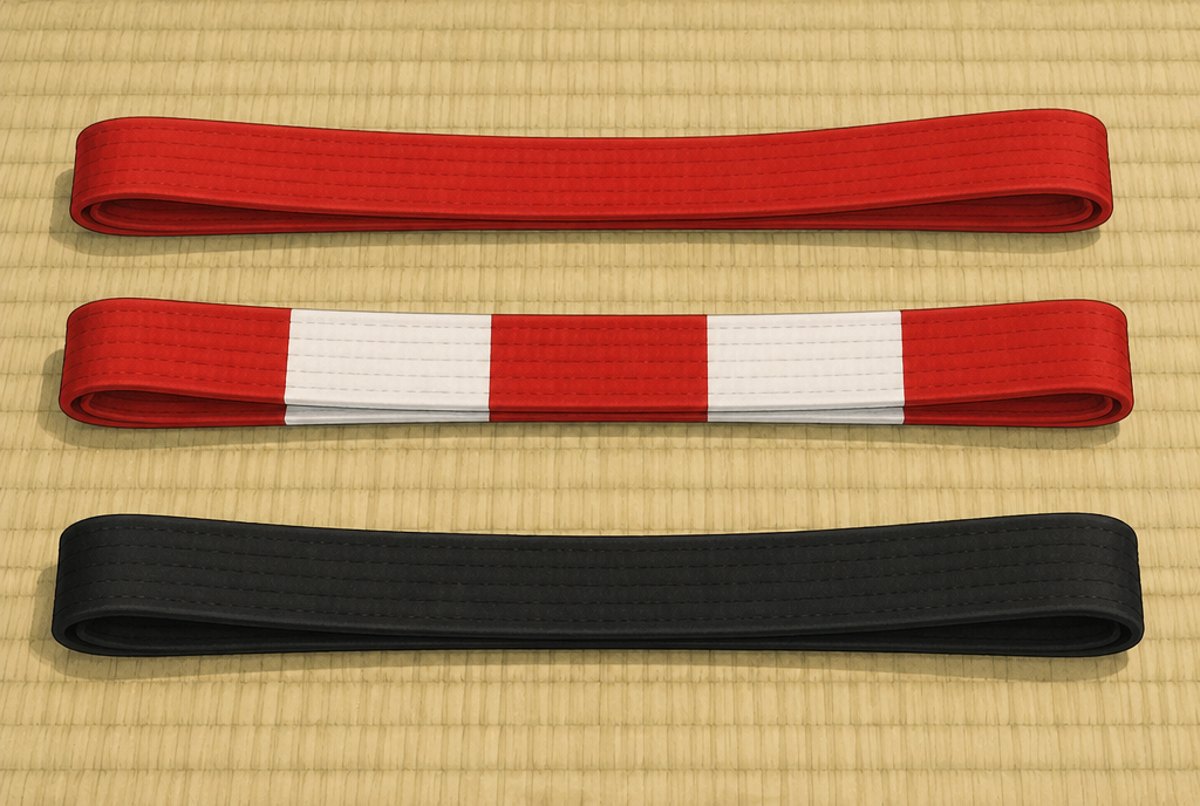
British Judo awards 1st to 6th Dan, and the IJF 8th to 10th. 86,87
The competitive route, 1st to 5th Dan
Points come from contests at gradings or approved Level 3 and above tournaments: 10 for a win by and 5 for a win by . At tournaments only wins against equal or higher British Judo grades count, and wins by penalty or withdrawal score nothing. Judoka selected for Great Britain at Olympic, World, European and IJF ranking events earn 10 points for any win. 86,87
A candidate who wins their first two contests at a grading by ippon can go on to a "line up" against several others; completing it earns promotion, as long as the age and time rules are met. 86 Contests are four minutes, three for veterans and under 16s. 86,87
- 1st Kyu to 1st Dan: at least 15 years old and 1 year in grade; 100 points; Nage-no-kata. 86,87
- To 2nd Dan: 17; 2 years; 100 points; Katame-no-kata. 86,87
- To 3rd Dan: 20; 3 years; 120 points; Ju-no-kata. 86,87
- To 4th Dan: 24; 4 years; 120 points; Kime-no-kata. 86,87
- To 5th Dan: 29; 5 years; 120 points; Kodokan Goshin-jutsu. 86,87
A 1st Kyu aged 14 may already collect points but cannot be promoted before 15. 81,86 Before a first Dan grading, a 1st Kyu needs a record of contest on at least two occasions within the previous 24 months. 86
The technical route
Promotion on examined technical knowledge, without contests, with a £50 application fee. The minimum time in grade is 5, 6, 7 or 8 years depending on the candidate's wider contribution as competitor, referee, official, coach or examiner, which also sets the minimum age (for example 20 to 23 for 1st Dan, 40 to 55 for 5th Dan). Kata must be passed at the higher Level 2 standard. 86,87
Kata certificates, and what changes in 2027
- Level 1 needs 60% and Level 2 needs 65%, and Level 2 may be taken six months after Level 1. There is no fee to sit the exam, but a £10 fee to register a pass. From 1 January 2026, attendance certificates no longer count. 88
- 6th Dan and above are applied for, not tested, with certificates in all six required kata (adding Koshiki-no-kata). 86,87
- Other routes: a once only "qualified by experience" promotion for judoka aged 70 and over, an "outstanding performance" route for international judoka, and compassionate promotions. 86
- From 1 January 2027 every Dan grading will need a British Judo licence; points from unlicensed gradings will not count. 85
- The Kodokan in Tokyo certifies its own Dan grades, including immediate promotion, , for a winning streak at its twice yearly Red and White contests. 69
Where other UK bodies differ
JudoScotland
Mon, Kyu and Dan grades "aligned with those of British Judo", using British Judo's syllabus booklets. 110 It adds nine grades for under 8s instead of Sho awards, and converts them differently at 8: Kai 1 to 3 become 2nd Mon, 4 to 6 become 3rd Mon, 7 to 9 become 4th Mon. 110,111 It runs national gradings for seniors of 4th Kyu and above, and grading fees are paid to the club. 110
Welsh Judo and the Northern Ireland Judo Federation
Members of British Judo for their home nation; they use British Judo's syllabus. The NIJF advertises its own dan gradings. 113
British Judo Council
The BJC awards its own grades, as its agreement with British Judo allows. 121 What follows is from its 2014 syllabus and 2015 grading cards. Check with the BJC that these are still current. 120,123
- Three age groups: Primary (5 to 9), Junior (10 to 15) and Senior (16 and over).
- Primary: everyone stays on a white belt and earns tabs, three each in red, orange, green, blue and brown.
- Junior: 6th Kyu white belt with yellow tabs, 5th Kyu yellow with orange tabs, 4th Kyu orange with green tabs, then 3rd Kyu green with blue, brown and finally black tabs.
- Senior: 6th Kyu white, 5th Kyu yellow, 4th Kyu orange, 3rd Kyu green, 2nd Kyu blue, 1st Kyu brown, then black. Seniors may choose to wear red tabs up to green belt.
- Timing: normally three months and 12 sessions between each tab or grade; one year between contest 1st Kyu and 1st Dan.
- Every grade has technique, safety and etiquette points and a Japanese word to learn. Its Dan grade requirements are not confirmed here; ask the BJC.
Amateur Judo Association
From its 2018 syllabus and its information booklet (edition reference 151117). 131,132
- Juniors have "" grades that count upwards: 1st kokyu white, then yellow, orange, green, blue, and 6th kokyu brown.
- Seniors: 6th Kyu white, 5th yellow, 4th orange, 3rd green, 2nd blue, 1st brown.
- Dan grades by points, scaled by age: 150 points under 35, 100 from 35 to 39 and 50 from 40, with a minimum age of 21 for 1st Dan and a coaching qualification.
- Separate "age grading" from 35, and an "injury grading" route for those with a permanent condition that prevents contest.
What differs most
- Red. In British Judo red is the first coloured belt for seniors; in the BJC and the AJA, 6th Kyu is white and seniors have no red belt. 81,123,131
- Young children. British Judo's youngest awards have no belt colours described; the BJC's youngest grades are all on a white belt with tabs. 83,123
- Counting. The AJA's junior grades count up, the opposite of Kyu grades. 131
Questions families ask
Does a grade carry over if we change club or association? Within British Judo and the home nations, yes. Grades from any IJF or EJU member federation are accepted and converted to the next higher British Judo colour (an IJF blue belt becomes 2nd Kyu). Grades from bodies outside British Judo, such as the BJC, can be converted by colour, but the examiner must test the earlier grades first. 81 How the BJC and AJA treat British Judo grades was not confirmed.
What about a long break? British Judo lets someone with no record of their grade, or returning after a long absence, be assessed and placed at the right level. 81 Whether a grade can lapse was not stated.
How old must you be for a black belt? 15 in British Judo on the competitive route; 21 for the AJA's 1st Dan. 81,86,132
Is it a pass or fail exam? For Mon and Kyu grades the coach can assess over several sessions, and for adaptive judoka British Judo says there is no pass or fail. 81,82
What does it cost? British Judo's registration fees are above; clubs and grading organisers may add their own charges. Class fees are set by each club.