

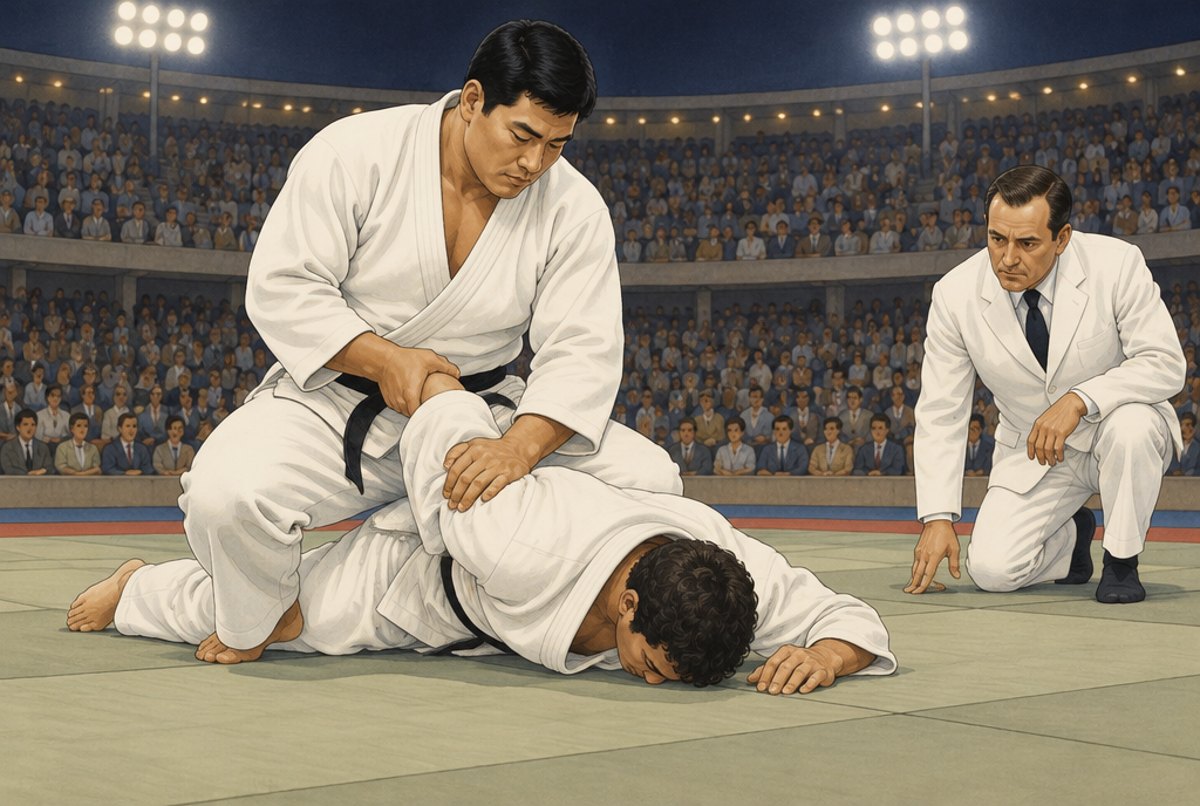
In October 1951 Hélio Gracie stepped onto the mat against Masahiko Kimura, a Japanese judoka. 6 Hélio lost. The hold Kimura finished him with, a bent arm shoulder lock, has carried the judoka's name in jiu-jitsu ever since: the kimura. 6,22
Three hours with a former student
Four years later, in 1955, Hélio fought his former student Valdemar Santana. The fight went on for well over three hours, and Hélio lost. 6,106
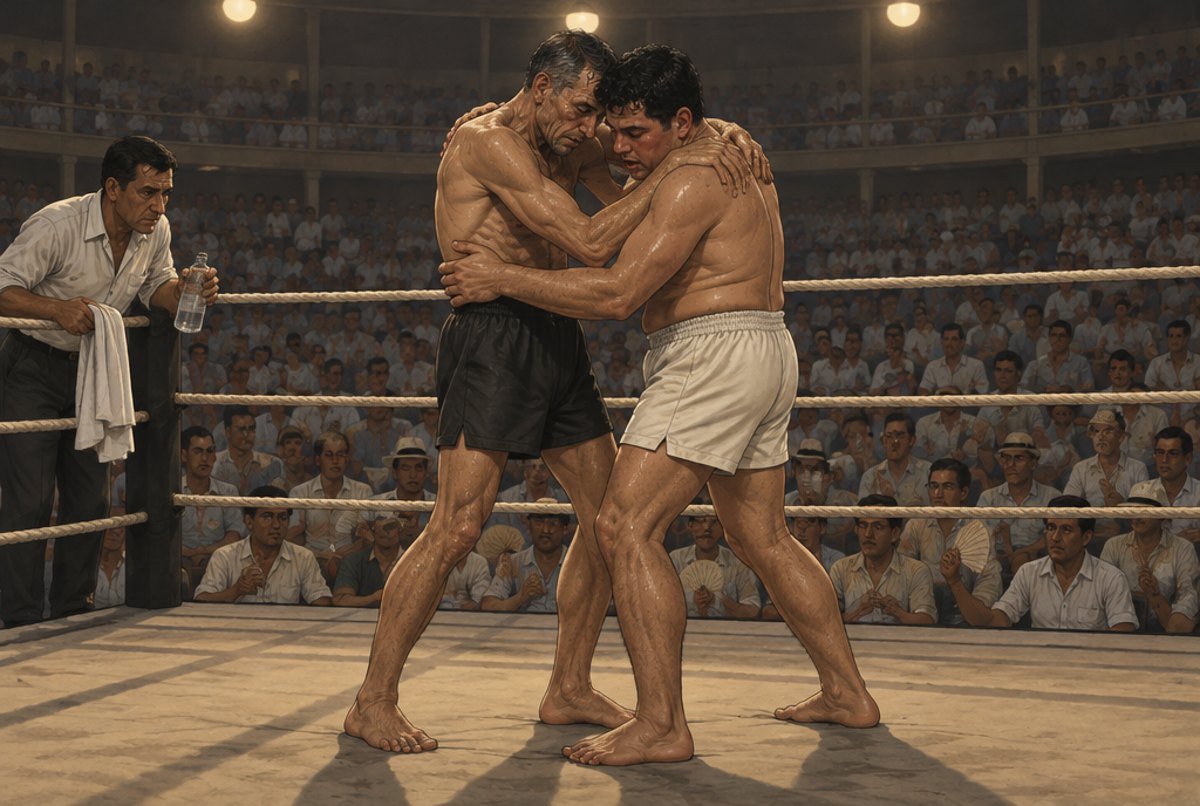
Alongside matches like these ran a Brazilian tradition of fights with almost no rules, which the Gracies encouraged through their open challenge to fighters of any style. 9 Their long time rivals in those fights were the fighters of luta livre, a Brazilian submission wrestling style. 9
A name from television
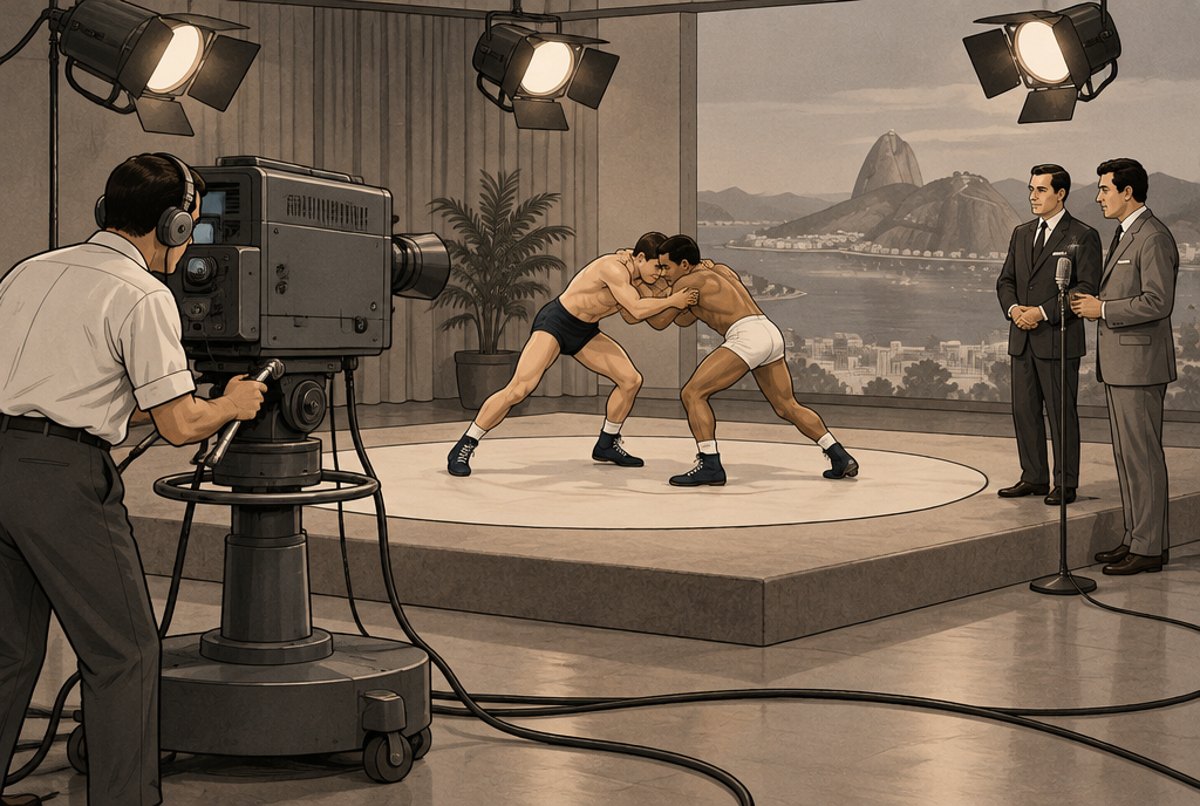
The phrase everyone now uses for those fights, vale tudo, "anything goes", only came into wide use in 1959 and 1960. It came from a Rio television show whose hosts included two Gracies, Carlson and Carley. 9
Carlson Gracie
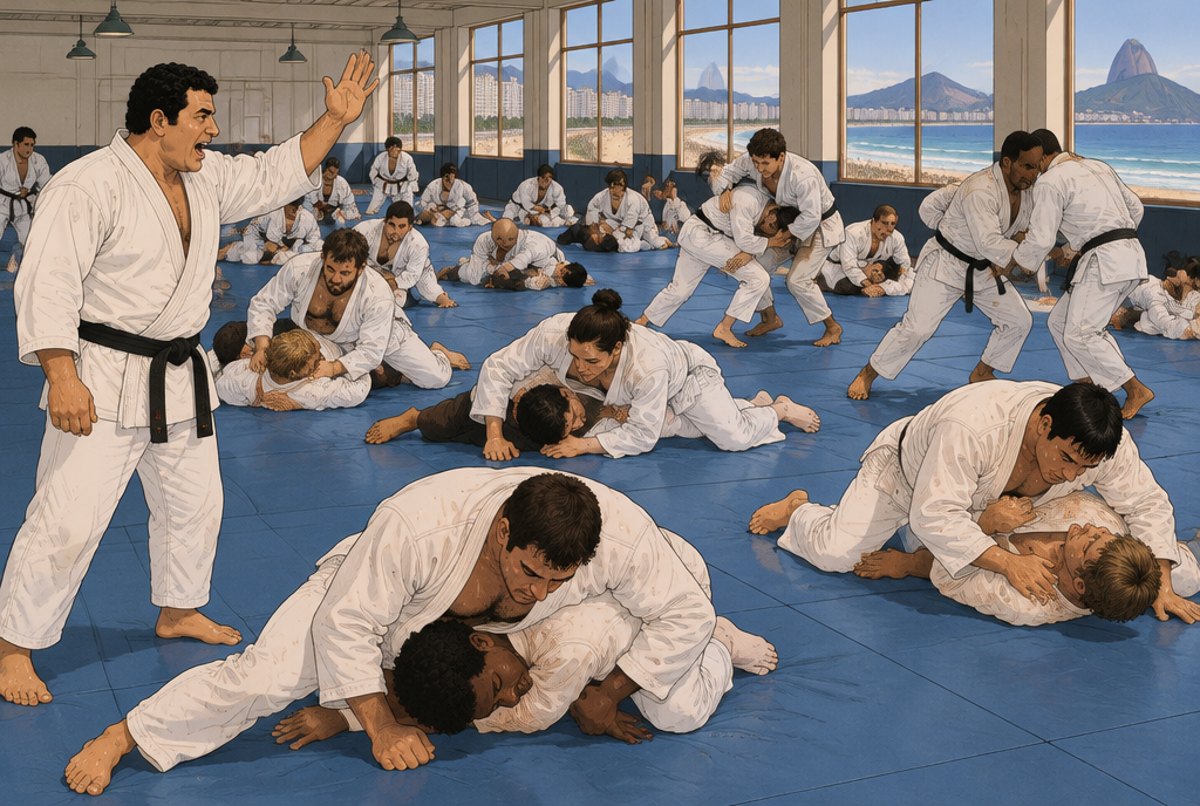
Carlson Gracie, Carlos's eldest son, was born on 13 August 1932. After he retired from fighting in 1970 he ran an academy in Copacabana, and it became a school of a different kind. 14
His approach was physical and aggressive: heavy pressure from the top, takedowns, and cross training in judo and wrestling, a "warrior style" that bridged self-defence jiu-jitsu and competition. His academy welcomed students from all social backgrounds, and it was built on large group training and hard competition between team mates. 14 It stood in contrast to the Gracie Academy linked to Hélio, which kept a more traditional, self-defence and technique focused approach. 14
His influence is everywhere in the art today. His students included Ricardo De La Riva, after whom the De La Riva guard is named. A guard is a way of fighting from your back, with your legs between you and your opponent, and the De La Riva is one of many named kinds. 1,14 The judoka Ezequiel Paraguassu trained with him and helped to popularise the sleeve choke now called the Ezekiel, one of the few jiu-jitsu chokes that presses on the windpipe rather than the blood vessels at the side of the neck. 1,14 His black belts founded Brazilian Top Team, Nova União, American Top Team and Black House, several of them mixed martial arts teams. 14
He also gave the art a word for loyalty. Carlson popularised "Creonte", after a character in a 1980s Brazilian soap opera, for a student he considered disloyal for leaving his academy or changing team. 14 That word still shows how strongly some lines feel about team loyalty. Carlson Gracie died on 1 February 2006. 14
Rolls Gracie
One more teacher of this generation shaped the teams a UK student is likely to meet. Rolls Gracie, another member of the family, was born in 1951 and died in 1982. He taught Carlos Gracie Jr., Romero "Jacaré" Cavalcanti and Mauricio Gomes, among others. 10 Carlos Gracie Jr. would found Gracie Barra. Cavalcanti would found Alliance, with his first black belt, Fabio Gurgel, promoted at 19. Gomes would carry the art to Britain and become the father of Roger Gracie. 10,11,12,102 Alliance's methodology page still traces the team to Cavalcanti's time as one of Rolls Gracie's black belts. 102
What the fights left behind
The challenge era gave jiu-jitsu some of its vocabulary, the kimura among it, and its habit of testing techniques against resisting opponents. 6,9 But the fights stayed in Brazil. The art was still a local thing when Hélio's eldest son packed up and moved to California. The next chapter follows him.