

Every club runs things a little differently, so in places the honest advice is "ask the club". Prices below are as published on 26 October 2026 and will change.
Before you go
- Choose the family. Ask whether the club is WT and Kukkiwon style, the Olympic style, or ITF style, and which association it belongs to. This decides the patterns, the sparring and who issues the black belt. 1,80,95
- Many clubs offer a free taster. British Taekwondo lists free taster sessions "at the discretion of the club"; some independent groups advertise free trial lessons, UKTC for example. 84,107
- Questions British Taekwondo suggests asking any club, paraphrased: is the club a current member of the governing body; does it hold a quality mark; does it have a Welfare Officer; are the coaches qualified, insured and DBS checked (British Taekwondo says its coaches renew DBS checks every two years and parents should not be embarrassed to ask to see them); what is the coach to student ratio; is there first aid cover for every class; and is everyone insured through current membership. It also suggests watching a class before joining. 84 The NSPCC publishes a similar short list for any sport. 120 In England, the Safeguarding Code in Martial Arts is a quality mark with a public map of clubs that hold it. 121
- Membership. In a British Taekwondo club everyone must be an individual member, £31 a year in 2026, on top of any club fees. A lead coach must be at least 18 and at least 1st Dan, and hold a Level 2 coach membership, a DBS or equivalent check, and British Taekwondo's concussion and safeguarding courses. 84 Other associations have their own membership and insurance; UK ITF instructors, for example, are accredited by the British Taekwondo Council every three years, covering safeguarding, DBS checks, insurance and health and safety. 101
What to wear and bring
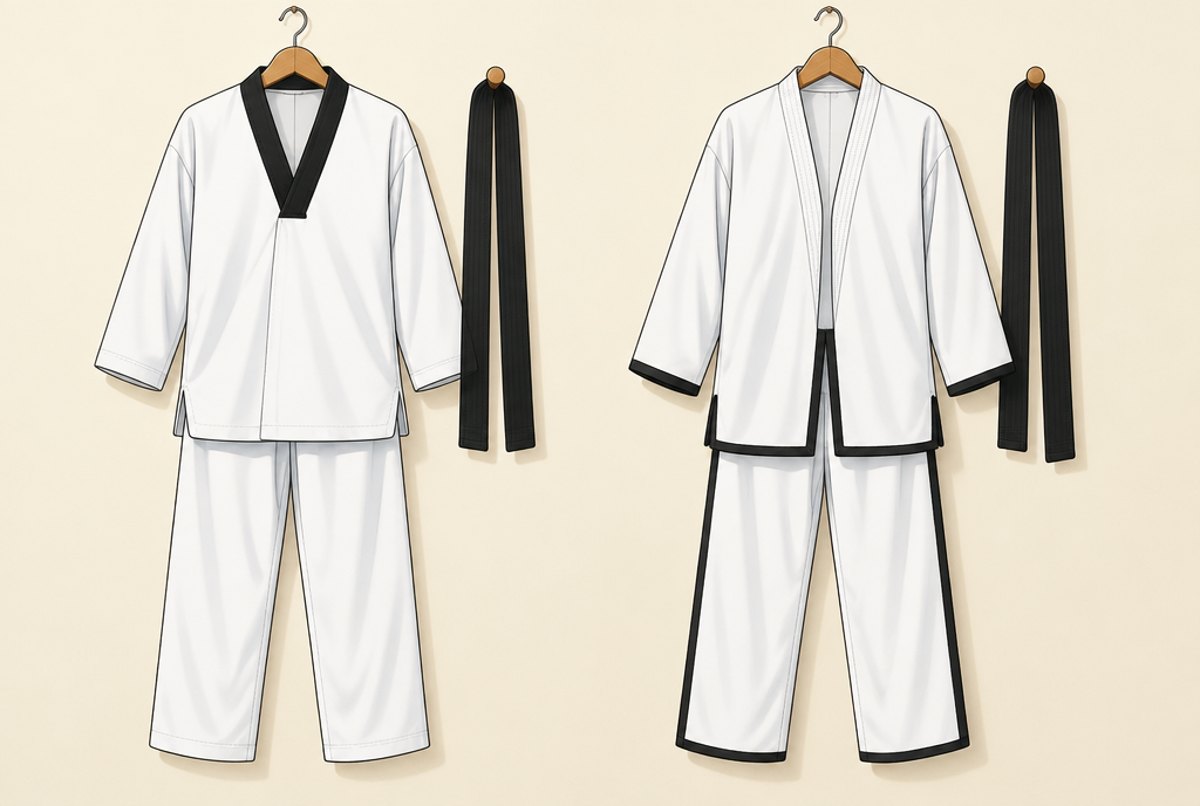
- First sessions: loose, comfortable sportswear is usual until the student buys a , the uniform; clubs say what they prefer.
- Dobok and belt. Beginners wear a white belt, 10th Gup. 62,81 WT and ITF style doboks differ in cut, and some associations sell their own; UKTC says its shop is "the only Official Supplier to all UKTC Students". 107
- Bare feet on the mat is normal.
- Jewellery, long nails and hair grips are not allowed in ITF competition, and nails must be trimmed; similar rules apply at WT events. Clubs usually apply the same in training. 40,61
- Glasses. British Taekwondo's guidance says glass, metal or hard plastic glasses should not be worn during sparring and self-defence where possible, suggests prescription safety glasses or flexible frames if sight is too poor, and says glasses should never be worn in full contact sparring. 86
What a class usually contains
Classes vary, but these are the parts British Taekwondo and the ITF list as the content of training; how a class orders them is up to the instructor. 1,62,80
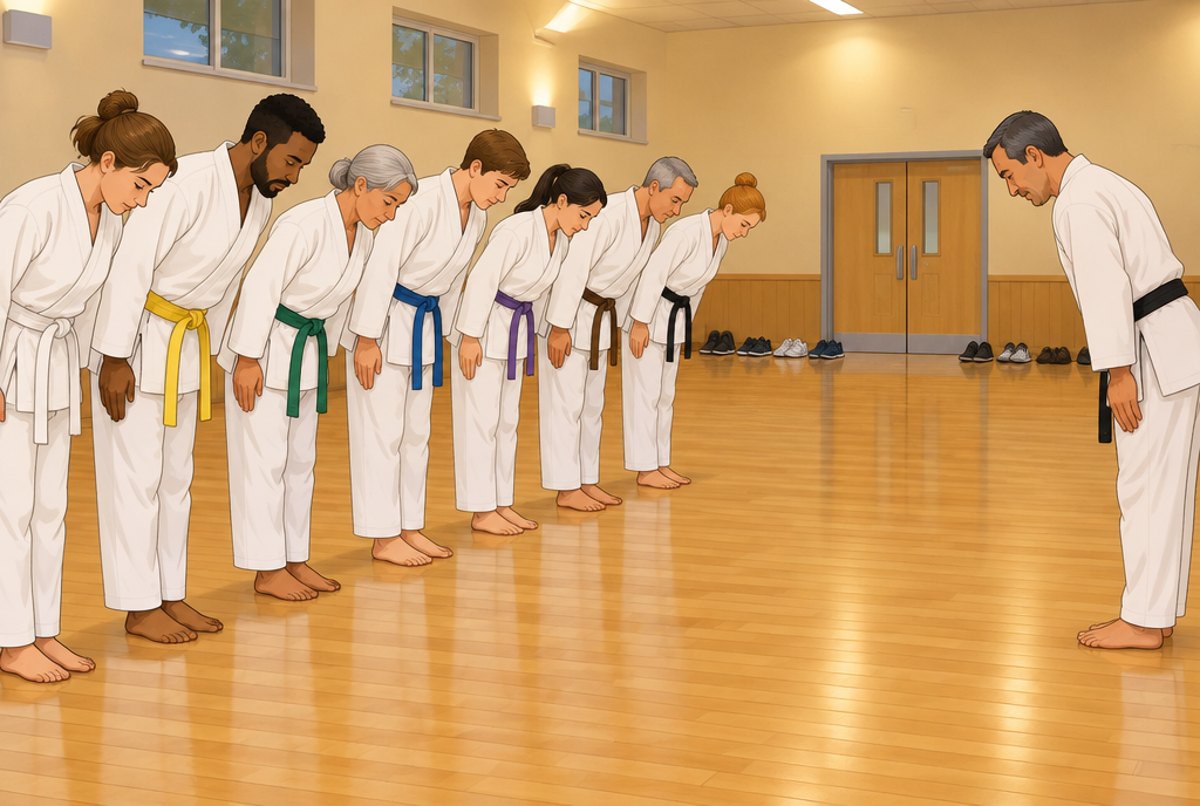
- Bowing in and warm up. The commands , attention, and , bow, then stretching and fitness work. 1,87
- Basics. Stances, blocks, punches and kicks, often practised up and down the hall in lines. 80,82,97
- Patterns. Poomsae or tul for the student's grade. 62,80
- Partner work. Step sparring, self-defence against grabs, and for older or more experienced students, sparring. 62,80
- Pad and kick work. Kicking targets and pads; breaking for higher grades, not for children in ITF style, and foam boards for 15 and under at British Taekwondo dan gradings. 62,82,97
- Bowing out.
Children and adults are often taught separately; the TAGB, for example, says it splits juniors and seniors where it can and runs a different curriculum for children even when they share a class. 97
Protective kit, for sparring
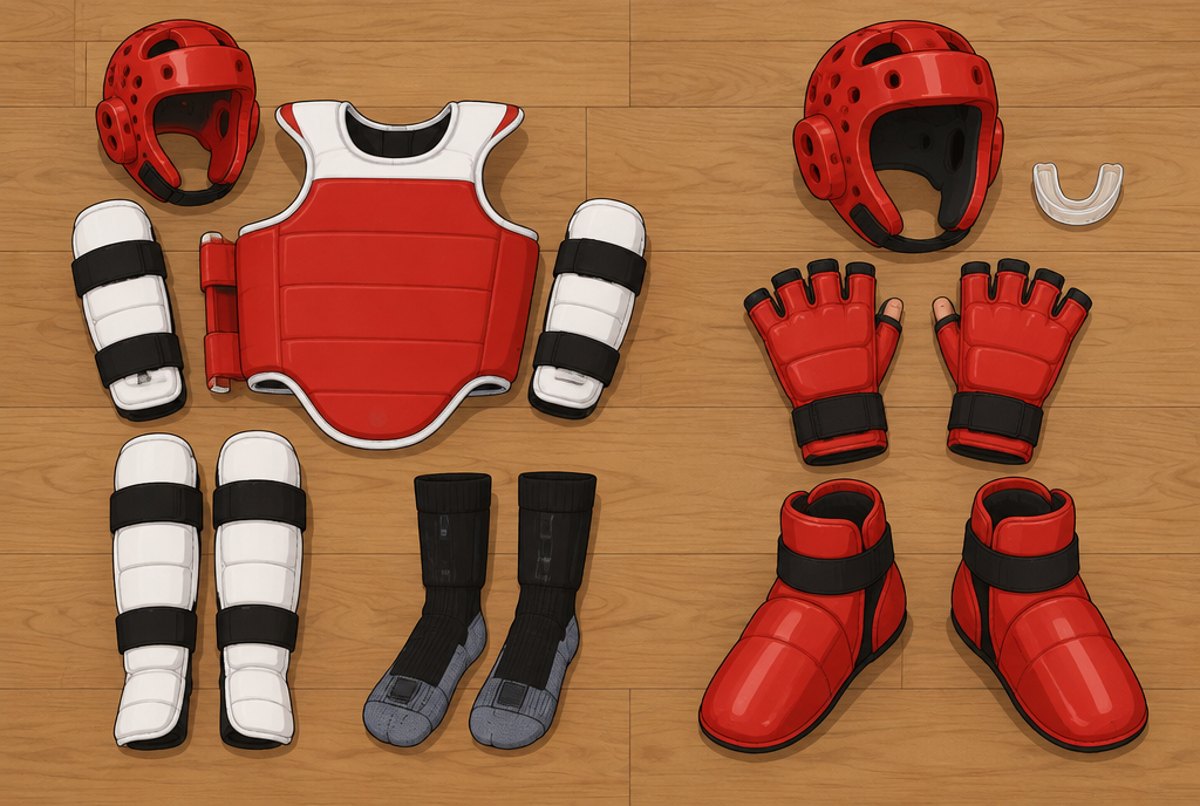
Beginners usually do not spar in the first weeks; when they do, clubs ask for kit, and what is needed depends on the family. 40,61
| WT style, at WT events | ITF style, Vienna ITF rules 2026 | |
|---|---|---|
| Body | Trunk protector, , electronic at higher events | Breast protector for women and groin guard for men, under the dobok; optional chest or rib protectors |
| Head | Head protector, electronic at higher events; cadets may use a face shield | Headgear covering the whole head except the face |
| Hands | Gloves | Closed sparring gloves, 8 or 10 ounce for ages 8 to 13, 10 ounce from 14 |
| Feet | Sensor socks when electronic scoring is used | Foot protectors, red or blue |
| Other | Forearm guards, shin guards, groin guard, white or clear mouthguard | Shin guards and mouthguard |
British Taekwondo publishes a list of approved protective equipment for its events. 88 Club rules for training may be lighter; ask the club.
Questions families ask
What age can my child start? British Taekwondo's Taekwondo Tots is a non contact programme for ages 3 to 7. 85 UKTC runs Little Tiger Cubs for 3 to 5 and Active Tigers for 5 to 8. 107 The TAGB has said its members start "as young as five". 97,99 Adults can start at any age; the TAGB mentions a member gaining his 5th Dan on his 70th birthday. 99
Is it safe? British Taekwondo says that, as a martial art and full contact sport, there is always a risk of some minor injury, but no one should be seriously hurt. It asks clubs to report injuries needing medical attention within 48 hours, uses a head injury suspension notice with a graduated return, and requires its coaches to complete a concussion course. 86 ITF style sparring is light or semi contact, and the Encyclopedia forbids breaking for children. 61,62,65
Does my child have to fight or compete? No. Poomsae is a non contact discipline, competitions are optional, and many clubs focus on the martial art rather than the combat sport. 80
How long to a black belt? About three years in British Taekwondo; 12 to 30 months of regular training in General Choi's programmes. 62,81 Children under 15 in WT style receive a Poom black belt, black and red. 81,82
What will it cost? British Taekwondo membership is £31 a year in 2026, and its Dan grading fees are £155 to £295 in November 2026. 82,84 Club fees, uniforms and Gup grading fees vary by club.
Is it good for fitness and confidence? British Taekwondo lists strength, flexibility, balance, concentration, confidence and self discipline. These are the body's own claims. 80