

Patterns are taekwondo's equivalent of karate's kata: set sequences of blocks, strikes, kicks and stances against imaginary opponents. 1,87 The WT and Kukkiwon family calls them ; the ITF family calls them , also written teul; older and traditional schools say . 1 The two sets are completely different. A child moving between an ITF club and a WT club starts patterns again. 1,54,62 The story chapter "Who are the patterns named after?" tells the people behind the names.
WT and Kukkiwon poomsae
- Coloured belts: eight poomsae, Taegeuk 1 to 8 Jang. Black belts: nine poomsae, from Koryo to Ilyeo. British Taekwondo says there is generally one new poomsae per belt level. 80
- History. Before the Taegeuk set, the Kukkiwon style is said to have used eight forms from about 1967, replaced by the Taegeuk forms around 1971, with a new Koryo replacing the old one at the same time. Some schools still teach Palgwae. The Kukkiwon has not confirmed the dates. 11,12
- Meaning. British Taekwondo explains Taegeuk as the origin of all things, from tae, vastness, and geuk, eternity; each of the eight is linked to one of the eight trigrams of the I Ching, four of which appear on the South Korean flag. 12,54,87
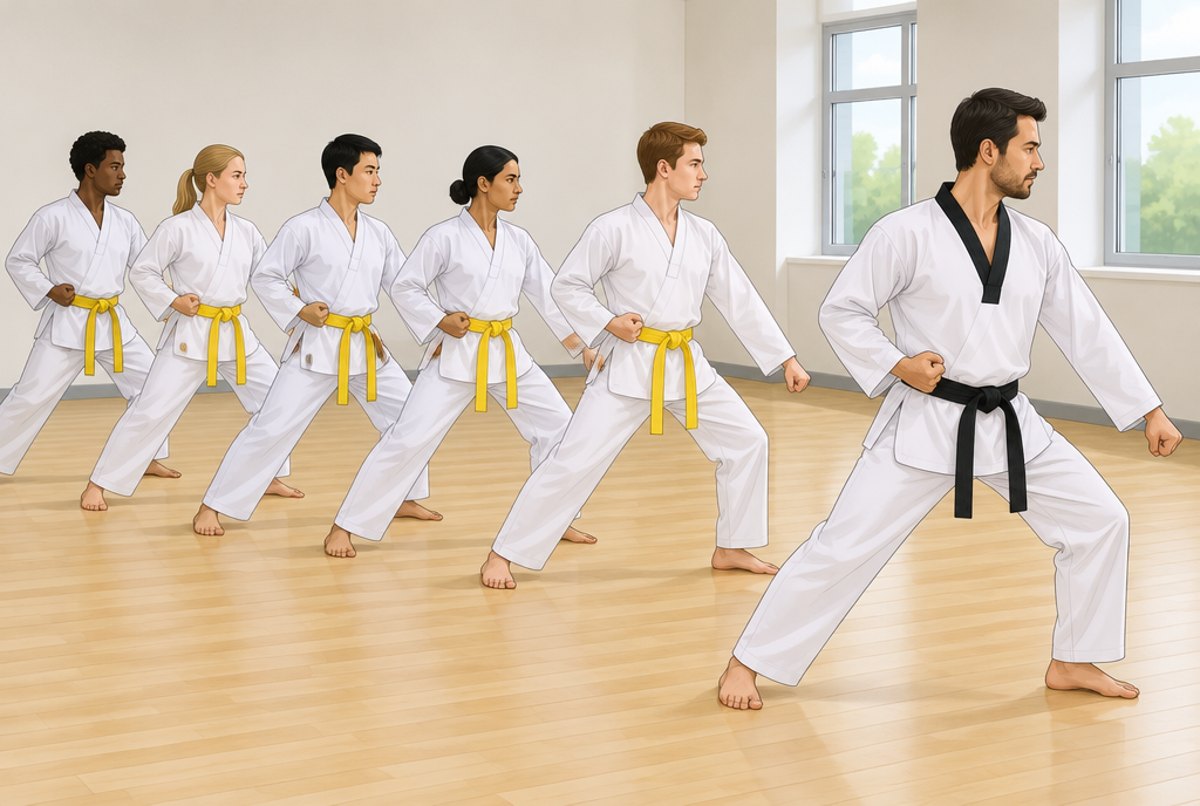
Coloured belt poomsae
Movement counts are British Taekwondo's; meanings are summarised from the Kukkiwon's own explanations. 54,87
| Poomsae | Moves | Trigram | Meaning, in brief |
|---|---|---|---|
| Taegeuk 1 Jang (Il Jang) | 18 | Keon, heaven | Heaven and light, the beginning of all things; the basic movements |
| Taegeuk 2 Jang (Ee Jang) | 18 | Tae, a calm pond | Calm on the surface but deep; control of breathing and emotion |
| Taegeuk 3 Jang (Sam Jang) | 20 | Ri, fire | Fire and clarity; linking defence and attack boldly |
| Taegeuk 4 Jang (Sa Jang) | 20 | Jin, thunder | Thunder and lightning; quick footwork and changes of direction |
| Taegeuk 5 Jang (Oh Jang) | 20 | Son, wind | Wind, gentle or as strong as a typhoon; the hips as a source of power |
| Taegeuk 6 Jang (Yuk Jang) | 19 | Gam, water | Flowing water; techniques that flow without stopping |
| Taegeuk 7 Jang (Chil Jang) | 25 | Gan, mountain | Mountain; using joints and muscles efficiently |
| Taegeuk 8 Jang (Pal Jang) | 27 | Gon, earth | Earth, where all things grow; the last coloured belt form, with jumping attacks |
Which Gup grade learns which Taegeuk is not published by British Taekwondo. A student usually needs all eight for black belt. 12,80
Black belt poomsae
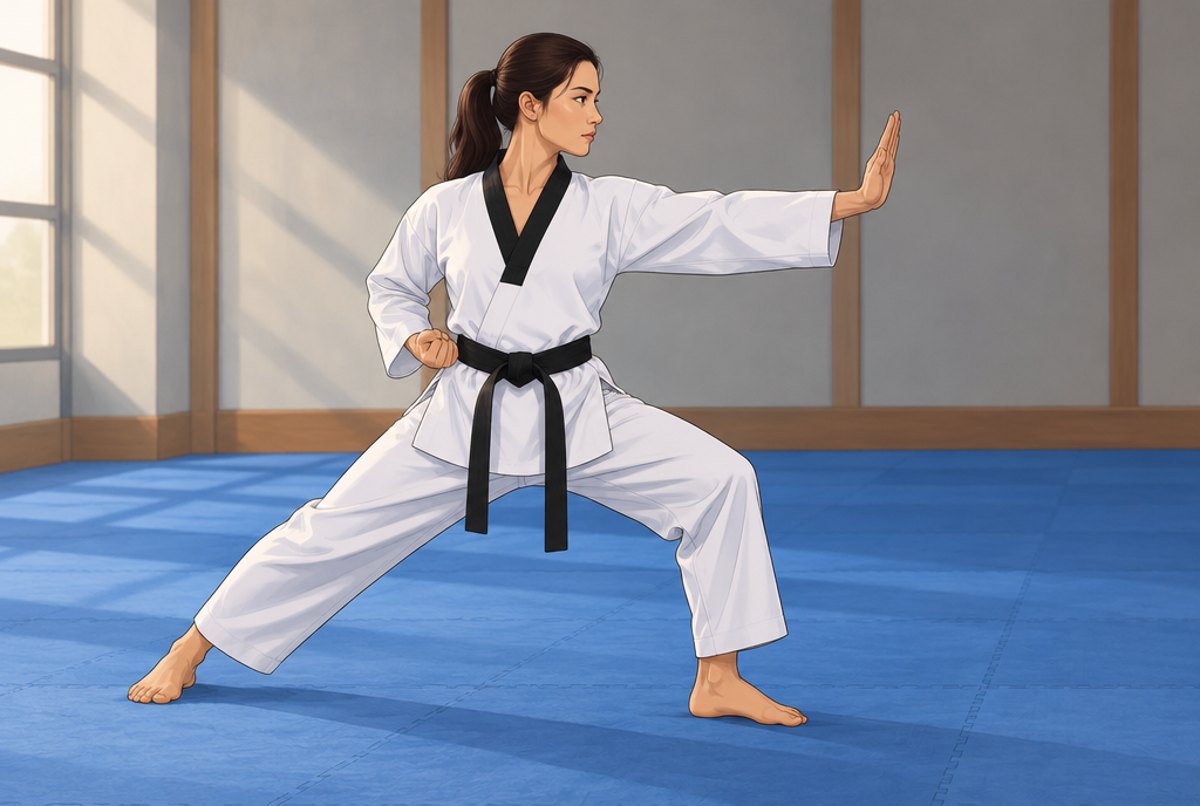
The Kukkiwon describes Koryo, Keumgang and Taebaek as the first group of black belt poomsae. At British Taekwondo's National Dan Grading of November 2026, Koryo is required for 2nd Dan, Keumgang from 3rd and Taebaek at 4th. 54,82 Counts are British Taekwondo's. 87
| Poomsae | Moves | Meaning, in brief | Tested for (British Taekwondo) |
|---|---|---|---|
| Koryo | 30 | The Goryeo dynasty; the seonbae, a learned person of strong martial spirit | 2nd Dan 82 |
| Keumgang | 27 | Diamond, too strong to break; Mount Keumgang | 3rd Dan 82 |
| Taebaek | 26 | Bright mountain, linked to Dangun, the legendary founder of Korea | 4th Dan 82 |
| Pyongwon | 21 | A wide plain, the source of life | Not stated; 5th Dan and above are UK Kukkiwon Office tests |
| Sipjin | 28 | The 10 symbols of long life: sun, moon, mountain, water, stone, pine, herb of youth, tortoise, deer and crane | Not stated |
| Jitae | 28 | A person standing on the earth, reaching for the sky | Not stated |
| Chonkwon | 26 | The great might of heaven | Not stated |
| Hansu | 27 | Water, the source that nurtures all living things | Not stated |
| Ilyeo | 23 | Oneness, from the thought of the monk Wonhyo; mind and body as one | Not stated |
Spellings vary even within British Taekwondo: Sipjin and Shipjin, Chonkwon and Cheonkwon. 80,87
Poomsae in competition
- WT's poomsae rules, in force since 30 September 2024, set which poomsae each age division may be asked for: cadets, aged 12 to 14, draw from Taegeuk 4 to 8, Koryo, Keumgang and Taebaek; the over 65s from Koryo to Hansu. 44
- British Taekwondo uses the same lists and adds a national Peewee division for under 11s: Taegeuk 4 to 8, Koryo and Keumgang. 87
- Freestyle poomsae is a separate event: a choreographed routine to music with acrobatic kicks, for ages 12 and over. 44,87 See the competition page.
ITF tul
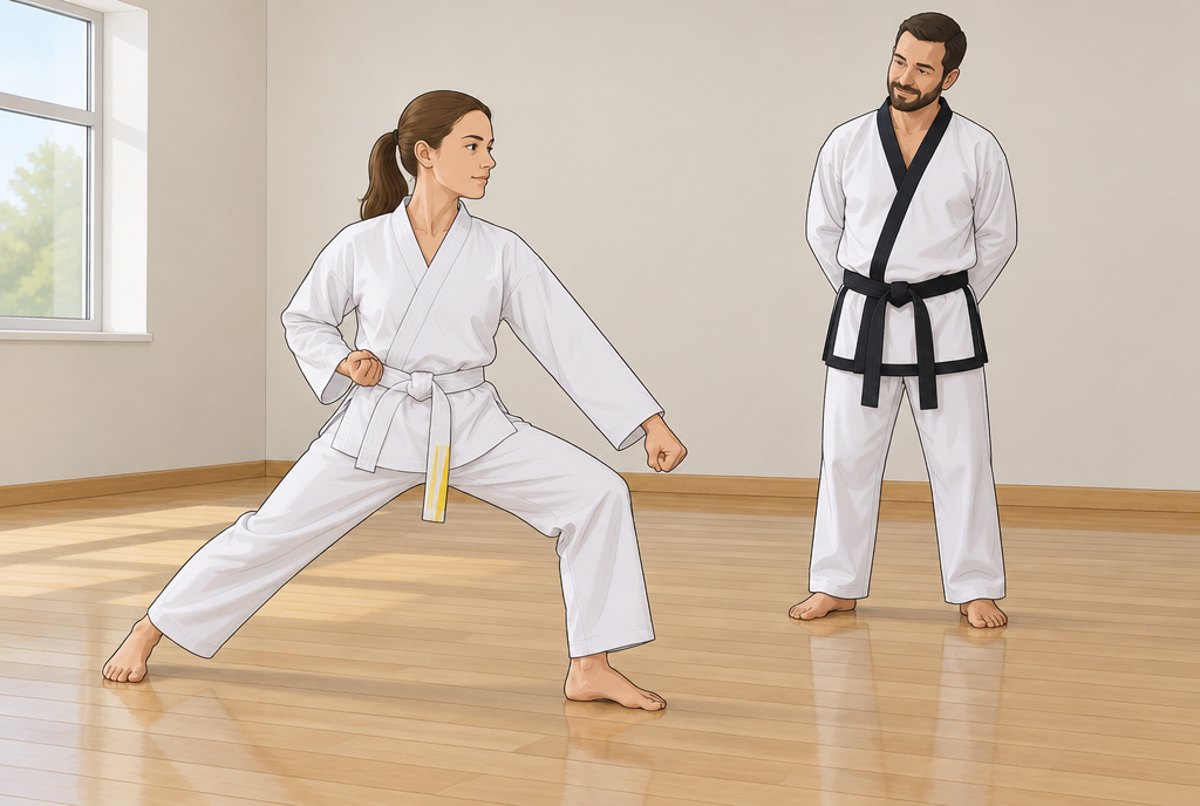
- There are 24 patterns, which General Choi explained as the 24 hours of a day, standing for a lifetime. Each pattern's name, number of movements and floor diagram refer to a figure or event in Korean history. 62
- Beginners' exercises: four direction punch, Saju Jirugi, and four direction block, Saju Makgi, at 10th Gup, and four direction thrust, Saju Tulgi, usually taught around 2nd Gup. 3,13
- History: the first patterns date from 1955 to 1959; most were created in 1961 to 1964; Eui-Am, Yon-Gae, Moon-Moo and So-San were added in 1968; and Juche replaced Ko-Dang in the early 1980s. 13
The 24 patterns
Grade and belt are from the Vienna ITF's Encyclopedia; movement counts from the Encyclopedia where it gives them, otherwise from another account. For patterns after Kwang-Gae, only the person or event named is given. 13,62
| Pattern | Learned at | Moves | Named after, in brief |
|---|---|---|---|
| Chon-Ji | 9th Gup | 19 | Heaven and earth, the creation of the world |
| Dan-Gun | 8th Gup | 21 | Dangun, legendary founder of Korea |
| Do-San | 7th Gup | 24 | Ahn Chang-Ho, 1878 to 1938, patriot; 24 for his life of work 160 |
| Won-Hyo | 6th Gup | 28 | The great Silla monk Won-Hyo, 617 to 686; the Encyclopedia credits him with bringing Buddhism to Silla, which had adopted it in 528 161,162 |
| Yul-Gok | 5th Gup | 38 | The scholar Yi I, 1536 to 1584; 38 for his birthplace near the 38th parallel |
| Joong-Gun | 4th Gup | 32 | The patriot Ahn Joong-Gun; 32 for his age when executed in 1910, counted the Korean way; he was 30 163 |
| Toi-Gye | 3rd Gup | 37 | The scholar Yi Hwang; 37 for the 37th parallel |
| Hwa-Rang | 2nd Gup | 29 | The Hwarang youth group of Silla; 29 for the 29th Infantry Division |
| Choong-Moo | 1st Gup | 30 | Admiral Yi Sun-Sin and the turtle ship of 1592 |
| Kwang-Gae | 1st Dan | 39 | King Gwanggaeto of Goguryeo; 39 from the year 391 |
| Po-Eun | 1st Dan | 36 | Jeong Mong-ju, of the Goryeo period |
| Ge-Baek | 1st Dan | 44 | Gyebaek, of the kingdom of Baekje |
| Eui-Am | 2nd Dan | 45 | Son Byong-hi, of the period of Japanese rule |
| Choong-Jang | 2nd Dan | 52 | Kim Deok-ryeong, of the Joseon dynasty |
| Juche | 2nd Dan | 45 | The North Korean idea of self reliance; replaced Ko-Dang in the Vienna ITF list |
| Sam-Il | 3rd Dan | 33 | The independence movement of 1 March 1919 |
| Yoo-Sin | 3rd Dan | 68 | Kim Yu-sin, of the kingdom of Silla |
| Choi-Yong | 3rd Dan | 46 | Choe Yeong, of the Goryeo dynasty |
| Yon-Gae | 4th Dan | 49 | Yeon Gaesomun, of Goguryeo |
| Ul-Ji | 4th Dan | 42 | Eulji Mundeok, of Goguryeo |
| Moon-Moo | 4th Dan | 61 | King Munmu of Silla |
| So-San | 5th Dan | 72 | Hyujeong, of the Joseon dynasty |
| Se-Jong | 5th Dan | 24 | King Sejong the Great of Joseon |
| Tong-Il | 6th Dan | 56 | The reunification of Korea |
Retired patterns: Ko-Dang, 39 moves, named after Cho Man-sik and replaced by Juche; and U-Nam, after President Syngman Rhee, dropped in the 1960s. 13
Where the ITF bodies differ
General Choi's nine points for performing a pattern, in short: start and finish on the same spot, keep correct posture and facing, tense and relax the muscles at the right moments, move rhythmically, speed up or slow down as instructed, perfect each pattern before the next, know the purpose of each move, perform with realism, and use both sides equally. 62
GTF patterns
The Global Taekwon-Do Federation is said to add six patterns of its own to the ITF set: two for coloured belts and four for black belts. Not confirmed. 11,14,69
Official videos
Both families publish official technique libraries. The Kukkiwon has an official video for each of its 17 poomsae and a newer step by step series for the Taegeuk, and British Taekwondo sends its members to those. 80 The Vienna ITF's channel, ITF HQ, has official performances of most of the 24 patterns. These are linked, not copied, on the sources page.