

Taekwondo's rules change often, so every rule here carries its date. On 26 October 2026 World Taekwondo's rules page listed these as current: kyorugi rules in force 1 November 2026, replacing the 1 January 2026 edition, and poomsae rules in force 30 September 2024. The Vienna ITF's Tournament Rules are the version of 22 March 2026, and the ITF led by Paul Weiler publishes its Official ITF Rules of Competition Version 2026-1. For anything that matters, check the rulebook itself, linked on the sources page. 40,44,45,61,65
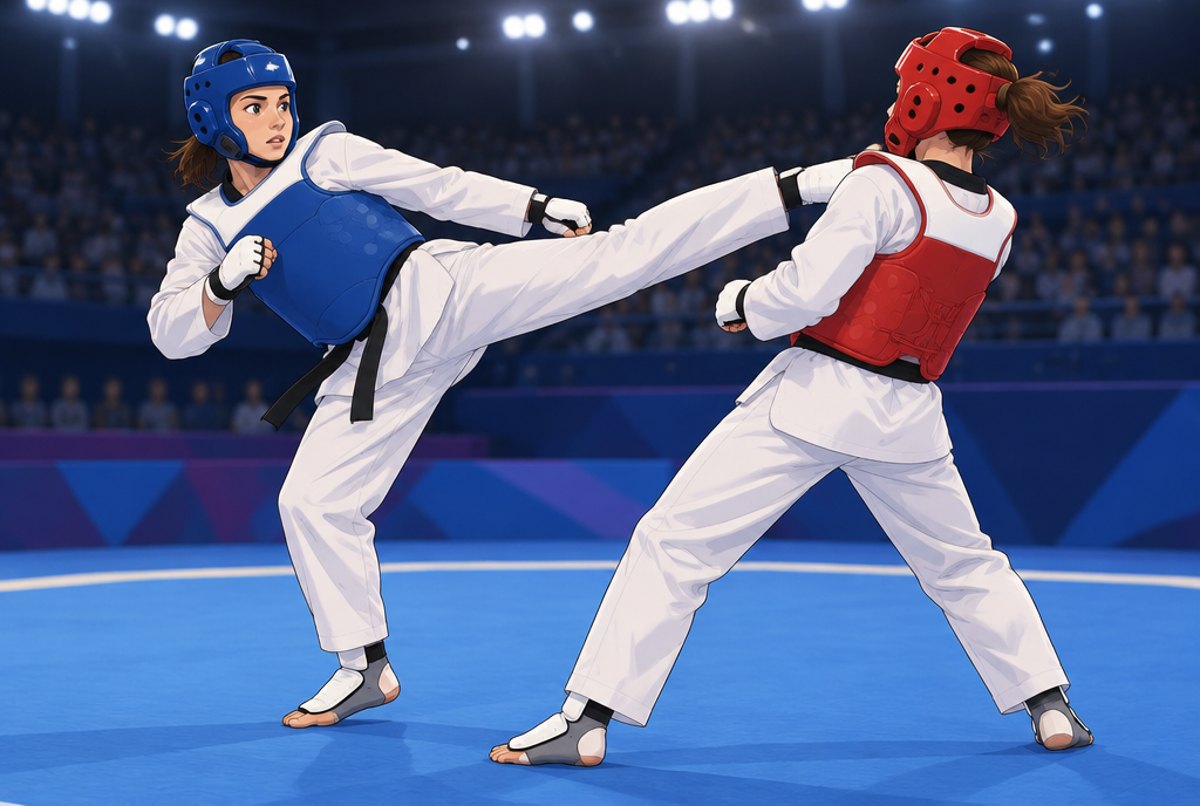
WT sparring, kyorugi, rules in force 1 November 2026
All from the WT rules unless another source is named. 40
Who and how long.
- Age groups, by year of birth: cadets 12 to 14, juniors 15 to 17, seniors 17 and over.
- A contest is three rounds of two minutes with a minute's rest; organisers may shorten this, which is common at junior and local events.
- Two formats. Total points over three rounds, with a one minute golden round if tied, in which earlier scores are wiped and the first to score 2 points wins; or best of three rounds, where each round is won separately and the match goes to whoever wins two. Which format an event uses is set by the organisers.
- Weight categories. Olympics: four per sex (men under 58, 68 and 80 kg and over 80 kg; women under 49, 57 and 67 kg and over 67 kg). World Championships: eight per sex. Juniors and cadets: 10 per sex, and cadet events may use height categories. Since 1 January 2026 the rules also include a six category set "to be tested" as a possible future Olympic structure. 40,42
Kit. A WT approved dobok, electronic trunk and head protectors, the , groin guard, forearm and shin guards, gloves, sensor socks when the PSS is used, and a white or clear mouthguard. Cadet head protectors may have a face shield.
What scores, from 1 January 2026, unchanged on 1 November 2026. 40,42
| Technique | Points |
|---|---|
| Straight punch to the trunk protector (punches to the head are not allowed) | 1 |
| Kick to the trunk protector | 2 |
| Kick to the head | 3 |
| Turning kick to the trunk | 4 |
| Turning kick to the head | 6 |
| Each penalty, , given to the opponent | 1 |
- The change to know: until 31 December 2025 a turning kick to the head scored 5. On 1 January 2026 WT doubled the points for turning kicks. WT's own "About Taekwondo" page still shows 5. 42,43,46
- How scoring works. The PSS sensors decide whether kicks land with enough force; judges add the extra points for turning kicks and score punches. A back kick only counts as a turning kick if the head and shoulders turn too.
- Penalties, gam-jeom, for stepping over the line, falling down, avoiding the fight, grabbing or pushing, kicking below the waist, attacking after , the break, hitting the head with the hand, and more. Ten penalties lose the match; in best of three, five in a round lose that round.
- Last 10 seconds. A penalty for crossing the line, falling or running away in the last 10 seconds of a round gives the opponent 2 points, and from 1 November 2026 this applies to conduct generally. 40,41
- Point gap. In total points, a 20 point lead after round 2 or during round 3 ends the match; in best of three, a 15 point lead ends the round. Not applied in senior semi finals and finals. 40,41
- Knock down. The referee counts from to ; an athlete who cannot show they are ready by , eight, loses.
- Winner announced, from 1 November 2026, as , blue wins, or hong seung, red wins. 41
WT poomsae competition, rules in force 30 September 2024
All from the WT poomsae rules. 44
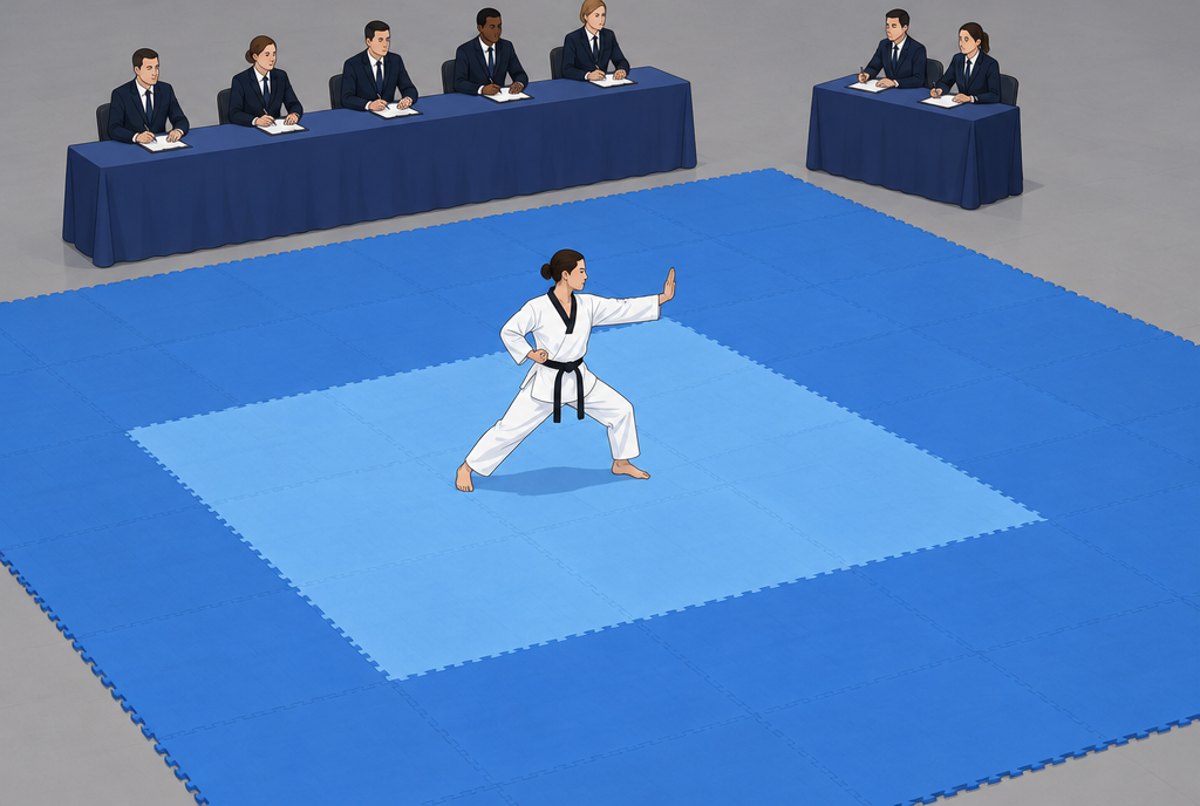
- Events: recognised poomsae (individual, pair, team), freestyle poomsae (to music, with acrobatic kicks), and a mixed format.
- Age divisions: cadet 12 to 14, junior 15 to 17, then under 30, 40, 50, 60, 65 and over 65. British Taekwondo adds a national Peewee division for under 11s and a 71 and over division. 44,87
- Scoring, out of 10: accuracy 4.0 (basic movements, each poomsae's details, balance) and presentation 6.0 (speed and power, rhythm and tempo, expression of energy). Judges deduct 0.1 for each small mistake and 0.3 for a big one, for example the wrong block or stance, a missing or mistimed , a pause of three seconds or more, or the eyes not following the technique.
- Format: cut off rounds or knockout; two designated poomsae per round, drawn from the list for the division. See the patterns page.
ITF competition
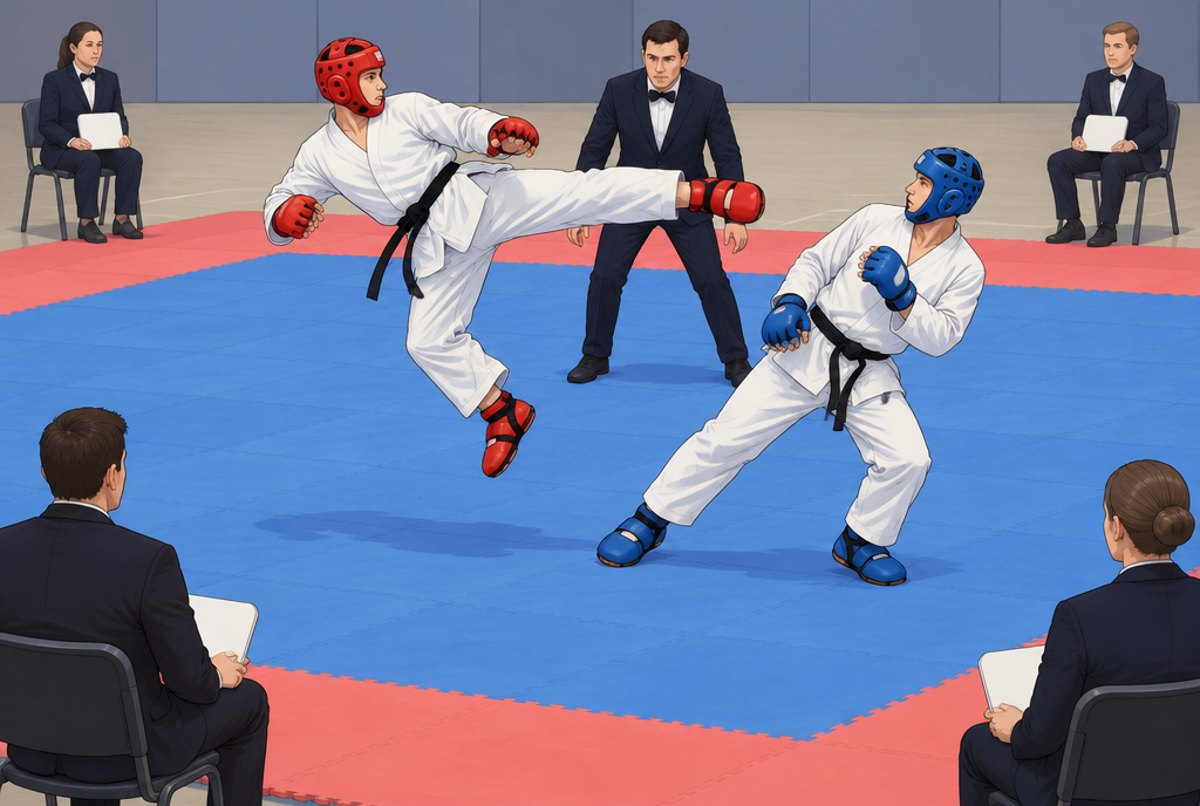
There are two separate 2026 ITF rulebooks in use by different ITFs, and they score sparring differently. Choi Jung Hwa's ITF rules are not confirmed. 61,65,68
Sparring
| ITF, Vienna, version of 22 March 2026 61 | ITF led by Paul Weiler, Version 2026-1 65 | |
|---|---|---|
| Contact | Controlled at the point of contact | Light contact; heavy contact costs a point |
| Hand attack, body or head | 1 | 1 |
| Kick to the body | 1 | 2 |
| Kick to the head | 2 | 3 |
| Higher scores | 2 to 5 points for turning, flying and mid air turning kicks and flying hand attacks, by difficulty and height; 1 point for a perfect block that makes the opponent lose balance | Only 1, 2 and 3 |
| Penalties | Warnings, , three of which cost a point, and deductions for fouls such as attacking the groin, a fallen opponent, using the head, elbows or knees, sweeping, and avoiding engagement in the final 15 seconds | Minus 1 point for heavy contact, attacking a fallen opponent, leg sweeping, holding, attacking an illegal target, unsportsmanlike conduct |
| Bouts | 2 rounds: 1 minute for ages 8 to 9, 1.5 minutes for 10 to 13 and 45 plus, 2 minutes for 14 to 44 | World Championships 2 rounds of 2 minutes; World Cups 1 round of 2 or 3 minutes in eliminations |
| Ring | 9 by 9 metres with a 1 metre safety border | 8 by 8 metres |
The Vienna ITF's 2026 rules also add Power Taekwon-Do, a separate full contact sparring event for black belts aged 16 to 34. 61
Patterns, breaking, special technique and self-defence
- Patterns. Two competitors perform side by side. In the Vienna ITF, dan divisions perform two designated patterns in each of two stages, drawn by computer from a range set by degree, scored out of 100, 80 for technique and 20 for power. In the Weiler ITF, judges score 0 to 10 per pattern. 61,65,66
- Power breaking, : boards in a frame with set techniques; for adult men in the Vienna ITF rules, at least three boards for forefist, knife hand, ball of the foot and back heel, and four for the footsword; each fully broken board scores 10. 61
- Special technique, : flying kicks to a board held at a set height, for example a flying high kick at 2.8 metres for adult men in the Vienna ITF rules. 61,66
- Self-defence routine, : a pre arranged demonstration event in the Vienna ITF. 61
- Children. The Vienna ITF holds pre children (8 to 9) and children's (10 to 11) tournaments with patterns and sparring only, grouped by Gup grade. The Encyclopedia forbids power tests for children. 61,62
Para taekwondo
- Para kyorugi follows the WT rules but with no kicks to the head. It is the only Paralympic taekwondo event, with 10 medal events at Paris 2024. 47
- Para poomsae caters for athletes of all impairment groups, puts more weight on presentation, and is not on the Los Angeles 2028 Paralympic programme. 44,47
- Athletes are classified into sport classes, K for kyorugi and P for poomsae. 10,47
Competition in the UK
British Taekwondo, WT style
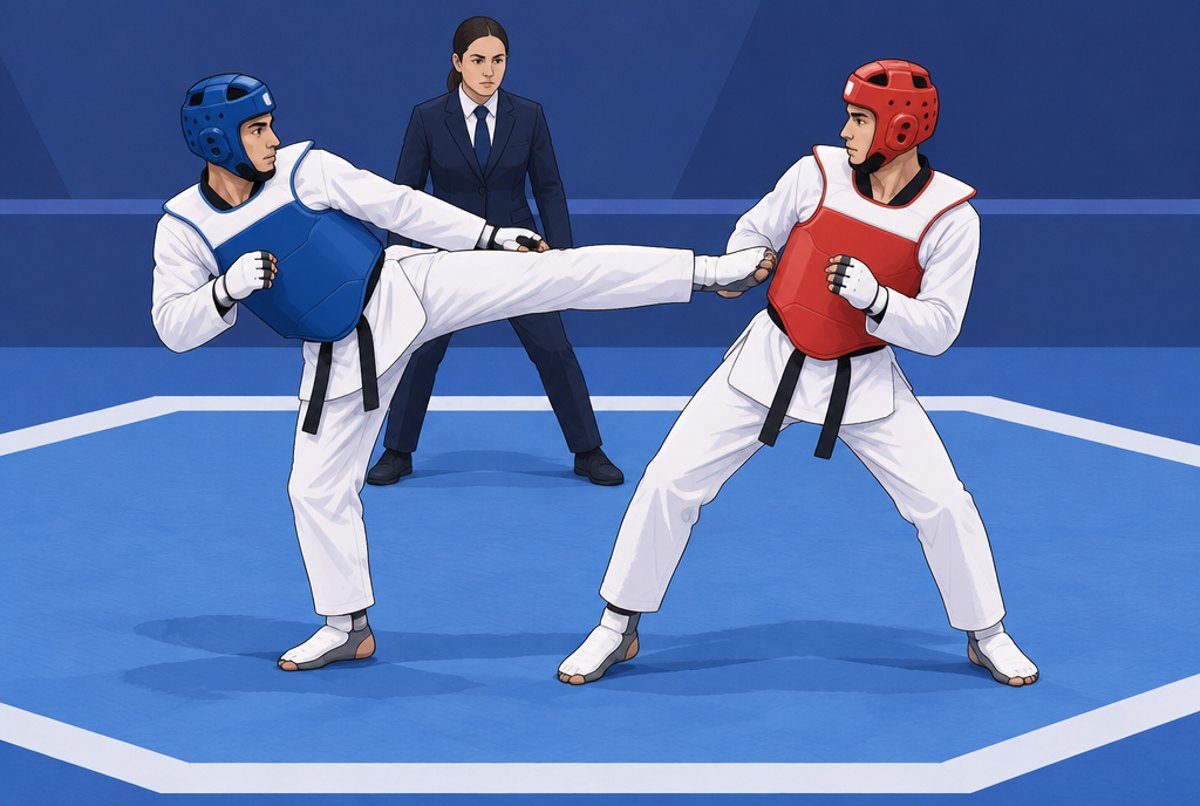
- Event types it sanctions: kyorugi open tournaments, kyorugi "1-2-1" events, single matches with no knockout as a beginner friendly step, and poomsae opens. Only clubs with a Welfare Officer may host, and a named Welfare Officer must attend with no other role. 88
- National events include the British National Kyorugi Championships, the British International Open and the National Poomsae Championships. 80,90
- Pathway: British Taekwondo's performance department manages cadet and under 21 squads; GB Taekwondo runs the full time World Class Programme in Manchester, about 30 athletes, and a development programme for 13 to 18 year olds. To compete abroad at WT events, athletes need a Global Athlete Licence through British Taekwondo. 80,84,91
ITF style and independent bodies
- Each association runs its own championships: the TAGB British Championships at Worcester Arena on 29 November 2026, ITF England and UK ITF national championships, UKTC competitions, and the British Taekwondo Council's annual national championships for its member organisations. 95,96,101,103,107
- International routes depend on the ITF: the UKTA and the squad of the ITF England body under the Vienna ITF compete in that ITF's European and world events; the ITF England body under the Weiler ITF, and ITF Scotland, in the Weiler ITF's; UK ITF in Choi Jung Hwa's. 63,67,101,102,105
British Olympic and Paralympic medals
From the owners' own lists and GB Taekwondo. 8,9,17,80,91
| Games | Medallist | Medal |
|---|---|---|
| Barcelona 1992 (demonstration) | Amanda Broadbent | Bronze |
| Beijing 2008 | Sarah Stevenson | Bronze, Great Britain's first Olympic taekwondo medal |
| London 2012 | Jade Jones | Gold |
| London 2012 | Lutalo Muhammad | Bronze |
| Rio 2016 | Jade Jones | Gold |
| Rio 2016 | Lutalo Muhammad | Silver |
| Rio 2016 | Bianca Walkden | Bronze |
| Tokyo 2020 | Bradly Sinden | Silver |
| Tokyo 2020 | Lauren Williams | Silver |
| Tokyo 2020 | Bianca Walkden | Bronze |
| Tokyo 2020 Paralympics | Beth Munro | Silver |
| Tokyo 2020 Paralympics | Amy Truesdale | Bronze |
| Paris 2024 | Caden Cunningham | Silver, over 80 kg |
| Paris 2024 Paralympics | Amy Truesdale | Gold, women's over 65 kg |
| Paris 2024 Paralympics | Matt Bush | Gold, men's over 80 kg |