

The one thing every family should know: almost every UK taekwondo club uses the same 10 coloured belt steps, white, yellow, green, blue and red with a stripe or tag between colours, and black belt above them. What differs is who awards the black belt, what a child under 15 gets instead of a Dan, which patterns are tested and how often gradings happen. Those depend on the club's association: British Taekwondo for the WT and Kukkiwon style, one of the ITFs, the TAGB, or another independent body. 62,81,97
How the numbers work
- Coloured belts are grades; British Taekwondo and the TAGB write Kup, and some write geup. They count down from 10th, the beginner, to 1st. 1,62,81
- Black belts are grades, called degrees in the ITF family. They count up from 1st to 9th, the highest in both families. 51,62
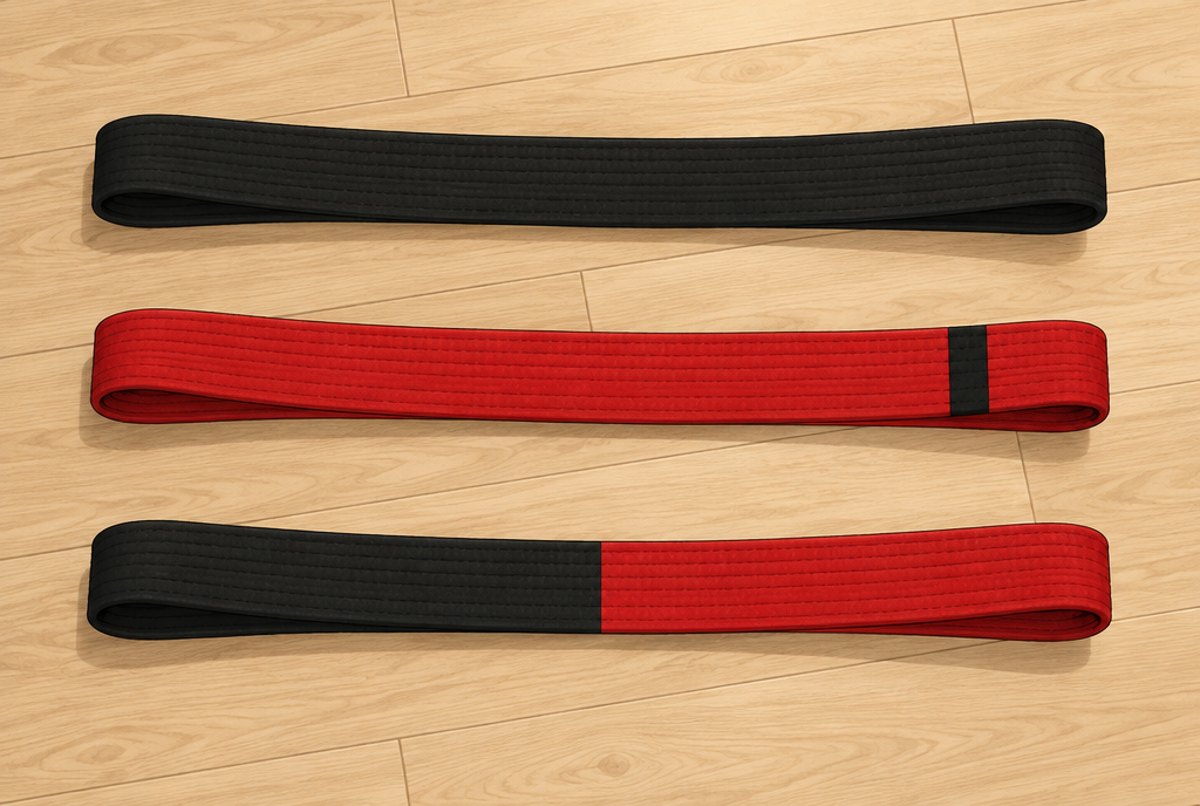
- Poom, WT and Kukkiwon only. Since 1 March 1975 the Kukkiwon has given children a rank instead of a Dan, 1st to 4th Poom, which converts to the matching Dan later. The ITF family has no Poom. 51,53
- Why nine. General Choi explained nine as the highest single digit and three times three, and grouped the degrees into novice black belts (1st to 3rd), experts (4th to 6th) and masters (7th to 9th). 62
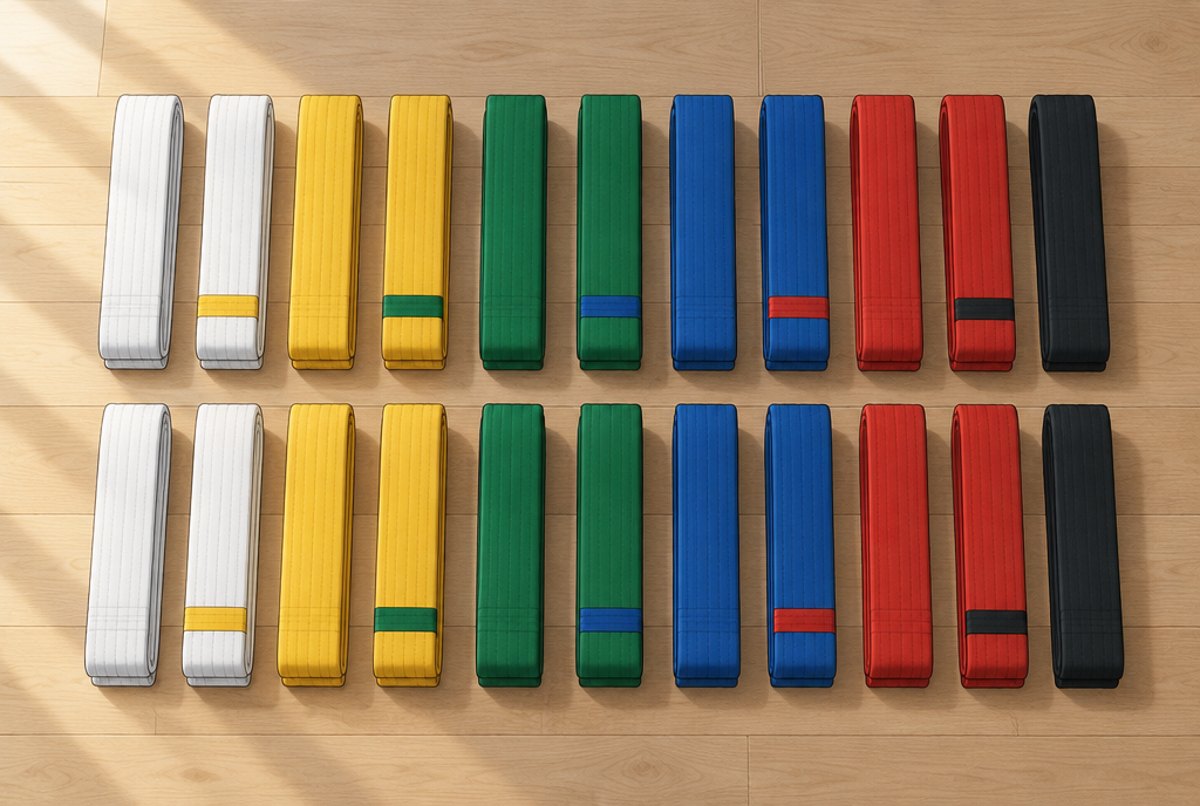
The coloured belts, side by side
| Grade | British Taekwondo chart 81 | ITF Encyclopedia 62 | ITF pattern learned 62 |
|---|---|---|---|
| 10th | White | White | Four direction punch and block |
| 9th | White with yellow stripe | White, yellow stripe | Chon-Ji |
| 8th | Yellow | Yellow | Dan-Gun |
| 7th | Yellow with green stripe | Yellow, green stripe | Do-San |
| 6th | Green | Green | Won-Hyo |
| 5th | Green with blue stripe | Green, blue stripe | Yul-Gok |
| 4th | Blue | Blue | Joong-Gun |
| 3rd | Blue with red stripe | Blue, red stripe | Toi-Gye |
| 2nd | Red | Red | Hwa-Rang |
| 1st | Red with black stripe | Red, black stripe | Choong-Moo |
Many UK clubs say "tag" rather than "stripe". 16 The TAGB follows the same colours. 97 Which Taegeuk poomsae each British Taekwondo Gup grade learns is not published, so that column is left empty here; British Taekwondo says only that there is generally one new poomsae per belt. 80,81
What the colours mean. Many ITF style clubs explain the colours like this, as the TAGB did in 2004: white for innocence; yellow for the earth in which the seed takes root; green for the growing plant; blue for the heaven towards which it grows; red for danger, a warning to the student to use self control and to opponents to stay away; black for maturity and proficiency. 97
British Taekwondo and the Kukkiwon
- Every member is individually registered with British Taekwondo. 84
- Gradings are usually offered about every three months in the club and test basic technique, poomsae, self-defence and sparring, with some clubs adding theory. 81 It takes about three years to reach black belt. 80,81
- Gup gradings are run by clubs. British Taekwondo has an application form for Gup grading examiners and sells the certificates to approved grading hosts. 88,90
- Black belt. A student who reaches black belt becomes 1st Dan, or 1st Poom if 14 or younger. 81 At the November 2026 National Dan Grading, 1st Dan candidates aged 15 and over receive a black belt; 1st Poom candidates receive a black and red Poom belt. 82
- Certificates. British Taekwondo gives a certificate on the day; the official Kukkiwon certificate follows from Korea in about 6 to 8 weeks. Only the Kukkiwon may issue anything called a Poom or Dan certificate. 82,83
- Dobok collar. A white collar for 1st Dan and Poom candidates; black, or black and red, from 2nd Dan and Poom. 82
Usual waiting times, British Taekwondo 81,82
| From | To | Usual wait |
|---|---|---|
| 1st Gup | 1st Dan or Poom | 6 months at 1st Gup |
| 1st Dan | 2nd Dan | 1 year |
| 2nd Dan | 3rd Dan | 2 years |
| 3rd Dan | 4th Dan | 3 years |
| 4th Dan | 5th Dan (Master) | 4 years |
| 5th Dan | 6th Dan | 5 years |
| 6th Dan | 7th Dan | 6 years |
| 7th Dan | 8th Dan (Grandmaster) | 8 years |
| 8th Dan | 9th Dan | 9 years |
What a British Taekwondo Dan grading involves, November 2026 82
| Going for | Poomsae | Other content |
|---|---|---|
| 1st Dan or Poom | Taegeuk 8 plus two other Taegeuk chosen by the examiners | Three lines of basic technique; five one step sparring techniques; five self-defence escapes; controlled free sparring, two rounds of one minute, in WT approved head and trunk protectors; a two way breaking test |
| 2nd Dan or Poom | Koryo plus two Taegeuk | As above; three way breaking test |
| 3rd Dan or Poom | Keumgang, Koryo and one Taegeuk | As above, six self-defence escapes, and knife defence against six attacks |
| 4th Dan or Poom | Taebaek, Keumgang, Koryo and one Taegeuk | As 3rd Dan |
- Breaking uses real boards for 16 and over and a foam board for 15 and under. The panel takes age into account, and people with long term conditions can submit medical and instructor notes so the test can be adapted. 82
- Fees, November 2026, including the Kukkiwon application: 1st Dan or Poom £155; 2nd £190; 3rd £220; 4th £295. 82
- Who examines. A panel of at least three, led by a Kukkiwon 6th Dan or higher from an approved list. 5th Dan and above are run by the UK Kukkiwon Office, set up after British Taekwondo and the Kukkiwon signed a memorandum of understanding in December 2022; 6th and 7th Dan can also be gained by video and a written thesis. 82,83
The ITF family: General Choi's Encyclopedia
All three ITFs and most ITF style UK associations start from the Encyclopedia. 1,62
- How long it takes. General Choi set out three training programmes to 1st degree: 18 months at 1.5 hours a day, six days a week; 30 months at three days a week; and 12 months at four hours a day. On the 30 month course the minimum time at each grade runs from 2 months at 10th to 5 months at 1st Gup. Minimum years between degrees: 1.5 at 1st, then 2, 3, 4, 5, 6 and 7 at 2nd to 7th. 62
- What is marked. Five headings: pattern, sparring, power (breaking), education (knowledge) and attitude. The pass mark is 60 points, and the Encyclopedia says that for every 10 points above or below, a student may be promoted or demoted accordingly. 62
- Sparring by grade: three step sparring for the lowest grades, then two step, one step, semi free and free sparring by the red belts. 62
- Power test. Breaking starts around 5th Gup with a front kick, but is "strictly prohibited for children" because of the risk of bone or muscle damage. 62
- Who tests whom. Gup tests are held at the student's own gym. Degree tests up to 3rd are run by a national board; 4th to 8th by the ITF's promotion committee; 9th needs the unanimous consent of a special committee. A qualified instructor may test up to half of their own degree. 62 In Choi Jung Hwa's ITF, instructors must hold 4th degree and have passed an International Instructor Course to grade students. 68
Independent UK associations
TAGB
- Every TAGB school follows the same syllabus, and all students are graded by external examiners, not their own instructor. 96
- Black belt patterns differ from the Vienna ITF list. The TAGB's 2006 competition list gives 1st Dan Choong-Moo, Kwang-Gae, Po-Eun and Ge-Baek; 2nd Dan Choong-Jang, Ko-Dang and Eui-Am; 3rd Dan Choi-Yong, Yoo-Sin and Sam-Il; 4th Dan Tong-Il, Ul-Ji and Se-Jong; 5th Dan Yon-Gae, Moon-Moo and So-San. Whether this is still the TAGB order is not confirmed. 97
- Junior black belts. A 2011 TAGB pack sets "star" gradings after one, two and three years at 1st Dan, the third adding a power test. At what age a junior black belt converts to an adult grade is not confirmed. 97
- The TAGB's current syllabus is not published on its site. 96
Others
- UKTA follows the Vienna ITF and holds national black belt gradings with ITF masters; for example 35 candidates were promoted at Elgin in September 2023. 63,100
- UK ITF offers ITF degree certificates as Choi Jung Hwa's ITF's "Independent National Organisation #2". 101
- UKTC runs Little Tiger Cubs (3 to 5) and Active Tigers (5 to 8) before its main classes from age 9; its grading scheme for these was not published. 107
Side by side
| British Taekwondo (WT and Kukkiwon) | ITF Encyclopedia (all three ITFs) | TAGB, pages of 2004 to 2011 | |
|---|---|---|---|
| Coloured belts | 10 Gup grades, stripes between colours 81 | 10 Gup grades, stripes between colours 62 | Same colours 97 |
| Black belt for children | 1st Poom, black and red belt, for 14 and under 81,82 | 1st degree; no separate junior rank found 62 | 1st Dan with junior stars after 1 to 3 years 97 |
| Who issues the black belt | The Kukkiwon, in Korea 83 | The ITF the club belongs to 62,68 | Not confirmed |
| First dan patterns | Taegeuk 8 and others; Koryo at 2nd Dan 82 | Kwang-Gae, Po-Eun, Ge-Baek 62 | Choong-Moo, Kwang-Gae, Po-Eun, Ge-Baek 97 |
| Who grades coloured belts | The club, with approved examiners 81,88 | The student's own gym 62 | External examiners 96 |
| Breaking for children | Foam boards for 15 and under at dan tests 82 | No power test for children 62 | Not confirmed |
Questions families ask
Does a belt carry over if we change club? Within the same body, yes. Between bodies, not automatically. British Taekwondo accepts earlier grades "at the complete discretion of British Taekwondo", and only from clubs or instructors it recognises; Choi Jung Hwa's ITF runs a certificate exchange, considered case by case. 82,101 Other bodies' rules are not confirmed.
How old must you be for a black belt? British Taekwondo has no published minimum age for 1st Poom; at 15 and over the black belt is a Dan. 81,82 The Encyclopedia gives no minimum age. 62
How often are gradings? About every three months at British Taekwondo clubs. 81 ITF minimum times range from one to five months a grade, depending on the training programme. 62
What does it cost? British Taekwondo membership is £31 a year in 2026, and its Dan grading fees are above. 82,84 Gup grading fees are set by clubs.
Can my child be held back? Both systems test against a standard; the Encyclopedia even allows demotion for a very low mark. 62