

The one thing every family should know: a first Muay Thai class is usually a warm up, skipping or shadow boxing, the guard and footwork, then punches, kicks, knees and the push kick on pads or bags, with no sparring on day one. Gyms that follow IFMA's grading teach the from the first grade. Before joining, ask: is the gym part of a body, the UK Muaythai Federation, Muaythai GB, another or none? Are coaches DBS checked, first aid trained and insured? Do children train separately, and how is head contact handled for under 16s? 1,27,40,41,45,47
Before the first class
- Is the gym in a body? The UK Muaythai Federation publishes a gym directory, 86 gyms on 26 October 2026. Muaythai GB has affiliate and "verified" member gyms, but its gym list sits behind a member log in. Many good gyms are independent; for them, ask about insurance and safeguarding directly. 40,41
- Safeguarding. Muaythai GB's verified gyms must show that the head coach has an up to date DBS check, renewed every three years, first aid training, instructor insurance and a club safeguarding policy; it says all coaches and volunteers should be DBS checked, and that in Scotland an enhanced disclosure is required by law. The UKMF asks gyms for a DBS number when they join. Muaythai GB recommends that clubs seek the Safeguarding Code in Martial Arts mark. 40,45,80
- Contact with children. Muaythai GB's safe practice policy: head contact light at all times and avoided altogether for non competitive under 16s; sparring across ages or sexes only in touch contact learning drills; no knuckle press ups or heavy bag work for children, whose joints are still developing. 45
- Concussion. Muaythai GB follows the UK government's guidance: anyone with signs of concussion stops and is checked by a health professional, and return needs clearance. IFMA bans anyone knocked out, or stopped by blows to the head, from competition and sparring for at least 30 days, and says the same protections apply to head injuries in training. 21,45,81
What to wear and bring
Shorts or loose trousers, a T-shirt and water. Muay Thai is fought barefoot; whether a gym trains barefoot is up to the gym. Competition rules also ask for short nails, no jewellery and tied back hair. Tell the coach about any illness or injury. 21,42
A typical class
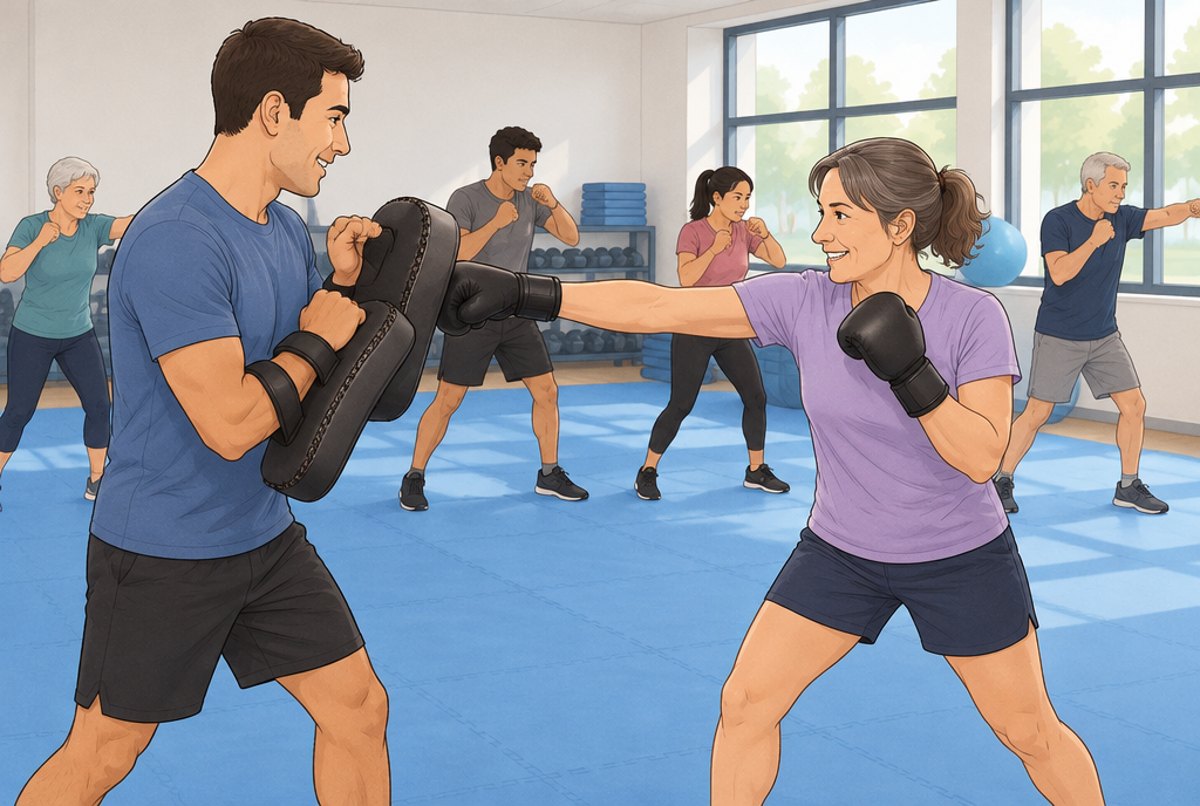
- A warm up, often skipping and running. 1,45,47
- Stretching and basic exercises. 47
- : the , footwork and techniques in the air. 1,47
- Pad work: a coach or partner holds for punches, kicks, knees and push kicks. 1
- Bag work, with gloves on, for adults. 1,45
- Partner drills; later, light technical sparring or clinch practice in full kit. 1,45
- Conditioning to finish. 1
Kit you will hear about
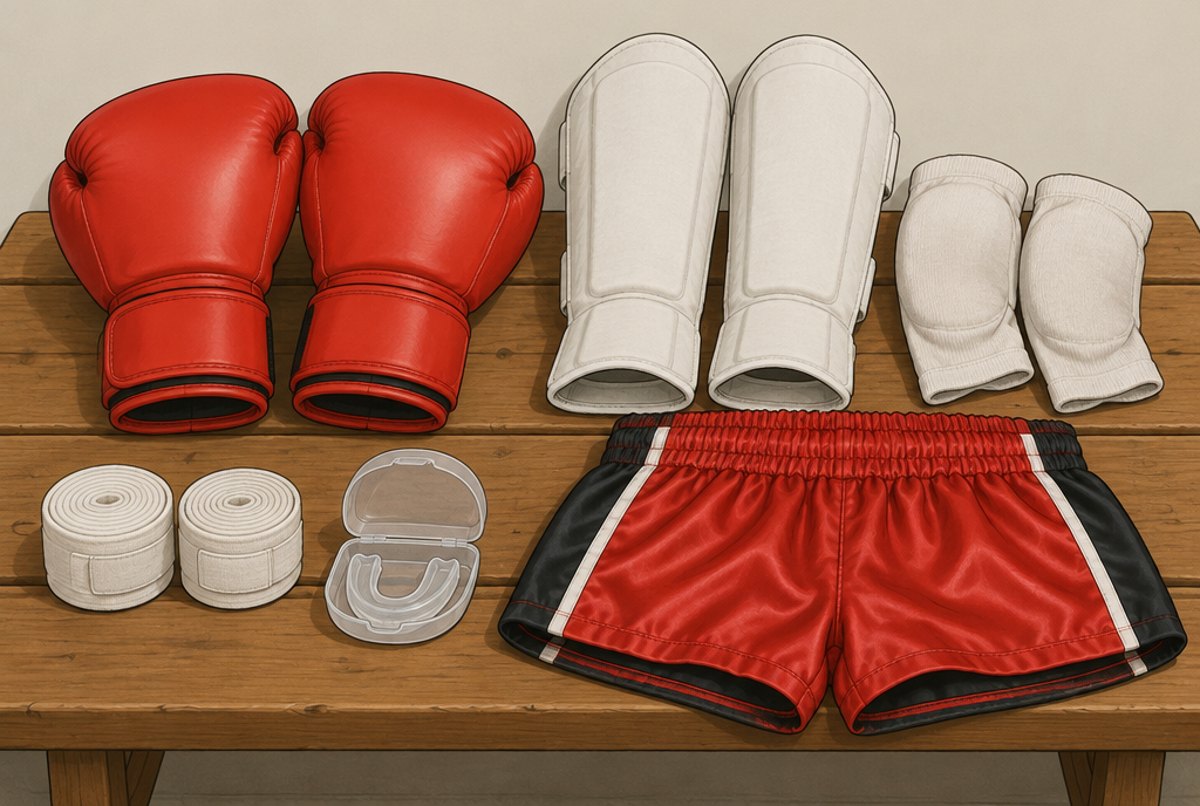
Gyms usually ask for kit gradually, often gloves and wraps first, then shin guards and a gum shield before partner work; that is not confirmed for any particular gym. These are the items the competition rules ask for. 21,42
| Item | What it is | Competition rules |
|---|---|---|
| Gloves | Padded boxing style gloves | IFMA: 10 oz for all amateurs. Muaythai GB juniors: 6 to 8 oz; amateurs: 10 oz for head contact. WBC professionals: 8 oz up to welterweight, 10 oz above 21,31,42,43 |
| Cotton or Velcro wraps under the gloves | IFMA: up to 5 m; Muaythai GB juniors: up to 6 m; tape only at the wrist 21,42 | |
| Cloth or foam pads over the shins | IFMA amateurs; Muaythai GB juniors (cotton) 21,42 | |
| A fitted mouthguard | Compulsory for IFMA amateurs; optional in Muaythai GB's junior and professional rules 21,42,44 | |
| Groin guard | A hard cup, or foam for women in IFMA | Compulsory for all IFMA athletes; for boys and men under Muaythai GB 21,42 |
| A padded helmet with no face cage or chin guard (IFMA) | IFMA amateurs, put on after the wai kru; Muaythai GB head contact bouts 21,43 | |
| Cloth sleeves over the elbows | IFMA amateurs; Muaythai GB where elbows to the head are used 21,43 | |
| A padded vest in the corner colour | IFMA youth divisions and older Masters; Muaythai GB juniors (body shield) 21,42 | |
| Muay Thai shorts | Loose satin shorts | IFMA: "Muaythai" written on the front 21 |
| Mongkhon and prajied | Headband and armband | Not bought by beginners; traditionally given by the teacher 1,21 |
Children
- From what age? Muaythai GB's junior rules start at 5, though its strike table starts at 6; IFMA's youngest division is the under 8s, ages 6 and 7; the Master Sken Association teaches children from 6 to 13. 21,42,47
- Head contact. Muaythai GB bans head strikes for all under 16s in junior competition and advises no head contact in training for non competitive under 16s. IFMA bans head strikes until the year a child turns 12, and elbows and knees to the head until the year they turn 14. 21,42,45
- Weight. An article on IFMA's site says "Kids shouldn't cut weight on fights at all". 26
- Competition is optional. The MSA invites only children who show an interest, and already train in its main classes, into its competition class. 47
What it costs
No UK body publishes typical class prices. Ten UK clubs' own published prices in October 2026: a single adult class cost £5 to £15 and a monthly membership £32 to £75; two that listed junior prices charged £4 and £7 a class. These are examples, not averages. 71 Body fees are separate: the Master Sken Association's UK student licence was £14 a year, and Muaythai GB charged £30 to enter its 2026 British Championships. 41,47
Common questions
- Is the wai kru religious, and do we have to do it? It is a mark of respect for teachers. The Kru Muaythai Association calls it cultural, not religious; the World Muaythai Council describes it in spiritual terms. IFMA requires it before every competition bout; whether a gym asks every student to learn it is up to the gym. 21,29,32
- Will my child be hit in the head? Not in Muaythai GB junior competition, which also advises against head contact in training for non competitive under 16s. Under IFMA's rules, head strikes start in the year a child turns 12, punches and kicks only until 14. 21,42,45
- Do women and girls train and compete? Yes. IFMA runs female divisions in every age group, the World Games have had equal events for women and men since 2022, and Thailand's two great stadiums now hold women's bouts. 7,8,21
- Is there a fitness only option? IFMA lists , a workout using pads, bags and circuits, as one of its disciplines, and many gyms run fitness classes with no contact. 20
- Can older beginners start? IFMA's competitions run to Masters 45 and over in fighting and Masters 60 and over in the wai kru. 21