

Spellings vary. Southern styles and most UK schools use Cantonese names, in many home made spellings; modern wushu and the northern styles use Mandarin in pinyin. The same idea can look very different: and are both the horse stance. Each style teaches these in its own way, so this is a guide to what families will hear, not a syllabus. 6,15,46
What families will hear. Most training is built from the same ingredients: stances, hand shapes, kicks, partner drills, forms, sparring and, later, weapons. Northern styles use more kicks and long movements; southern styles use lower stances and more hand techniques. 1,40
Stances
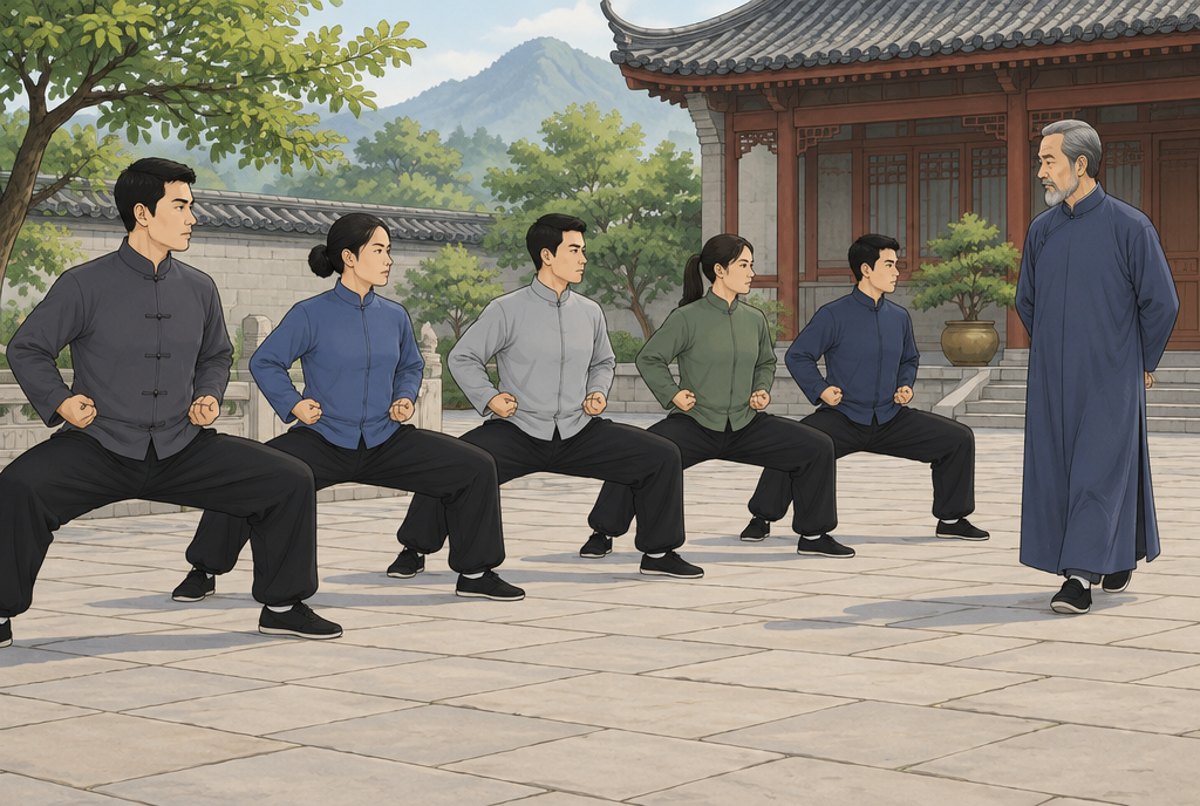
Stances are the base of every style, and beginners often hold them for some time to build leg strength. 1,8
| Stance | Mandarin | Cantonese | What it looks like |
|---|---|---|---|
| Horse stance | Feet wide apart, knees bent as if sitting on a horse; Hung Gar's is deep and wide | ||
| Bow stance | Not confirmed | Front knee bent, back leg straight, like a drawn bow | |
| Empty, or cat, stance | Not confirmed | Weight on the back leg, the front foot resting lightly | |
| Crouching stance | Not confirmed | One leg bent in a deep squat, the other straight out to the side | |
| Resting stance | Not confirmed | Legs crossed and bent low, as if about to sit | |
| Wing Chun training stance | Narrow and upright, knees turned slightly in | ||
| Turning stance | Turning the whole body on the spot, in Wing Chun's second form |
Sources: 6,15,46,105,119. Shaolin Temple UK teaches the first five as its classic stances in its first class. 119 Wing Chun schools also name steps, such as the arrow step, , the pursuit step, , and the plum blossom step, . 105 Baguazhang trains by walking in a circle. 40
Hand shapes
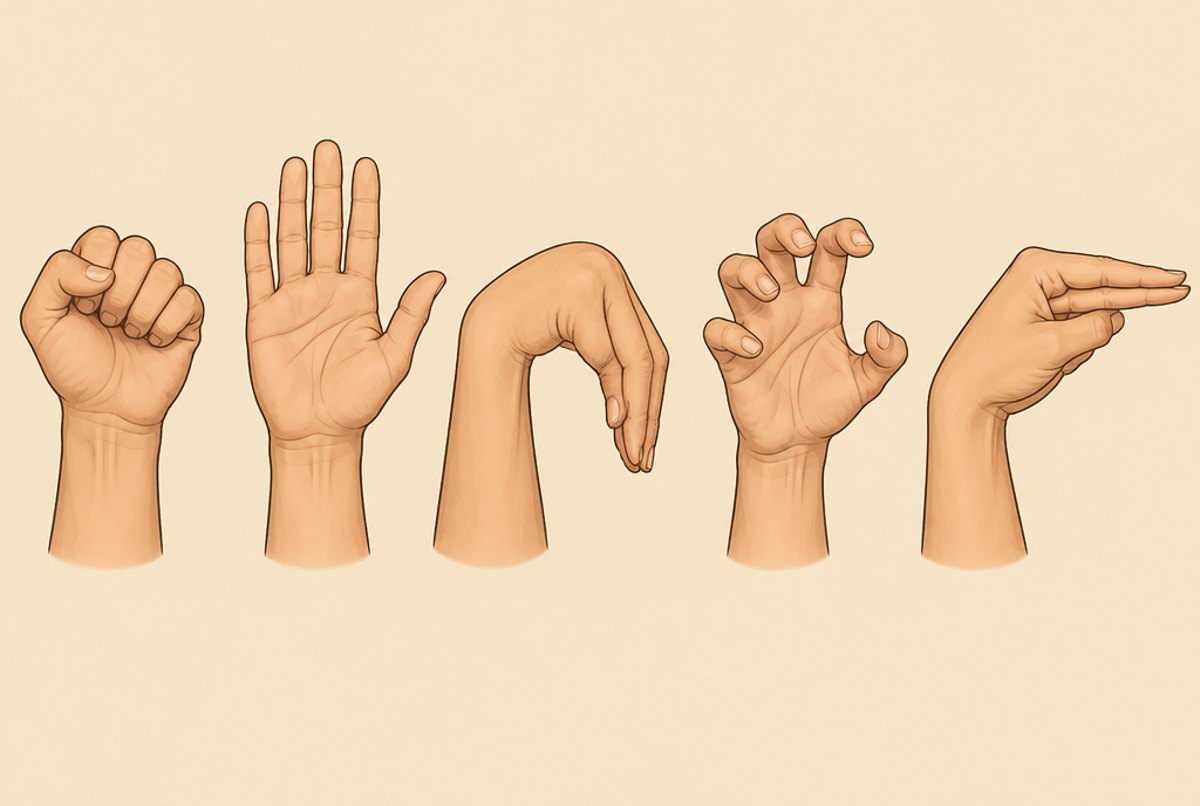
- Fist, palm and hook. The three basic hand shapes of modern wushu are the fist, , the open palm, , and the hook, , with the fingertips pinched together and the wrist bent. 46
- Animal hands. The of Hung Gar; the of White Crane and of Hung Gar's Tiger and Crane form; and the of Northern Praying Mantis, which uses one to three fingers to divert and grab. 8,10,11
- Bridge hands. Southern styles train the forearm as a bridge, , to make and keep contact with an opponent's arm. 8,105
Wing Chun hand positions
| Cantonese | Mandarin | English |
|---|---|---|
| tān shǒu | Spreading, palm up hand | |
| bǎng shǒu | Wing arm | |
| pāi shǒu | Slapping hand | |
| lā shǒu | Pulling hand | |
| fú shǒu | Taming or subduing hand | |
| hù shǒu | Protecting hand | |
| biāo shǒu | Darting hand |
Sources: 6,105. The straight centre line punch and the chain punch, , are among the first things taught, and the UK Wing Chun Kung Fu Association's beginners' syllabus also lists double, side and turning punches. 6,102
- Choy Li Fut strikes with long, swinging arms, the upper body twisting for power, which is called . Choy Li Fut counts 10 hand techniques, including the back fist and sweeping and upward strikes. 9
- Shouts. Southern styles often shout with strikes; Choy Li Fut practitioners used set sounds for palm, claw, fist, beak and kick. 9,40
Kicks
- Basic kicks taught early in many schools: front, side and turning kicks. Nam Pai Chuan's first grades also include jumping front kicks. 121
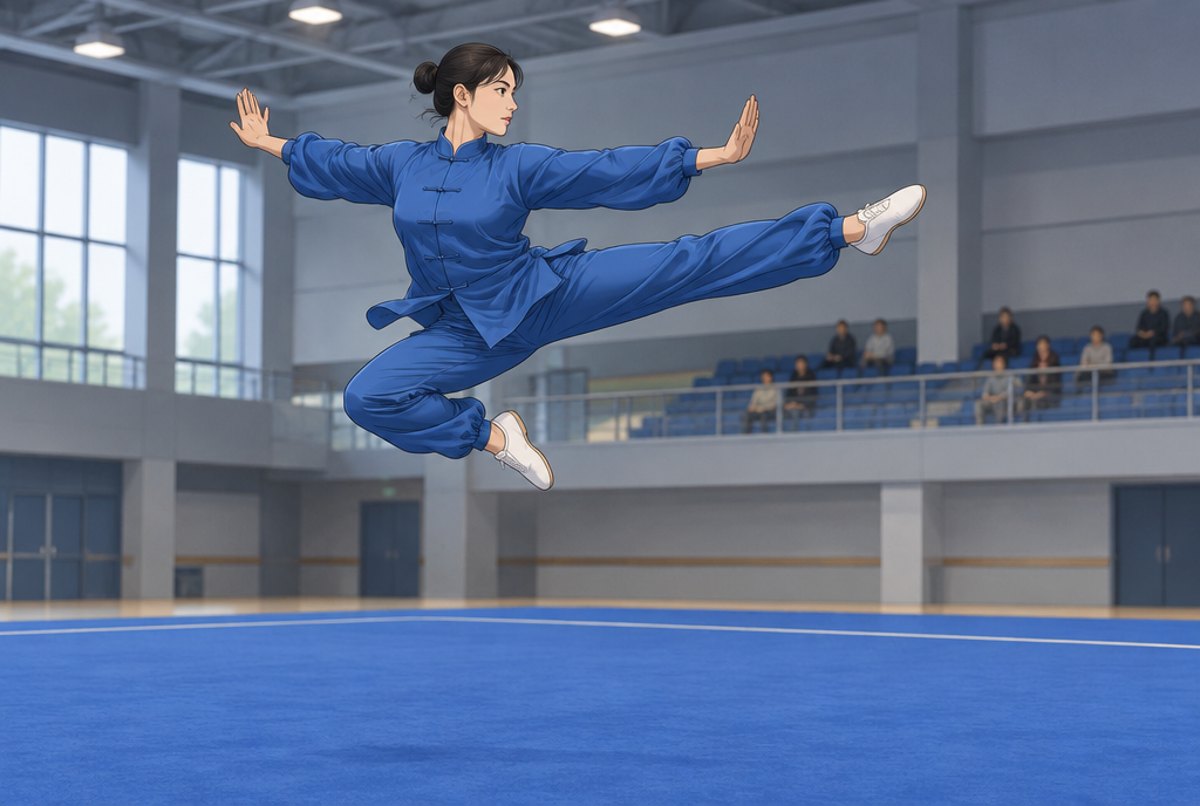
- Northern and wushu kicks, mostly in long fist: the front slap kick, crescent kicks, the , the and the , a jumping spinning kick with a slap of the foot. 11,46
- Southern styles kick less and lower. Some Wing Chun schools avoid high kicks, and Southern Mantis keeps its kicks low, short and quick. 6,11
Partner drills
| Drill | Name | What it is |
|---|---|---|
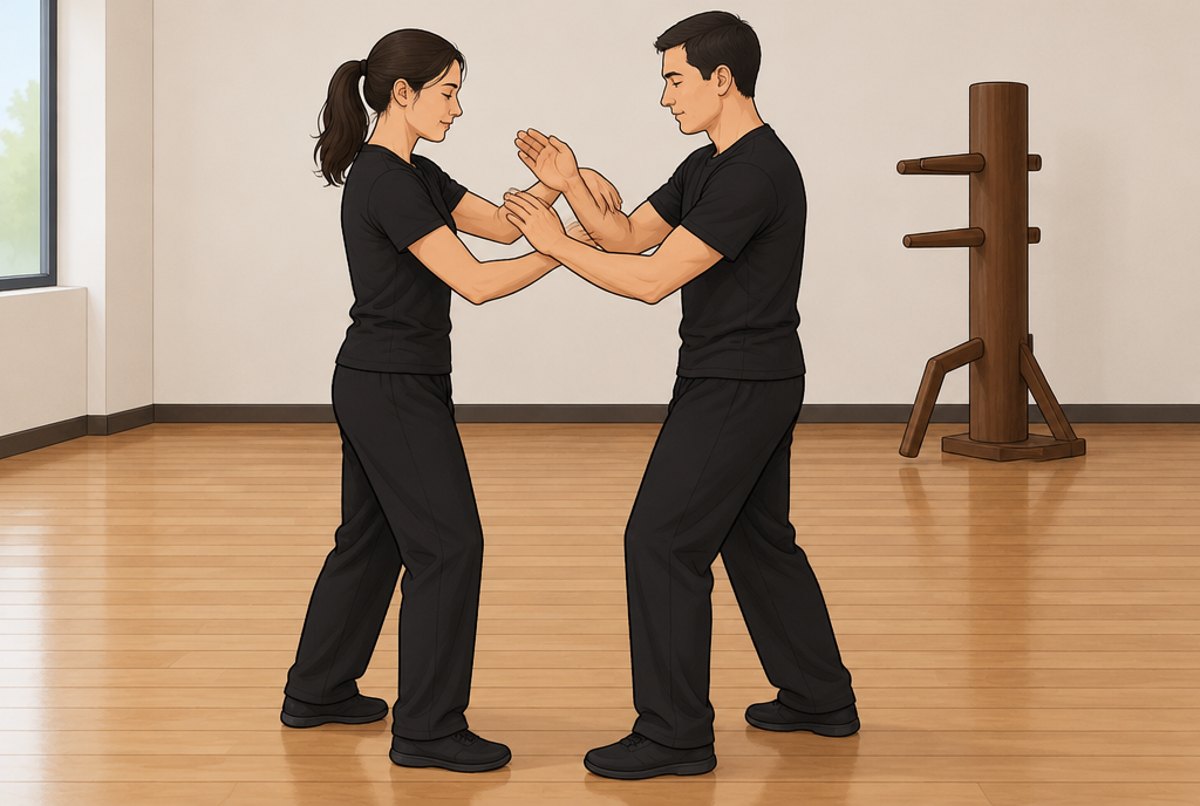
| Sticky hands | Wing Chun's signature drill: forearms in contact, partners roll, press and strike, learning to feel movement. Beginners start with single sticky hands, , then double, also called rolling hands, . The leg version is 6,105 | |
| Sticking hands, Lau Gar | An advanced form of fighting for brown and black sashes only, because no protective kit is worn 100 | |
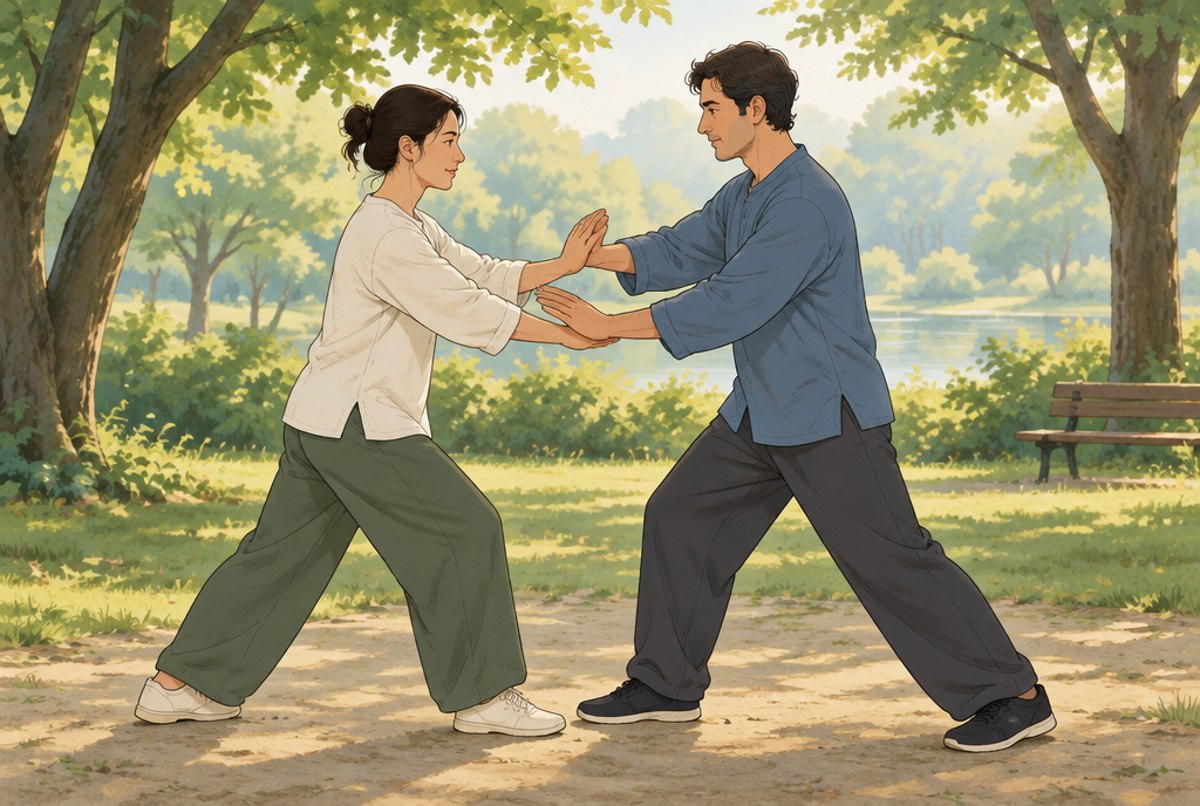
| Push hands | Tai chi partners keep contact and try to unbalance each other, learning to yield to force; also a competition 13,81,82 | |
| Set partner sequences | Two person sequences of attack and defence, with or without weapons; a competition event too 1,41 | |
| Free sparring | Unscripted fighting with rules. Optional in most BKFA clubs, though a basic level is needed for grading 1,100 | |
| Wooden dummy | A wooden post with arms and a leg, for practising against a solid target; Wing Chun has a form for it 6,103 |
Throws, locks and conditioning
- Throws and takedowns are allowed in sanda, in Chinese wrestling, , and in many traditional styles. A brings an opponent down by hooking or striking the legs. 1,43,84
- Joint locks, , are taught by some UK schools as part of self-defence or on special courses. 100,121
- Conditioning. Lau Gar lists hand and body conditioning; Hung Gar's Iron Wire is a strength form. 8,100
- Qigong, breathing and movement exercises, is taught alongside kung fu in many UK clubs; Shaolin Temple UK teaches beginners the . 13,17,119
Weapons, in outline
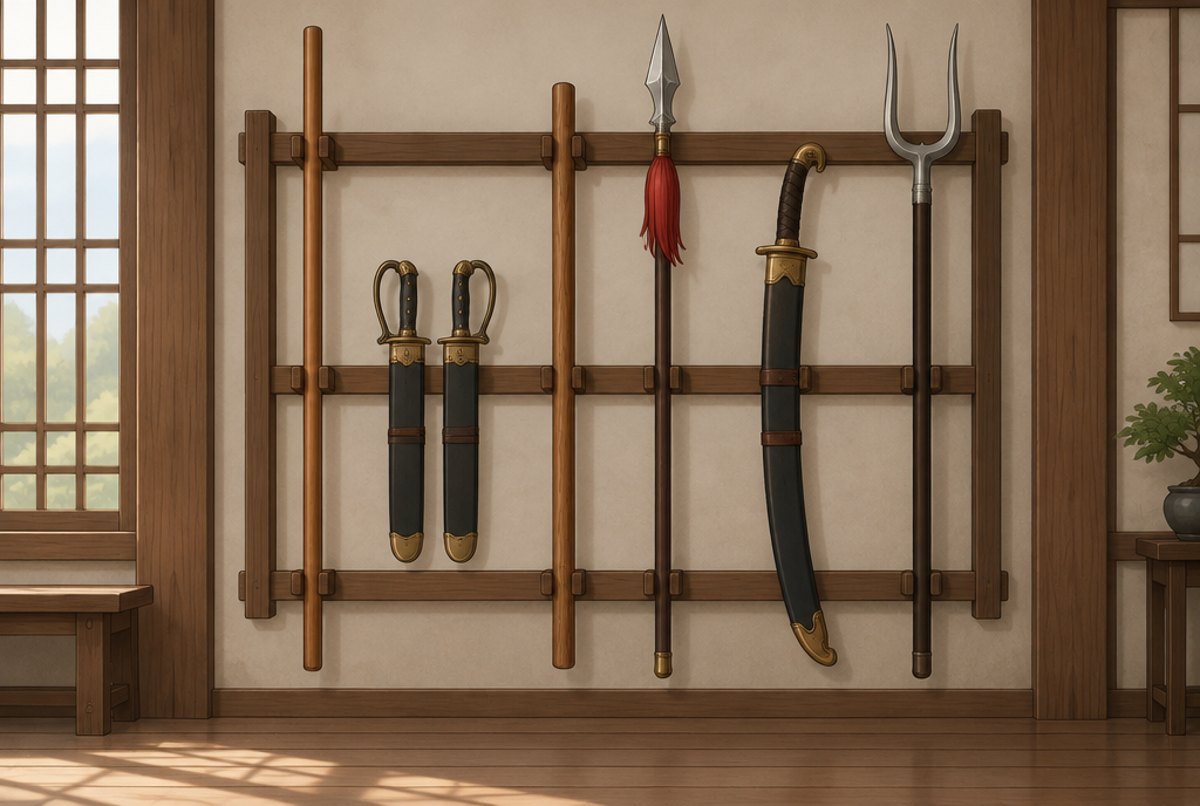
- Chinese styles traditionally speak of the , and most styles teach some weapons. 1
- The IWUF calls the staff, , the father of all weapons and the spear, , the king. Modern wushu also uses the broadsword, , the straight sword, , southern versions of the broadsword and staff, and in tai chi the fan, . 20,40,41
- Wing Chun has the long pole and the butterfly swords, . Lau Gar teaches the eyebrow staff, rat tailed staff, broadsword, butterfly knives, and spear. 6,100
- Weapons come later. Weapons training generally follows the basic unarmed forms; the BKFA says students must understand unarmed work first; and in Wing Chun the weapons are usually the last forms taught. 1,6,100
Safety in contact training
In BCCMA light sanda for 5 to 14 year olds there are no strikes to the head or face, strikes must use under 30% of full power, a knockout means disqualification, and full kit is compulsory. 84 In IWUF sanda, juniors and children may not punch continuously to the face or kick to the head unless the event's rules say otherwise. 43
Reading about a technique is for understanding it. Techniques, partner work and weapons are learned from an instructor, in a hall.