

The one thing every family should know: every style has its own forms, and even schools of the same style may teach them in a different order or a different way. Modern wushu adds a separate set of standard , the same for everyone worldwide. A student who changes style learns completely new forms. 6,41,51
Forms are set sequences of movements done alone, or in pairs, against imaginary opponents. In Mandarin they are ; UK southern style schools often say sets; and many form names end in , fist. 1,6,100
Wing Chun: six forms
| Order | Cantonese | Chinese | Meaning | In brief |
|---|---|---|---|---|
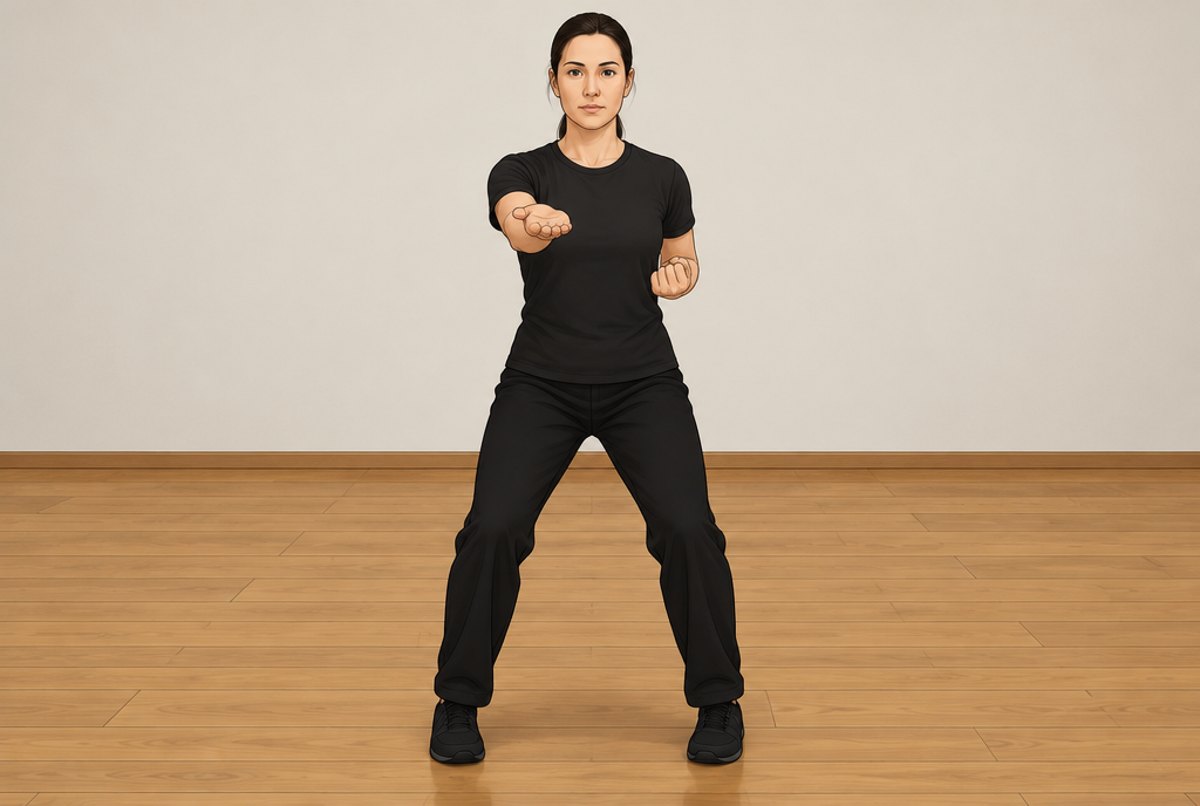
| 1 | 小念頭 | Little idea | Standing still in the training stance: structure, relaxation, the centre line. Taught first and practised for life | |
| 2 | 尋橋 | Seeking the bridge | Turning, stepping, kicks and elbows; using the whole body and closing the gap | |
| 3 | 鏢指 | Darting fingers | Emergency techniques to recover a lost position; some say it was taught only to trusted students | |
| 4 | 木人樁 | Wooden man post | The techniques applied against the wooden dummy | |
| 5 | 六點半棍 | Six and a half point pole | A long pole, 8 to 13 feet, about 2.4 to 4 metres | |
| 6 | 八斬刀 | Eight cutting knives | A pair of butterfly swords, usually the last form taught |
Sources: 6,102,103,105. The first form varies a great deal between branches. 6
Hung Gar: four core forms
In Wong Fei-hung's lineage the core is four empty hand forms; other branches differ a great deal in their other forms and weapons. 8
| Cantonese | English | In brief |
|---|---|---|
| Taming the Tiger | A long form that teaches the basic techniques and builds stamina; said to go back to the legendary monk Jee Sin | |
| Tiger and Crane | Builds on Taming the Tiger; the version handed down in his lineages is credited to Wong Fei-hung | |
| Five Animal Fist | Five Animals | Dragon, snake, tiger, leopard and crane; in the Lam Sai-wing branch, the Five Animal Five Element Fist |
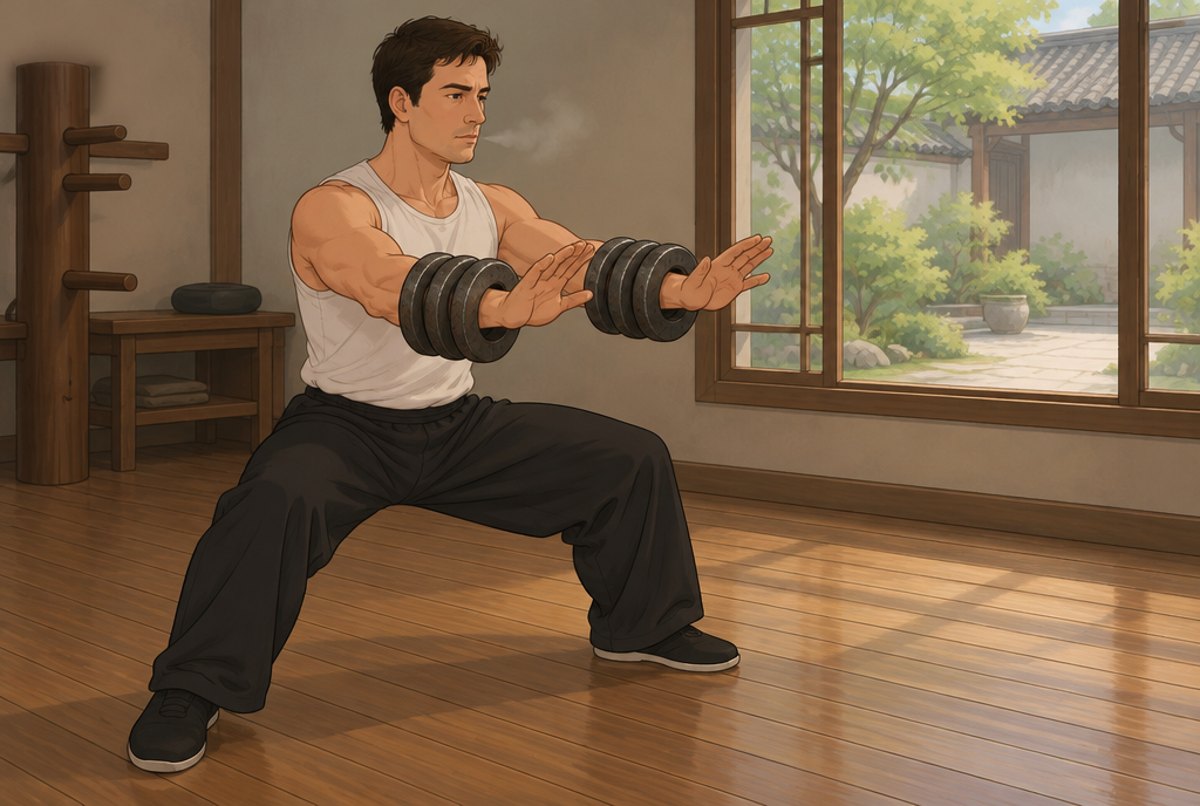
| Iron Wire | Breathing with dynamic tension, traditionally sometimes with iron rings on the wrists |
Sources: 8,112,123. Hing Chao calls Taming the Tiger, Tiger and Crane and Iron Wire the "three treasures" of the Lam family line. 123 Five Pattern Hung Kuen and other Hung lines do not practise Wong Fei-hung's forms. 8,111 Weapons in the Wong Fei-hung curriculum include the Fifth Brother Eight Trigram Pole and the Mother and Son Butterfly Swords. 8
Other southern styles
- Lau Gar. The British Kung Fu Association names some sets on its national courses: its brown sash course includes , Charp Choi and Lau Gar Luk Hap Kuen, and its weapons course covers the black sash syllabus from 2nd to 6th degree, including a broadsword form and staff forms. The full order is not published. 100
- Choy Li Fut has over 150 forms: empty hand, multiple person, weapon and training apparatus forms. Which are taught in the UK depends on the branch. 9,114
- White Crane. Fujian styles take , three battles, as a foundation. Tiger Crane Kung Fu's teaching videos name Yongchun White Crane forms, in the school's own spelling, such as 7 Steps 3 Battles, 13 Shaking Steps and White Crane Spreads Its Wings, with weapon forms for the staff, double knives and short forked rods. 8,113,116
- Shaolin schools each have their own forms. Manchester Shaolin Nam Pai Chuan lists Sah Poh Poo 1 and 2, the three step form, at its first two yellow belts; Ee Kee Boay, the first finger form, at 1st green; and Cheet Cheh, the seven immortals crossing the ocean, at 2nd green. 121
Northern styles
- Northern Shaolin, in the line of Gu Ruzhang, has 10 classical forms, with introductory routines such as , springing legs; some lines teach them in a different order. 11
- Northern Praying Mantis has core forms including Beng Bu, Luan Jie, Fen Shen Ba Zhou, Quan Zhong Zhai Yao and Fan Che, and its sources disagree about which are the original ones. 11
Tai chi forms, as kung fu clubs teach them
| Form | What it is |
|---|---|
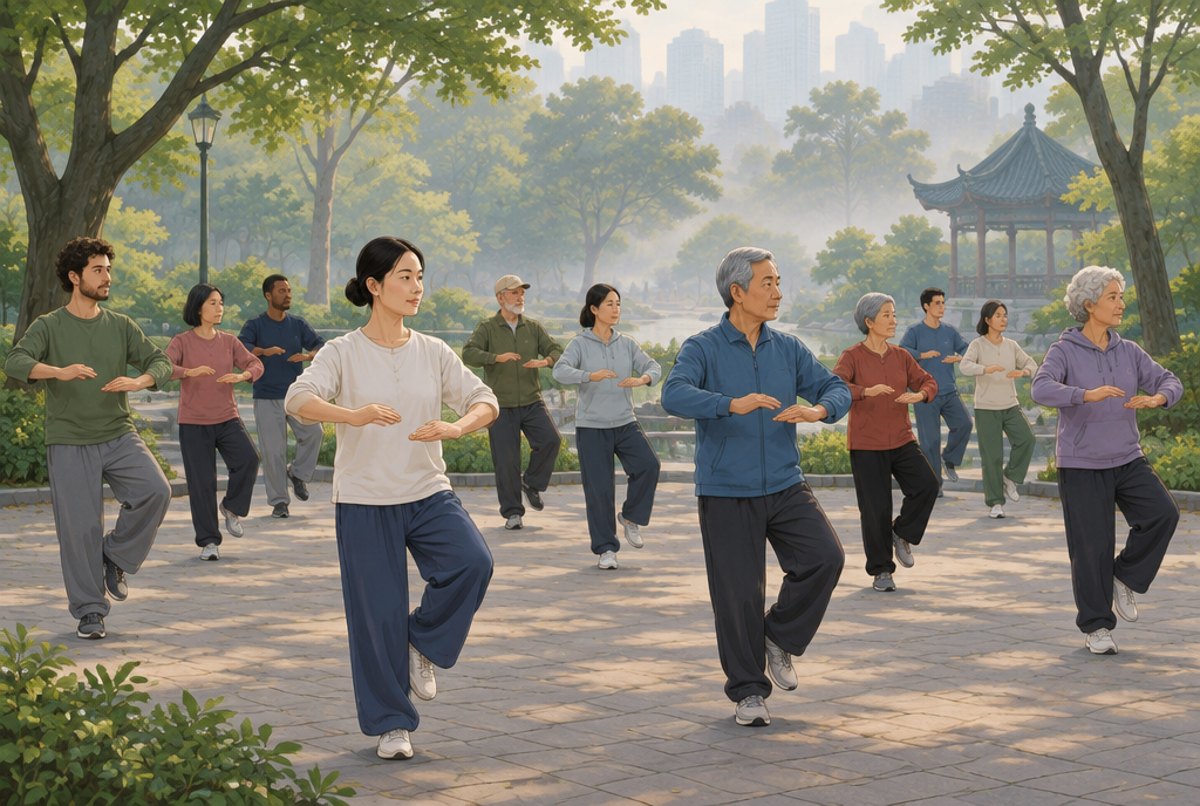
| The 24 movement simplified Yang form, created in 1956 for China's sports committee as a shorter form for health | |
| 42 movement competition forms | Compulsory competition routines for taijiquan and the tai chi sword |
| Yang family long forms | Some teachers use a 103 movement version; numbers differ between teachers |
| Chen style Old Frame | The Chen village forms: the first form, Yilu, and the second, Erlu, or Cannon Fist |
Modern wushu routines
- Optional routines are each athlete's own, built within the IWUF's rules on difficulty and content. Adult long fist, southern fist and weapon routines last 1 minute 20 seconds to 1 minute 35 seconds. 41
- Compulsory routines are fixed. The IWUF brought them into the world championships in 1993, added a second set in 1999, stopped using them at world level in 2005, and brought in a third set from 2013. 14 The 3rd Set is used at the Dakar 2026 Youth Olympic Games. 45
Movements in each compulsory routine, as the WKFE's 2026 regulations give them 51
| Event | 1st Set | 3rd Set |
|---|---|---|
| Changquan, long fist | 62 | 59 |
| Nanquan, southern fist | 65 | 63 |
| Taijiquan | 42 | 36 |
| Jianshu, straight sword | 53 | 64 |
| Daoshu, broadsword | 58 | 53 |
| Nandao, southern broadsword | 68 | 63 |
| Taijijian, tai chi sword | 39 | 39 |
| Taijishan, tai chi fan | Not in the 1st Set | 40 |
| Qiangshu, spear | 53 | 54 |
| Gunshu, staff | 50 | 51 |
| Nangun, southern staff | 68 | 66 |
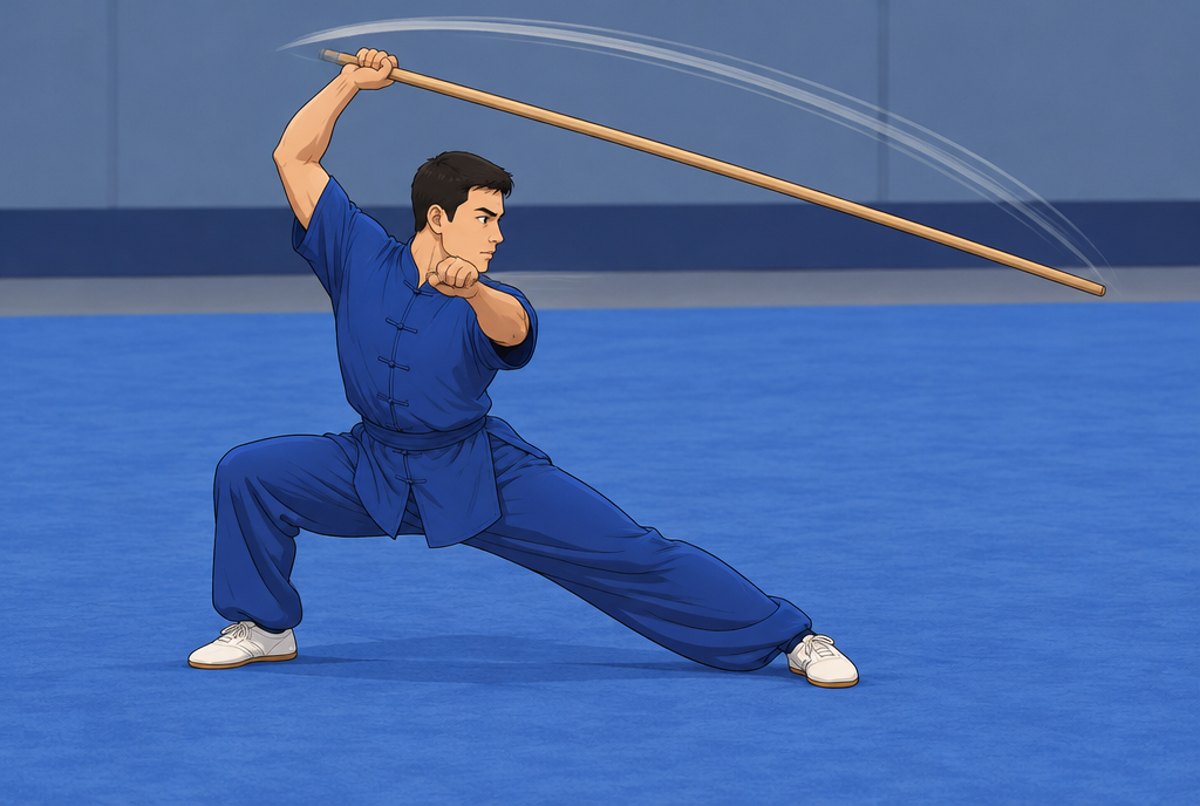
The IWUF publishes free teaching videos for every 3rd Set routine on its WUSHU TV channel, and bilingual teaching books for the four Youth Olympic routines; both are linked on the sources page. 46,47
Traditional forms in competition are grouped by family: northern, southern, taiji, and imitative and other styles such as eagle, mantis, drunken, monkey, xingyi and bagua, with weapon groups alongside. 51