

The one thing every family should know: a kickboxing belt means what the body or club that gave it says it means, and nothing more. , the world body, published a belt scheme in 2024 and calls it "highly recommended but OPTIONAL" for its national members. publishes no grading syllabus, belt list or fee on its site. The WKA and WKUWORLD run schemes of their own. Many clubs, especially competition gyms and fitness classes, do not grade at all. So ask: do you grade, whose syllabus is it, and is the grade recognised outside this club? 40,47,58,61,80
Clubs with no grades
- Competition is organised by age, weight and experience, not by belt. WAKO's categories are set by year of birth and weight, and a is defined by training time and events entered, not by grade. 41,43
- ISKA Europe sorts fighters by wins: novice under 3, C over 3, B over 6, A over 12. 55
- In WAKO a belt is optional and, if worn, should show the grade; in and a belt showing a grade is not allowed. 41
- Fitness classes do not usually grade. 92
WAKO's optional scheme
Approved as an optional system by WAKO's board on 29 November 2024 and updated in April 2025; a member from Great Britain sits on the committee that wrote it. 47 WAKO's black belt directory lists certificates issued since 2019. 40
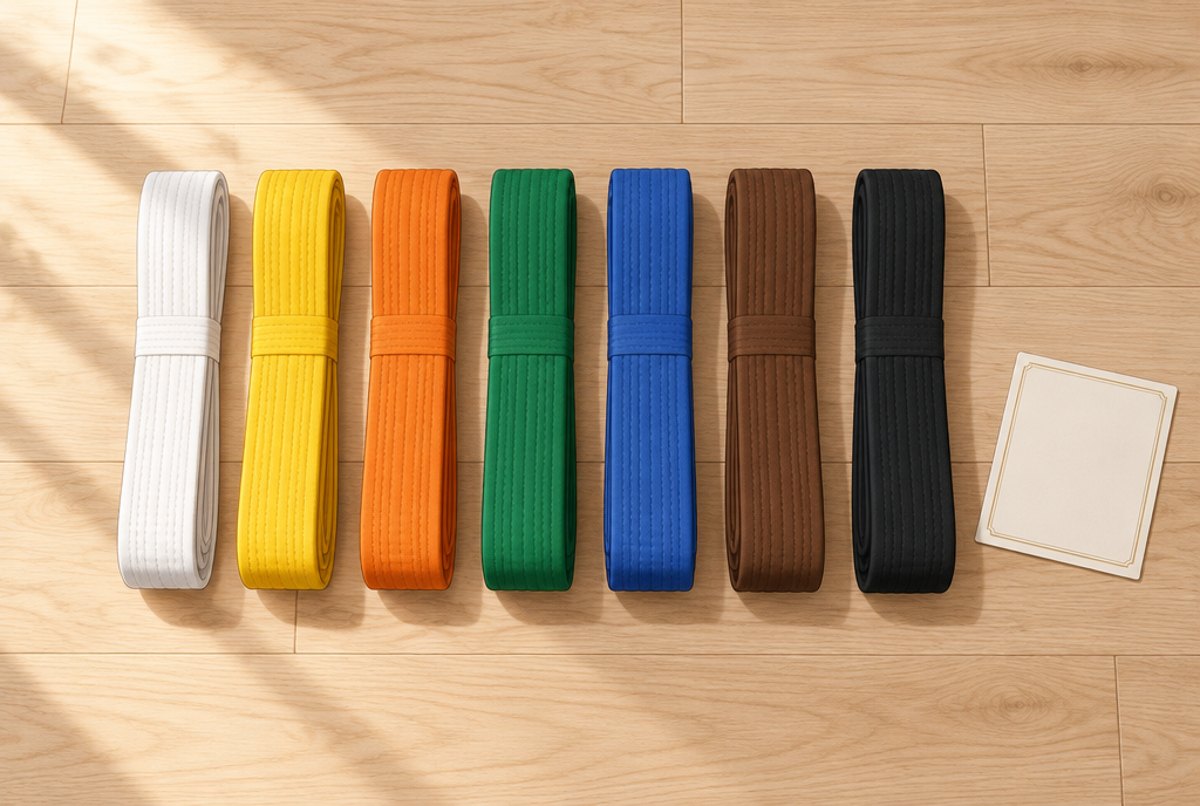
| Step | Minimum time | Other conditions |
|---|---|---|
| White to yellow | 6 months of regular training | |
| Yellow to orange | 6 months | |
| Orange to green | 6 months | A seminar with a regional coach; two regional competitions a year, or a musical form or aerokickboxing routine for non competitors |
| Green to blue | 6 months | Controlled sparring; a seminar; a national competition, or a musical form for non competitors |
| Blue to brown | 6 months | Free sparring; two seminars; a national competition |
| Brown to black, 1st Dan | 12 months | At least 16 in the year of grading; a short written paper on kickboxing history |
| 1st to 2nd Dan | 2 years | |
| 2nd to 3rd Dan | 3 years | |
| 4th to 7th Dan | 5, 6 and 7 years between grades | Graded at an international WAKO seminar; a thesis |
| 8th to 10th Dan | At least 35 years in kickboxing and WAKO; awarded by WAKO's board |
All rows from WAKO's grading programme. 47
- Who grades. National federations grade from white belt to 3rd ; WAKO's committee grades 4th to 7th; the board awards 8th to 10th. National federations may issue their own black belt certificates and set their own fees. 47
- What each grade holds. Fitness work, guards, footwork, blocks, punches, kicks, combinations, tactics and theory, all on both sides. The content is WAKO's and is only summarised here. 47
- Competition is part of it. Some colour grades ask for a regional or national competition, with a musical form or routine as the alternative for non competitors. 47
- Certificate fees: €100 for 1st Dan, rising to €450 for 7th; 8th to 10th are free. 47
- How long to black belt: two and a half years from white to brown and one more to black under the minimum times, and only from 16 in the year of grading. Real times are usually longer. 47
- Kickboxing GB. Whether its clubs use WAKO's programme is not confirmed; Kickboxing GB publishes no syllabus or grading fee. 80
- Kickboxing Ireland asks clubs to send instructors' Dan grades and the year's black belt certificates to its national secretary; its colour belt scheme is not published. 88
Other bodies' schemes
| Body | What it publishes |
|---|---|
| WKA International | Coloured belt certificates through approved examiners; 1st to 4th Dan graded by a local examiner, 5th to 9th approved centrally from a CV. A 4 to 5 hour 1st Dan test (techniques, pad work, controlled sparring, conditioning) for students with high attendance over about 4 years; 2nd Dan after 2 more years; 3rd after 3 years and 5 years as an instructor; up to 40 years of experience for 9th Dan. Colour belt order not published 58 |
| WKUWORLD | Three strands. Pandas, 3 to 7, move through 12 steps on a white belt with a coloured stripe; children wear coloured belts with a white stripe through the middle and may earn a children's black belt; adults wear plain white, yellow, orange, green, blue, brown and black with optional half grades. Minimum ages: brown 16, 1st Dan 18, 2nd Dan 20, rising to 9th Dan at 60. Its website says the programme runs to 5th Dan; its 2020 programme sets ages up to 10th Dan, at 70 60,61 |
| ICO | Five levels of coaching awards; student grades not confirmed 62 |
| ISKA | No student grading scheme published 54,57 |
Kickboxing inside other styles
- Lau Gar kickboxing in the British Kung Fu Association uses that association's sash grades. 100
- Contact karate bodies affiliated to Kickboxing GB, such as the ECKA, grade their own way. 93
- Clubs that teach kickboxing beside karate or taekwondo often use that style's belts; not confirmed for any particular club. 141
Children
- WAKO has no separate children's scheme; the same programme applies, but black belt candidates must be at least 16 in the year of grading. 47
- WKUWORLD is the one body here with separate preschool and children's belts. 61
- Competition ages are separate from grades. A WAKO child can compete in point fighting from the year they turn 7, whatever their belt. 41,43
Questions families ask
- Will a grade carry over if we change club? Only if both clubs use the same body's scheme. WKUWORLD asks people from other bodies to show their level at an official Dan grading. 61
- Is a kickboxing black belt the same as a karate one? No; each body sets its own standard. 47,58,61
- Grading fees for colour belts are not published by any UK body. 80