

Every academy runs things a little differently, so in places the honest advice is "ask the academy". Prices below are as published on 26 October 2026 and will change.
Before you go
- Ask which team and rules the academy follows. Many UK academies belong to a team, such as Gracie Barra, Roger Gracie, Carlson Gracie, Checkmat, Alliance or 10th Planet, or are independent; the team affects the curriculum, the children's belts and the competitions on offer. 100,102,105,141
- Ask whether the club is a UKBJJA member. A UKBJJA member club must have every instructor listed with the association, each with an enhanced DBS check, PVG in Scotland or Access NI in Northern Ireland, done or verified by the UKBJJA within three years, an in person first aid course and safeguarding training; insurance is only valid if those are in place. The club must also have a risk assessment, an accident book, a first aid kit, 40 mm mats with minimal gaps, a cleaning policy, a rule that jewellery comes off, and "zero tolerance" for skin infections. 82,83,86
- Questions any parent can ask. The NSPCC publishes five questions to ask a child's sports club. In England, the Safeguarding Code in Martial Arts is a quality mark with a public map of clubs that hold it. 121
- Trial classes. Many academies offer one: the Roger Gracie Academy's free induction, 15 minutes with an instructor and then a one hour fundamentals class; Gracie Barra's free class; a 10 day free trial for children at Gracie University training centres; three private introductory lessons at Alliance before group classes. 101,102,104,106
- Arrive early. The Roger Gracie Academy asks first timers to come 20 minutes before the class. 104
What to wear and bring
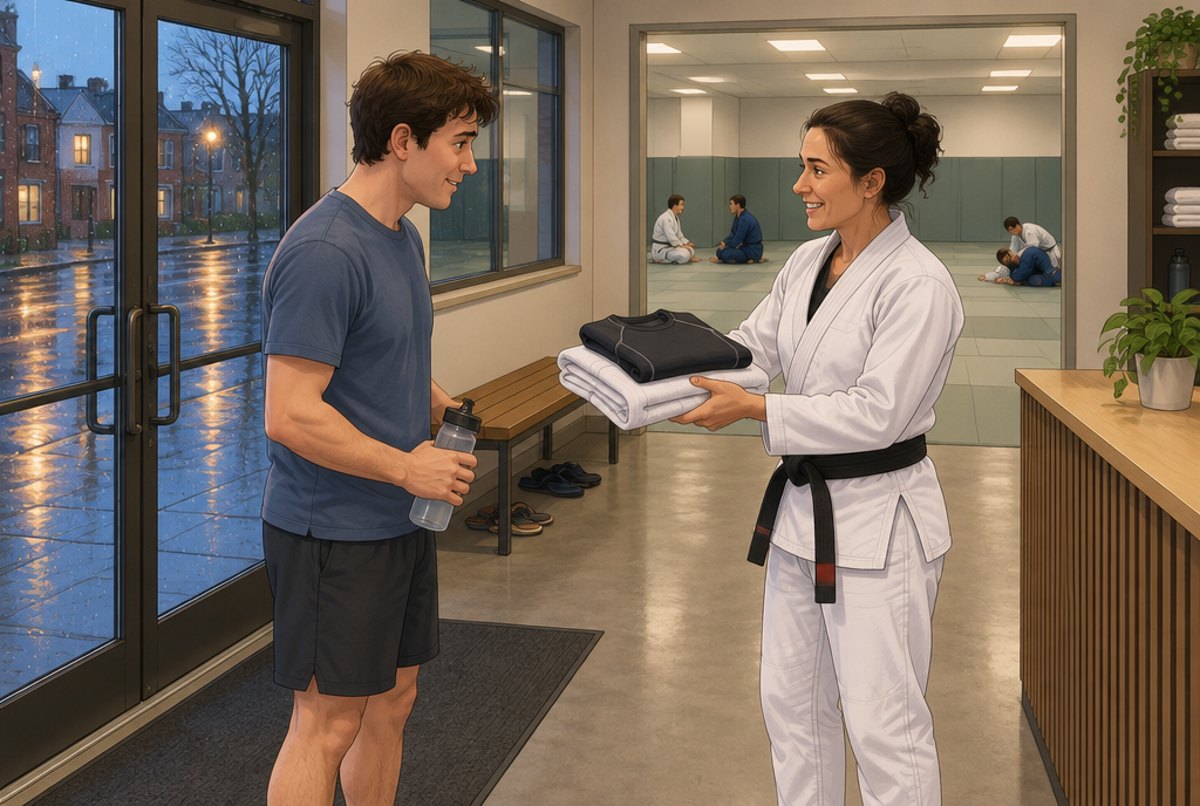
- First class: comfortable sportswear, shorts or leggings and a T-shirt, a water bottle and flip flops or sliders. Gracie Barra lends a gi and rash guard for the first class; the Roger Gracie Academy gives a gi in a welcome pack but asks you to bring your own T-shirt or rash guard to wear under it. 100,104
- Feet covered off the mat, bare feet on it. Footwear between the changing room and the mat protects feet and keeps the mat clean. 100,104 At IBJJF events athletes must wear footwear up to the mat. 43
- Later, a gi. At IBJJF competitions the gi must be one colour, white, royal blue or black, clean, untorn and correctly sized, with the belt tied in a double knot; women must wear a stretchy top under the gi. 43 Some teams ask for their own uniform from a certain level; Gracie Barra from GB2. 100
- For no gi: a rash guard and shorts; women may wear leggings. 43
- Mouthguard: recommended by Gracie Barra once sparring starts. 100
- Religious head and hair coverings are allowed for all genders in training and UKBJJA competitions if secured safely, with no hard parts or strings. 87 The IBJJF allows head covers in female divisions under set conditions. 43
- Nails short, long hair tied back, jewellery off. These are IBJJF competition rules and UKBJJA club guidance; where a piercing cannot come out, the UKBJJA allows a qualified coach to decide whether it may be taped. 43,86
Etiquette
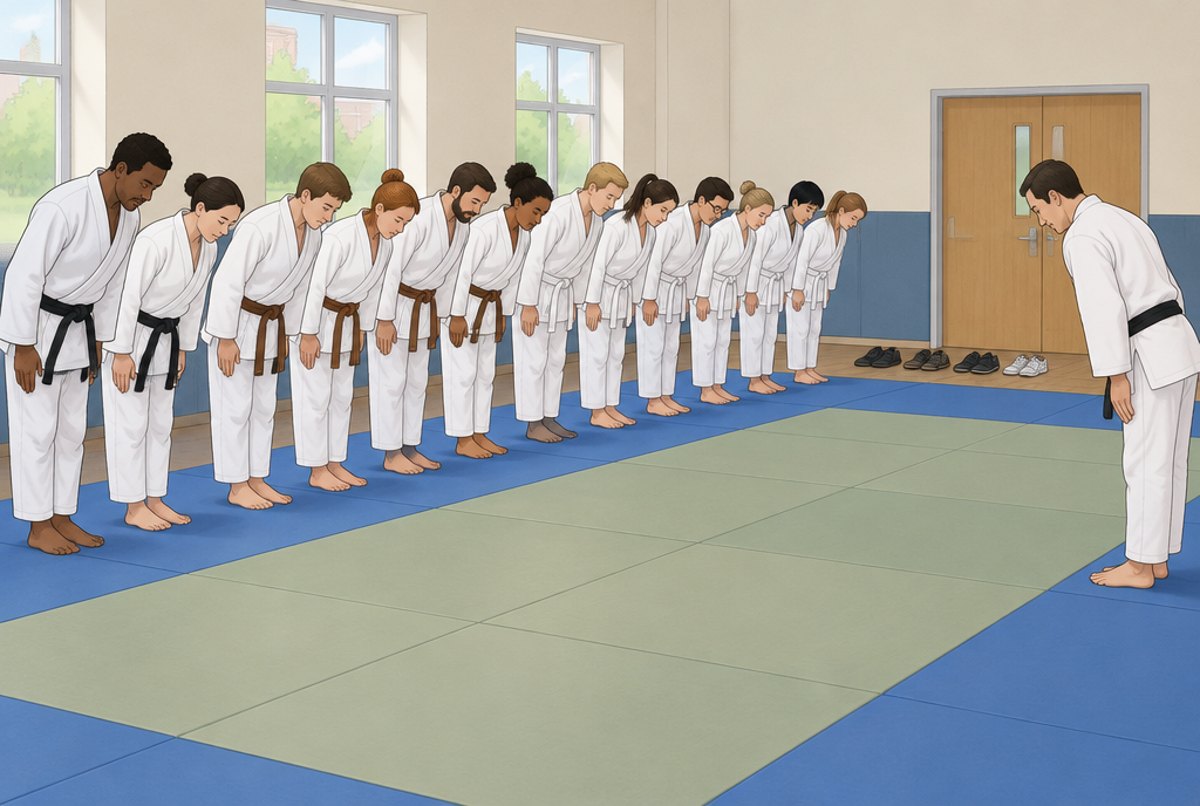
Customs vary, and some academies are more formal than others, but most share these: shoes off before stepping on the mat, and in some academies a bow when stepping on and off; lining up in order of rank at the start and end of class; addressing the teacher as coach or professor; keeping the gi closed with the belt; bowing or shaking hands before and after each roll; covering any cut with tape or gauze; good hygiene; and treating a roll with a senior belt as a privilege. 1 Some academies say as a greeting or acknowledgement. 25
Hygiene and skin infections
Jiu-jitsu means close contact on shared mats, so hygiene matters more than in most sports.
- Wash the gi after every class. The Roger Gracie Academy says so plainly, at no more than 40 degrees and out of the tumble dryer. 104 The IBJJF does not allow a wet, dirty or smelly gi at its events. 43
- Common infections. The skin problems grapplers are most at risk of are ringworm, impetigo, herpes gladiatorum and staph infections. Prevention: mats cleaned regularly, a shower with soap straight after class, cuts disinfected and covered, kit washed before the next class, no sharing of towels or uniforms. 1,24
- Do not train with a skin infection. The UKBJJA says nobody should train or compete with one, coaches should be able to spot the signs, and clubs must have a zero tolerance policy. Anyone bleeding or with an open wound should not train until it is treated. 82,86 At UKBJJA events anyone with symptoms of a skin infection may not compete; at IBJJF events a gi inspector checks athletes' skin after weigh in. 43,85
- What the NHS says. Impetigo is very contagious through skin contact, and the NHS advises not going to the gym or playing contact sports until it is no longer contagious. Ringworm spreads by close contact. Cold sores are contagious from the first tingle until fully healed. 120 For medical advice, follow the NHS. An academy may ask a student to stay off the mat longer than the NHS advises; that is the academy's own practice.
- Cauliflower ear. Repeated rubbing can damage the ear, and without prompt treatment the cartilage can become permanently swollen; some people wear wrestling headgear to prevent it. 1
Tapping and safety
- Tapping is the most important skill. The UKBJJA's safety policy says "Tapping is training!" and that every beginner must understand that tapping is a normal, healthy part of jiu-jitsu and the personal responsibility of every player. Holds must be applied with control, giving the partner time to tap, and released the instant they do. Students should tap before there is pain or injury. 86
- How to tap: pat the partner, the mat or yourself twice, clearly; tap with a foot if your arms are trapped; or say so. 43
- Chokes. The UKBJJA warns coaches about the risks of chokes and says anyone choked unconscious should stop for that class and not train for at least a week; beginners should learn the signs that a partner is unconscious. 86
- Slams and fouls. Beginners should be told from the first class about the dangers of slams and about fouls such as grabbing fingers or putting fingers in the eyes or mouth. 86
- Medical conditions and warm up. New students should say if they have a relevant condition, for example asthma or diabetes, and keep any medication with them; there should always be a warm up before sparring. 86
- Space and numbers. The UKBJJA recommends about 2 square metres per person for live sparring and no more than 24 students per qualified coach. 86
- For parents. The UKBJJA's junior policy asks parents never to shout to a child not to tap, and not to coach from the side of the mat. It also says children should not do intense training or physical conditioning before they are physically mature. 84
- How safe is it? Studies of competitions suggest jiu-jitsu has fewer injuries than mixed martial arts, boxing, judo or taekwondo, though the studies were done in different ways. Most injuries are to joints and the neck; head injuries are rare. 1
What a class usually contains
Classes vary, but most follow this shape:
- Bowing in or lining up, then a warm up; the UKBJJA says there should always be one. 1,86
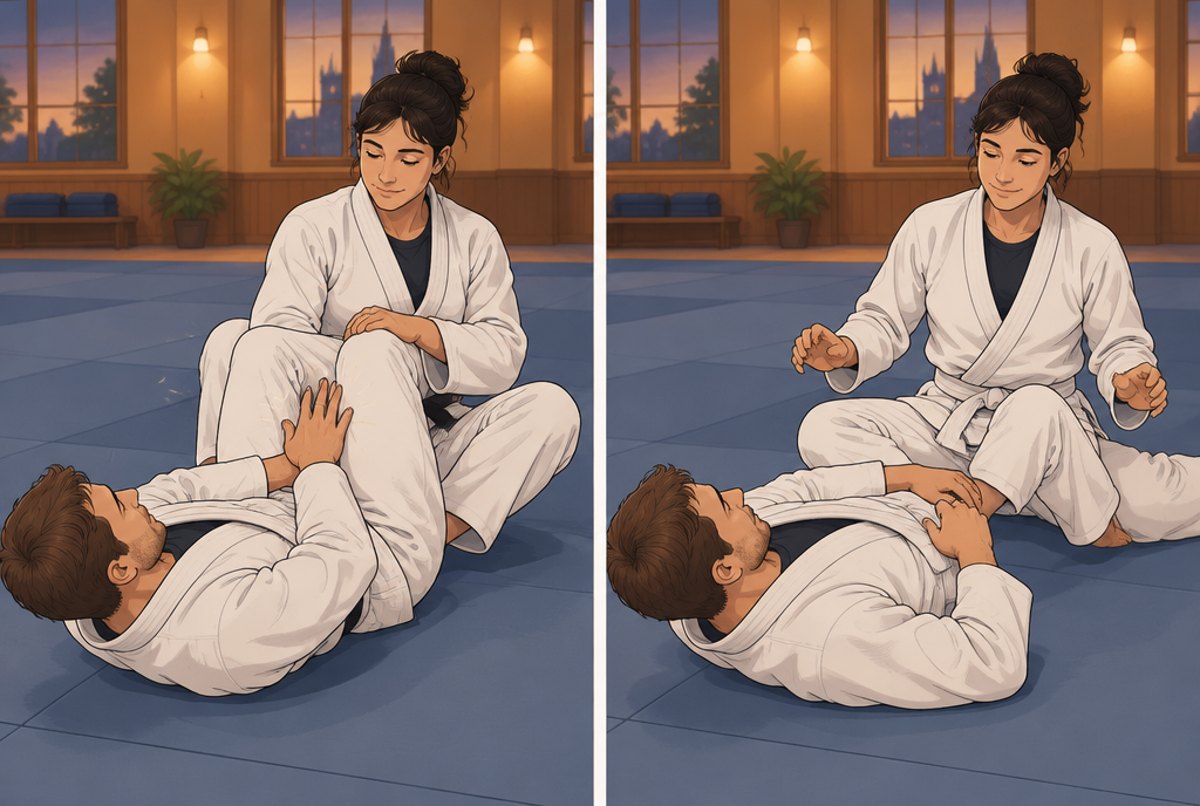
- Technique: the instructor shows a move, then pairs drill it on a partner who does not resist, then on one who resists. 1
- Positional sparring: rounds that start in one position, for example guard, with a limited goal. 1
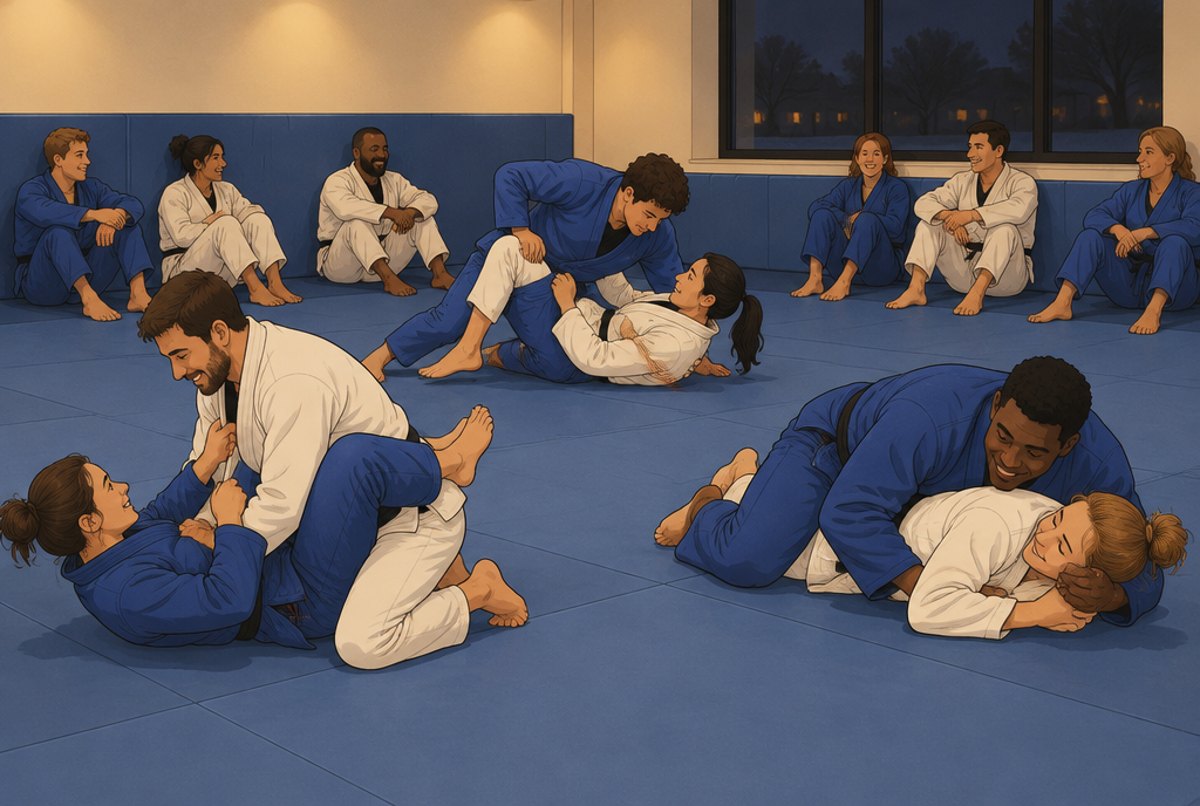
- Rolling, free sparring, usually towards the end, and often called the most essential part of training. 1
Beginners are often kept apart from live sparring at first: Alliance runs its first 60 classes as drilling only, and Gracie Barra moves students into GB2, with live sparring, after three white belt stripes, usually at least four months. 100,102 The Roger Gracie Academy's group classes last an hour. 104 Children's classes are run in age groups and often use games, Gracie University's "Gracie Games" for example. 105,106
Questions families ask
What age can my child start? Gracie University has a programme from 3, with parents joining in; Alliance and the Roger Gracie Association start at 4; the IBJJF's children's belts start at 4. 40,102,105,106 Adults can start at any age; the IBJJF has masters divisions from 30 upwards with no upper age. 43
Do I need to be fit? The Roger Gracie Academy says no; classes are for complete beginners as well as experienced students. 104
Are there classes for women? Several teams run them: Gracie Barra's GBF programme, Alliance's women's classes "developed by women for women", and Gracie University's Women Empowered self-defence course. The UKBJJA has a Women's Committee and held International Women's Day events in Birmingham in 2026. 80,81,100,102,106
Does my child have to compete? No. Competing is encouraged, but most academies do not require it for promotion. The UKBJJA runs a low cost, low pressure Kids League that gives no ranking points, and free Junior Development Days for 7 to 15 year olds. 2,89
Is it self-defence? Most teams say they teach self-defence as well as sport; Gracie University's beginner course is built around it. 100,104,106
What will it cost? UKBJJA individual membership is £15 a year, in the insurance year from 24 October 2025. 82 The Roger Gracie Academy's FAQ describes monthly and yearly memberships, a 10 day cooling off period and 60 days' notice to cancel, but publishes no prices. 104 For class fees and gi prices, ask the academy.