

Read this first. Jiu-jitsu is unusual among martial arts: most academies have no grading test. The belt is given by the student's own professor, at the professor's discretion, on what the professor sees in class and in rolling. 2,40 Where a test exists, it belongs to the team, and the team's own syllabus is the only one that counts. The examples here are a general picture built from published documents. They are not any team's syllabus, and they vary on purpose between teams.
What the published systems share
- Time and activity. Every published system sets minimum times at each belt and counts activity: the IBJJF's minimum times and ages, Alliance's counted classes, Gracie Barra's three stripes before GB2. 40,100,102
- Live performance. What a student knows, and how well they use it in rolling, in the academy or in competition, counts most. 2
- Safety knowledge. The UKBJJA expects beginners to know how to tap, how to breakfall, and which techniques are fouls, from the first class. 86
- Lineage. Under UKBJJA club rules an instructor's own promotions and timescales must be verifiable; under IBJJF rules a black belt promotion must be signed by a black belt with at least two certified degrees. 40,82
Three real examples of how it varies
- Alliance: promotion by counted classes, stripes and belt exams; 1,275 adult classes and 16 stripes from white to black; the first 60 classes without sparring. 102
- Gracie University: a Combatives belt by video test after the 36 Gracie Combatives techniques; blue to black only by live testing at a Certified Training Center; black belt by invitation at Torrance. Belts from elsewhere are "unverified" until the Combatives test is passed. 106
- Most academies: no set test. The IBJJF says the time to black belt "is at the professor's discretion" and sets no syllabus. 2,40
Three teams, three answers, and a professor in any of them may add expectations of their own.
Practice set: 15 example questions
These are examples of the kind of question a theory section might ask, if an academy had one. Each answer shows its source. An instructor may want a different answer, a different spelling or a different rule, and the instructor is right for that grading.
- Who brought the art that became jiu-jitsu to Brazil, and when? Mitsuyo Maeda, known as Conde Koma, who reached Brazil in 1914. 4
- Why is it called jiu-jitsu rather than judo? When Maeda arrived, judo was still widely called Kano jiu-jitsu or simply jiu-jitsu, and Brazilian newspapers used that name. 1,4
- What does arte suave mean? The gentle art, a name for jiu-jitsu. 80
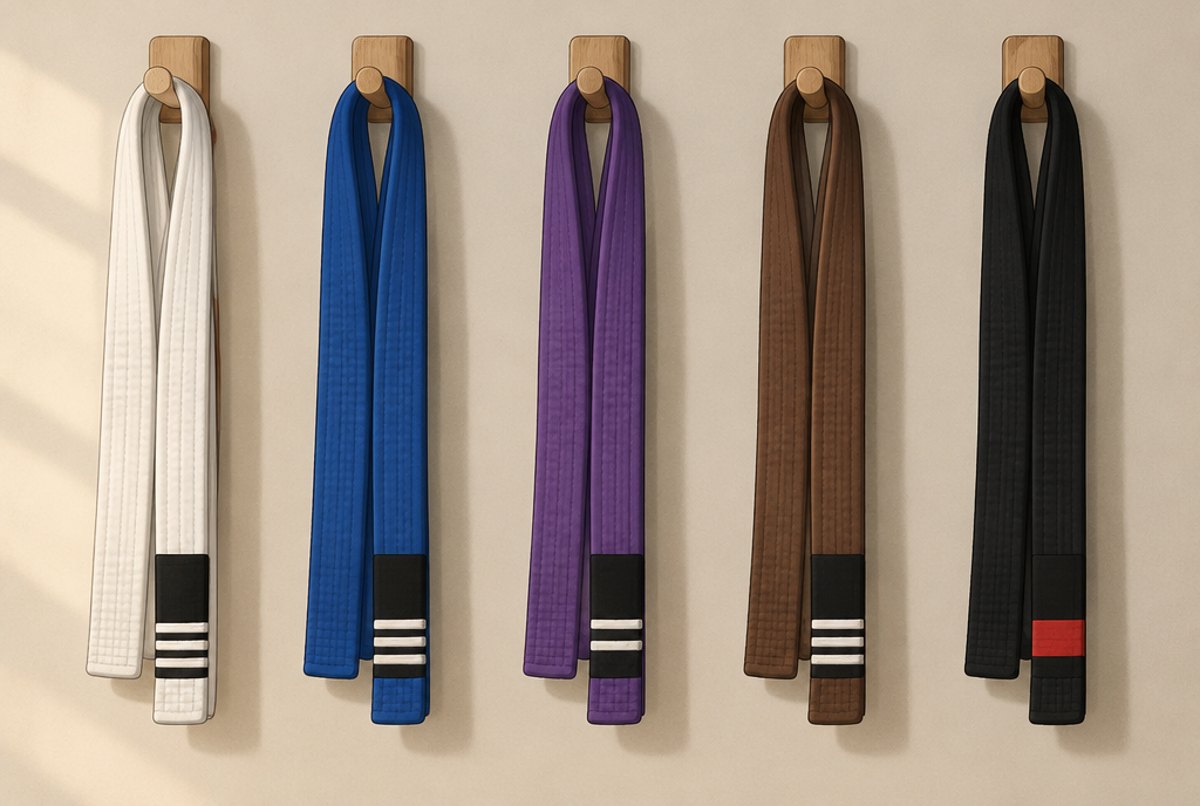
- What are the five adult belts, in order? White, blue, purple, brown, black. 40
- What are the five children's belt colour groups, and from what age does each start? White at any age; grey from 4; yellow from 7; orange from 10; green from 13. 40
- Under IBJJF rules, what scores 2, 3 and 4 points? A takedown, sweep or knee on belly 2; a guard pass 3; mount or back control 4, each held for three seconds. 43
- How do you tap? Pat the partner, the mat or yourself twice, clearly; tap with a foot if your arms are trapped; or say so. 43
- What is the guard? The person underneath uses one or both legs to stop the top person getting past to their side; a position to attack from, not only to defend. 1,22,43
- What do combate, parou, lute and falta mean? Start; stop; fight, the penalty for stalling; foul. 43
- Why is the kimura called the kimura? After Masahiko Kimura, the judoka who beat Hélio Gracie with the lock in 1951. 6,22
- What is cem quilos? A hundred kilos, the Portuguese name for side control. 1
- What is a stripe, and what is it called in Portuguese? A mark on the belt's bar showing progress within a belt; grau. 2,8,40
- Who gives a student their belt? The student's own professor; the IBJJF sets only minimum ages and times, and the UKBJJA does not award belts. 2,40,80
- When was the UKBJJA formed, and when was it recognised by all four home nation sports councils? Formed in 2012; recognised in 2021. 80
- Which holds are banned for every division at IBJJF events? Slams, spine locks without a choke, the scissor takedown, bending fingers back, throwing an opponent on their head by the belt when defending a single leg, and suplexes onto the head or neck. 43
Questions only your professor can answer
Your own team's curriculum and the order it teaches techniques, how many classes or months your professor expects at each stripe, what your academy's children's belts are called, your team's own history questions, and anything about fees or dates. Those come from your professor. 2,40,100,102,106