

Jiu-jitsu's rules change often, and there is no single rulebook, so every rule here carries its date. The same match can be scored differently at an IBJJF event, an AJP event, an ADCC no gi event or a JJIF ne-waza event, and UK tournaments choose which rules to use. What is the same everywhere: no striking, a submission ends the match, and children are banned from the more dangerous holds. 43,50,60,65,85 The dated copies are listed on the sources page.
The rule makers at a glance
| Rule maker | What it is | Rulebook read | Typical events | UK link |
|---|---|---|---|---|
| IBJJF, International Brazilian Jiu-Jitsu Federation | A company founded by Carlos Gracie Jr. | Rules Book version 6.1, June 2024, current on 26 October 2026, plus the 2024 update guide | World, Pan American and European Championships; International Opens | Some UK academies register with it; UK events not confirmed 17,43,44 |
| AJP, Abu Dhabi Jiu-Jitsu Pro, the UAE Jiu-Jitsu Federation's tour | A national federation's tour | Rule Book of 25 August 2026, plus the update guide valid from 16 July 2026 | Abu Dhabi World Pro; Grand Slams | Not confirmed 19,50,51 |
| ADCC, Abu Dhabi Combat Club | No gi submission grappling | Rules pages as archived on 13 October 2026 and 1 August 2026 | World Championship every two years, first in 1998; regional trials | The UK has hosted the World Championship at least once 18,60 |
| JJIF, Ju-Jitsu International Federation, discipline "Jiu-Jitsu (Ne-Waza)" | International federation | Jiu-Jitsu Rulebook version 2.8.1, October 2026 | World Championships, The World Games, Asian Games | Great Britain Ju Jitsu is its British member 65,66,90 |
| UKBJJA | UK governing body, recognised by the four home nation sports councils | Tournament Regulations 2025: safety and governance, not scoring | Ranked tournaments run by others, Kids League, university league | Sets the UK safety rules 80,85,89 |
IBJJF rules, Rules Book version 6.1, June 2024 43,44
How a match is won. By submission: tapping twice, tapping with a foot, saying so, or crying out in pain while caught in a hold. By stoppage: injury, cramp, bleeding that cannot be stopped after two treatments, vomiting. By disqualification, by loss of consciousness, on , then on , then fewer penalties, then a referee decision. 43
Points. A position must be held for 3 seconds.
| Points | For |
|---|---|
| 2 | Takedown; sweep; knee on belly |
| 3 | Guard pass |
| 4 | Mount; back mount; back control with heels inside the thighs and feet not crossed |
Points add up through a chain of positions; a position given up and retaken does not score again. Advantages are given for nearly reaching a scoring position or for a submission attempt that put the opponent in real danger. 43
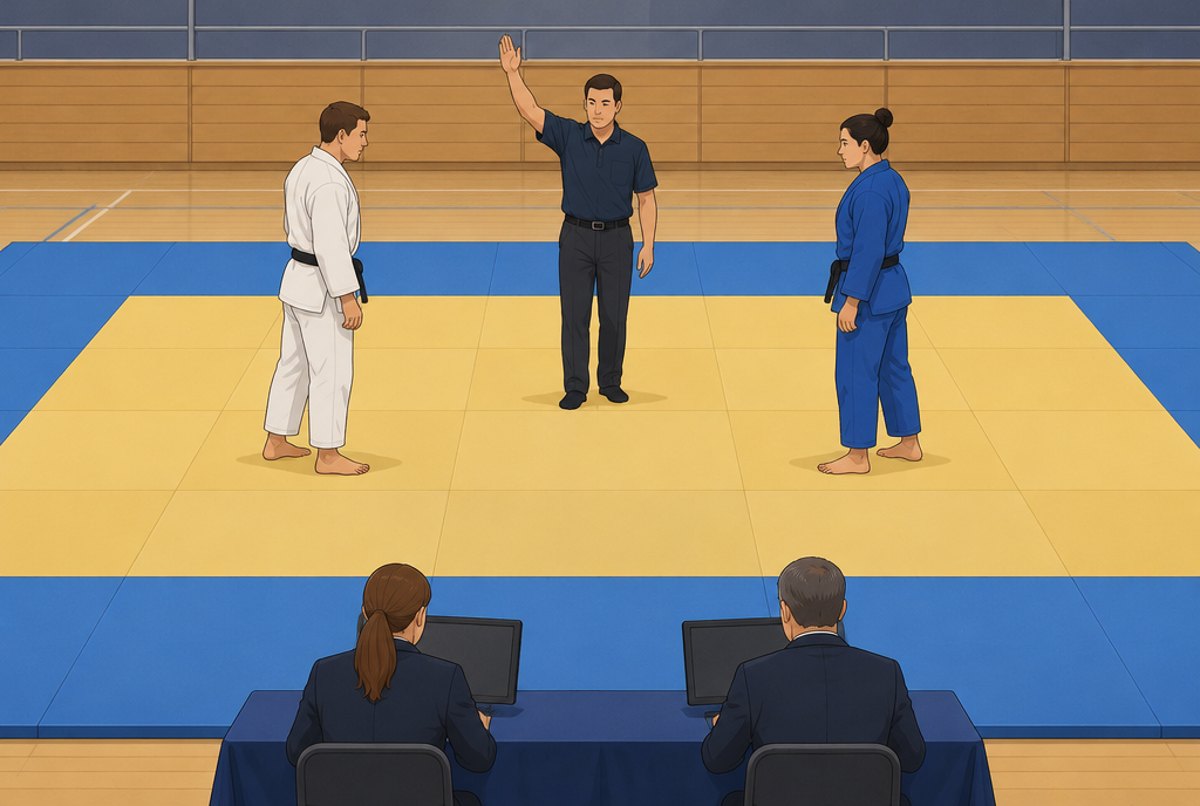
Penalties. For serious fouls and : the 1st penalty is marked; the 2nd gives the opponent an advantage; the 3rd gives the opponent 2 points; the 4th disqualifies. In under 15 divisions the 4th and 5th each give 2 points and only the 6th disqualifies. 43 Stalling is penalised after 20 seconds without trying to progress; since 2024, holding a lapel or belt in the 50/50 guard also starts a 20 second count. 43,44 Serious fouls include pulling guard without a grip, running out of the area, fingers inside the sleeve or trouser opening, a hand or foot on the face, and, for under 15s and all white belts, jumping guard. 43 Severe fouls, immediate disqualification, include illegal holds for the division, slippery substances on the body or gi, strangling with the hands round the throat, dangerous suplexes, and not wearing underwear. Since 2024 a disciplinary disqualification in a gi event also removes the athlete from the no gi event. 43,44
The referee's words are Portuguese: to start, to stop, to penalise stalling, for a foul. 43
Match times by age and belt. Age is the age reached in the calendar year. 43
| Division | Match time |
|---|---|
| Mighty Mite 1 to 3, ages 4 to 6 | 2 minutes |
| Pee Wee 1 to 3, ages 7 to 9 | 3 minutes |
| Junior 1 to 3, ages 10 to 12, and Teen 1 to 3, ages 13 to 15 | 4 minutes |
| Juvenile 1 and 2, ages 16 and 17 | 5 minutes |
| Adult, 18 and over | White 5, blue 6, purple 7, brown 8, black 10 minutes |
| Master 1, 30 and over | White and blue 5; purple, brown and black 6 minutes |
| Masters 2 to 7, 36 and over | 5 minutes |
The minimum rest between matches equals the match time up to the semi finals, and twice the match time before a final. Brackets are single elimination, except a group of three. 43
Entering IBJJF events. Every athlete needs an IBJJF membership under a registered academy, approved by a black belt professor, and can only enter at the belt registered with the IBJJF. 40,43,47 A judo black belt, an experienced wrestler or anyone who has fought MMA may not enter as a white belt. Athletes must register in the category matching their sex as listed on their original birth certificate, a rule added in 2024. The IBJJF has contracted the US Anti-Doping Agency for doping control. 43,44 Weight classes are on each event's page.
AJP rules, Rule Book of 25 August 2026 50,51
The AJP's rulebook follows the IBJJF's closely, with the same positions, point values and table of 26 illegal techniques, and these differences:
- An advantage is worth 1 point, and each minor fault or stalling penalty gives the opponent 1 point; the 2nd also an advantage, the 3rd also 2 more points; the 4th disqualifies; under 15s are disqualified at the 6th. 50
- Ties: if the score is level at the end of normal time, the athlete who scored last wins. At 0 to 0, or if all scores were simultaneous, there is one minute of restarted standing, first to score wins, then a referee decision. 50
- 2026 changes, valid from 16 July 2026: a double advantage when both athletes have a dangerous submission on at once; 10 seconds, not 20, to progress when holding a lapel or belt in 50/50; disqualification from both gi and no gi for a disciplinary foul. 51
- Entering: every athlete must be affiliated to the AJP for the current year through a registered academy; the same white belt bar applies to judo black belts, wrestlers and MMA fighters. 53
- Children: age groups are named Kids 1 to 3, Infant, Junior, Teen and Youth, 16 and 17; kids divisions can be merged by weight, age or belt, always upwards, and Teen and Youth athletes are never merged together. Match times for children are not published. 53
ADCC rules, as archived on 13 October 2026 60
- No gi in practice, a gi and wrestling shoes optional, on a 10 by 10 metre mat with no cage.
- No points in the first half. In World Championship qualifying rounds of 10 minutes the first 5 minutes score nothing; in finals of 20 minutes only minus points count in the first 10. Draws go to overtime. Trials use 6 and 8 minute matches, beginners 5 and 6 minutes.
- Points, each position held 3 seconds: guard pass 3; back with hooks or a body triangle 3; mount 2; knee on stomach 2; takedown 2, or 4 if it lands past the guard; sweep 2, or 4 if it ends past the guard.
- Minus points for pulling guard or going to the knees from standing for 3 seconds, backing away from contact, repeated passivity after two warnings, fleeing the mat, and bad behaviour by an athlete or coach.
- Legal: any choke except closing the windpipe with the hand; any arm, shoulder or wrist lock; any leg or ankle lock. Illegal for everyone: strikes, slams except to escape a locked submission, neck cranks that trap both shoulders, the full nelson, any crucifix, spiking the head, and others. Beginners and children use the beginner rules, which also ban heel hooks, toe holds, kneebars, slicers, the banana split, neck cranks and all slams. 60
- The first children's ADCC World Championship was held in 2024. 18 , two team mates in a final agreeing not to fight, is banned at ADCC. 1
JJIF Jiu-Jitsu (Ne-Waza), rulebook version 2.8.1, October 2026 65,66,67
- Age groups and match times: U8 and U10, 1.5 minutes; U12, U14 and U16, 3 minutes; U18, 4 minutes; U21, adults and masters, 5 minutes. Age is counted by calendar year, except that U21 and adult athletes must already be 18 on the day. 65
- Points are the same 2, 3 and 4 as the IBJJF; ties go to advantages, then fewer penalties, then golden score with no time limit, where the first point, advantage or penalty decides. 65
- Gi and no gi, in belt divisions or in open rank age groups. 65
- Weight categories for major events: men 56, 62, 69, 77, 85, 94 and over 94 kg; women 45, 48, 52, 57, 63, 70 and over 70 kg. 66
- Multi sport games. The JJIF added ne-waza in 2010; it has been at The World Games since 2013 and will be at The World Games 2029 in Karlsruhe; ju-jitsu has been at the Asian Games since 2018, with only ne-waza events, and was at the 20th Asian Games in Nagoya on 1 to 3 October 2026. 20,66,67 The 2026 JJIF World No-Gi Championships were held in Zadar, Croatia, on 22 August 2026. 67
UK competitions 80,81,85,89
- UKBJJA ranked tournaments. Medallists who are UKBJJA members earn ranking points: gold 9, silver 3, bronze 1, multiplied by 1, 2 or 4 according to the event's size. Events in the rankings on 26 October 2026: the BJJ British Open and English Open, times 4; the Scottish BJJ Open, Welsh Open and Bristol Open, times 2; the Scottish Cup of BJJ, Somerset Open, Caledonian BJJ Open, Surrey Open BJJ and Edinburgh BJJ Open, times 1. Rankings are published for adults, masters, under 18s, under 16s, under 14s and under 10s. 89
- Kids League: low cost, low pressure events across England, Wales, Scotland and Northern Ireland that give no ranking points; free Junior Development Days for 7 to 15 year olds; and, in 2026, a series of junior no gi events in Birmingham. 81,89
- University League: two competitions a year, autumn and spring, gi and no gi, for students and staff. 80
- Team events. Gracie Barra runs its own league, CompNet, for Gracie Barra students, including a European championship. 101
- Professional and events include the UK based Polaris Pro Grappling. 1
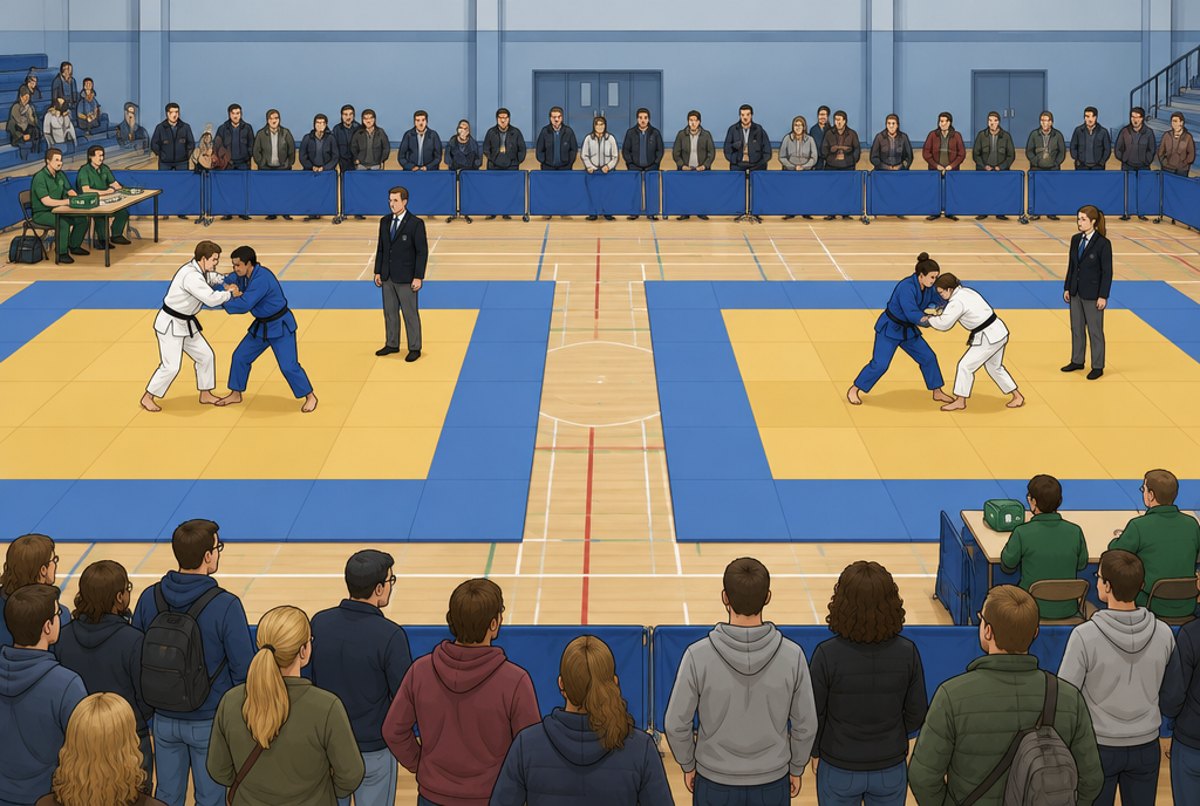
The UKBJJA's rules for any tournament it recognises, Tournament Regulations 2025 85
- Insurance of £5 million public liability, a risk assessment and medical cover: at least two first aiders at small in club events, a paramedic at public venues, and two or more paramedics, one per three mats, at larger events.
- Mats at least 40 mm thick, a 5 by 5 metre area with a 1 metre safety zone, calibrated scales, barriers and at least 2 metres between spectators and the mat.
- A qualified head referee, UKBJJA Level 1 or an experienced IBJJF referee; referees of children must have a current DBS check and safeguarding and first aid training.
- Rules: an established grappling ruleset, for example IBJJF or ADCC, with some deviations allowed on request; no striking under any ruleset. The UKBJJA's 2023 safety policy says simply that it "follows IBJJF rules for competition"; the 2025 regulations are wider. 85,86
- Children: no merging by gender or belt; weight and age merges only one category up, never down, at most two years apart, and never both at once; no open weight classes for juniors, except ultra heavyweights; juniors may not enter juvenile divisions until the year they turn 16, and juveniles may not enter adult divisions until their 18th birthday. This differs from the IBJJF and JJIF, which count adult status by calendar year or allow 18 year olds on the day. 43,65,85
- Safeguarding at events: a named safeguarding lead, a media consent form at sign up, separate changing for juniors where possible, and juniors and adults never on neighbouring mats or at the same time.
- Eligibility: no judo black belts, national level wrestlers or MMA competitors at white belt, and no former junior grey belts or above at white belt; athletes compete in the category of their sex at birth; UK Anti-Doping rules apply; competitors with signs of a skin infection may not compete. 85
Children's competition side by side
| IBJJF, June 2024 | UKBJJA, junior policy 2016 and regulations 2025 | JJIF, October 2026 | ADCC, 2026 | |
|---|---|---|---|---|
| Youngest division | Mighty Mite 1, age 4 | Pee Wee 1, ages 4 and 5 | U8, 7 and under | Kids; age bands not confirmed |
| Match length for the youngest | 2 minutes | 2 minutes | 1.5 minutes | Beginner rules: 5 minute qualifying rounds, not stated separately for kids |
| Banned holds | All 26 listed techniques up to 12; leg stretches allowed from 13 | The event chooses the ruleset | All listed up to U12; banana split allowed from U14 | Beginner rules: no heel hooks, toe holds, kneebars, slams, neck cranks and more |
| Other safety rules | No jumping guard under 15; referee protects a lifted child's spine under 12; disqualification only at the 6th penalty under 15 | Referees experienced with children; no open weight; no adult and junior mats side by side; safeguarding lead | Same jumping guard ban for U16 and white belts; referee protects a lifted U12 child | Not confirmed |
| Sources | 43 | 84,85 | 65 | 18,60 |