

The one thing every family should know: in jiu-jitsu the belt is given by the student's own instructor, usually called the , not by an association or an examining panel, and most academies promote without a set test. 2,40 Children from 4 to 15 wear a separate series of belts; at 16 a young person moves to the adult belts. Adult promotions are slow: about 10 years to black belt is typical. The most widely used written rules for minimum ages and times are the IBJJF's, last revised in June 2026. 2,40
How the ranks work
- Belts and stripes. Each belt has a black bar about 10 cm long near one end, red on a black belt. Progress within a belt is shown by a , also called a degree or , usually up to four, often made of white tape on the bar. 2,40
- Who decides. The IBJJF's own document says the time from white to black belt "is at the professor's discretion"; it sets only minimum ages and minimum times, and recognises a promotion for its own events only if those minimums are met. It sets no syllabus. 2,40
- What instructors look at. Mostly two things: the techniques a student knows, and how well they use them in , live sparring, in the academy or in competition. Competing is encouraged but rarely required. 2
- Tests are the exception. Some organisations test, especially for lower belts, and Gracie University grades students from uploaded videos. A formal test may carry a fee and may need private lessons first. 2,102,106
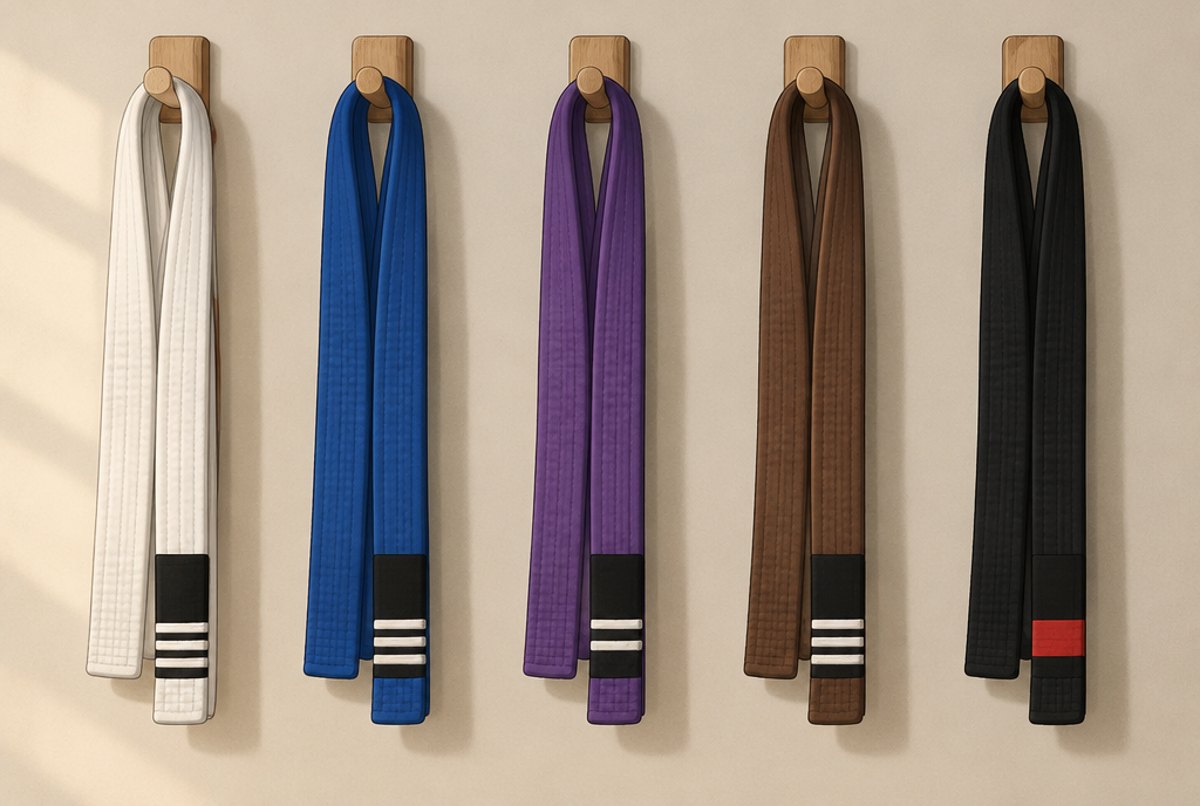
Adult belts, 16 and over: the IBJJF system, June 2026 40
| Belt | Minimum age | Minimum time before the next belt, 18 and over | Exceptions |
|---|---|---|---|
| White | Any age | None | |
| Blue | 16 | 2 years | 1 year if earlier registered as a grey, yellow or orange belt; none if earlier a green belt or a juvenile blue belt; none for the Adult Blue Belt World Champion |
| Purple | 16 | 1 year 6 months | 1 year if earlier a juvenile blue belt; none in some cases of earlier junior belts; none for the Adult Purple Belt World Champion |
| Brown | 18 | 1 year | None for the Adult Brown Belt World Champion |
| Black | 18, only for an athlete who has won the Adult World Championship at brown belt | See the degrees below |
- 16 and 17 year olds have no minimum time at white or blue; a juvenile purple belt can move only to brown in the adult division. 40
- Black belt at 18 is new. The June 2026 revision says it changes only the black belt age rule. Earlier rules put the minimum at 19, and the AJP still does. 2,40,52 In practice the 2026 rule still means 19 for nearly everyone, since a brown belt must be 18 and spend a year at brown unless they are the adult world champion. 40
- The clock starts at registration. Times count from when the belt is registered with the IBJJF, not from the day of promotion. A student promoted before the minimum may compete in neither the new belt nor the old one at IBJJF events. 40,43
- Four stripes on white to brown, but using stripes at all is the professor's choice. 40
Black belt and above 40
| Rank | Belt | Can be requested after |
|---|---|---|
| 1st to 3rd degree | Black, red bar | 3 years each: 3, 6 and 9 years as a black belt |
| 4th to 6th degree | Black, red bar | 5 years each: 14, 19 and 24 years |
| 7th degree | Red and black, a | 7 years, 31 in total; minimum age 49 |
| 8th degree | Red and white, coral | 7 years, 38 in total; minimum age 56 |
| 9th degree | Red | 10 years, 48 in total; minimum age 66 |
| 10th degree | Red | Given only to the pioneers: Carlos, Oswaldo, George, Gastão and Hélio Gracie |
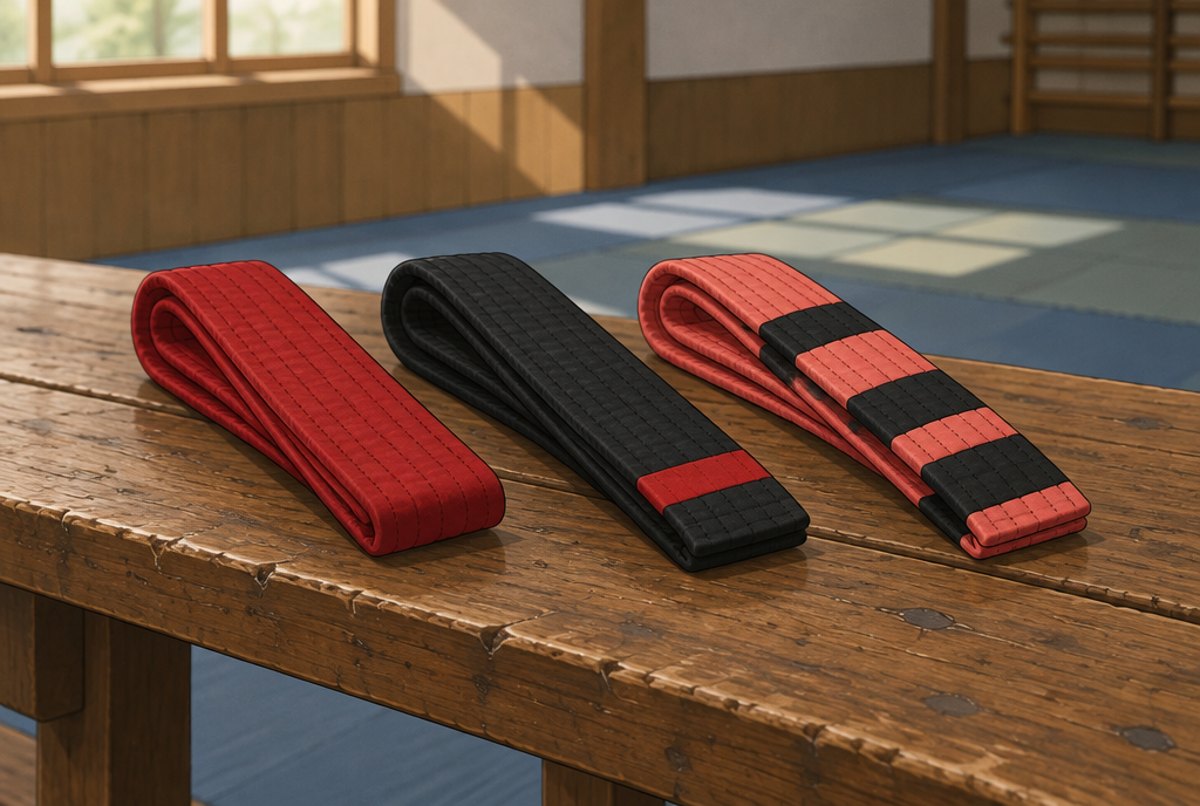
- A degree only counts in years when the holder shows activity under the IBJJF: membership, a registered academy, approving students, titles, or referee and rules course certificates. 40
- Who may promote. A colour belt's IBJJF membership must be approved by an affiliated black belt professor, and a promotion to black belt must be signed by a black belt with at least two IBJJF certified degrees. Someone registering at brown or black for the first time is for two years. 40
- Titles. Black belts are often called professor or , though some schools keep professor for senior black belts; coral belts are called and red belts grandmaster. In the Gracie system a black belt is commonly called professor from the 2nd degree. 2,3
The AJP's version, Abu Dhabi, last updated September 2022 52
The AJP uses the same belts and the same adult minimum times, but black belt at 19 with no world champion exception; red and black at 50, red and white at 57 and red at 67; and a two year minimum at purple for 16 and 17 year olds. Instead of a time exemption, an AJP world champion who has completed the minimum time must move up a belt division at AJP events. 40,52 The AJP also certifies purple, brown and black belts on the basis of a certificate from the coach, academy or a recognised federation, a rules course and a first aid certificate. 53
Children's belts, 4 to 15: the IBJJF system 40
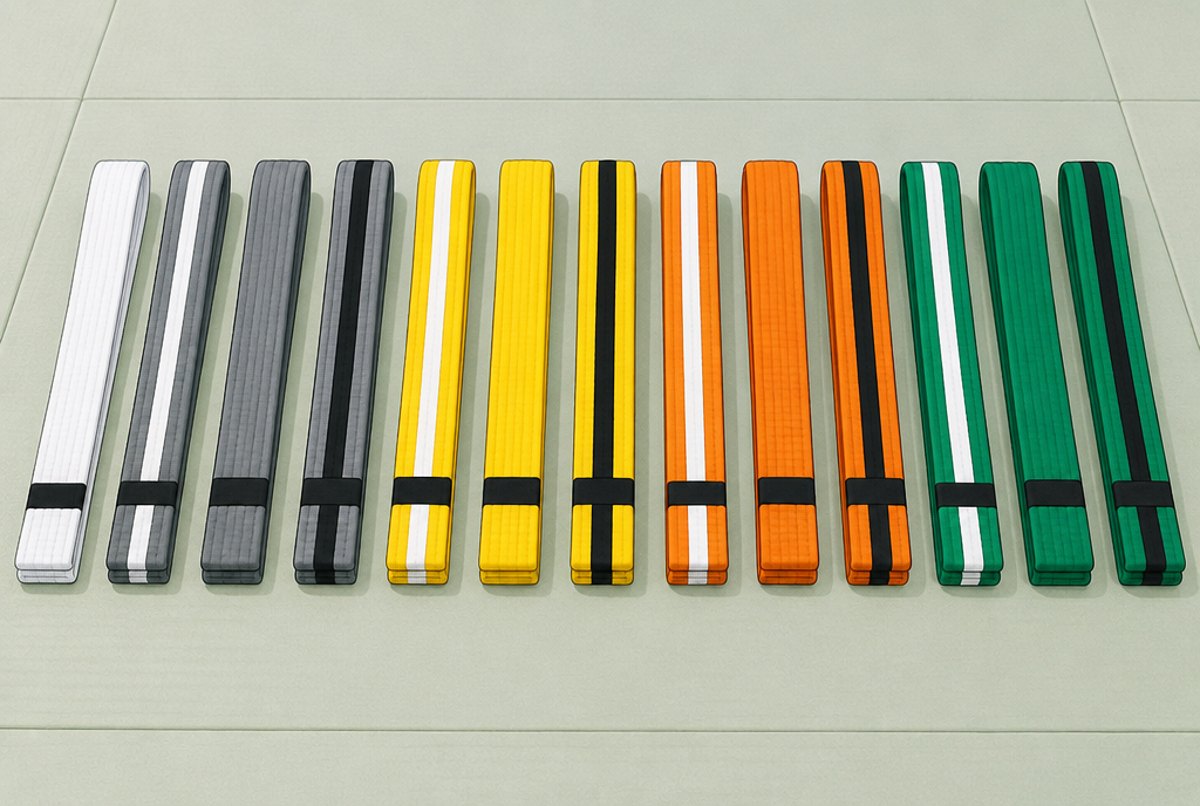
Thirteen belts in five colour groups. A child may hold any belt in a group from the group's starting age up to 15, and there is no minimum time at any children's belt.
| Group | Belts, in order | From age |
|---|---|---|
| White | White | Any age |
| Grey | Grey and white; grey; grey and black | 4 |
| Yellow | Yellow and white; yellow; yellow and black | 7 |
| Orange | Orange and white; orange; orange and black | 10 |
| Green | Green and white; green; green and black | 13 |
- How age is counted. The IBJJF uses the age the child reaches in the current year, not the birthday. The same rule sets competition divisions: Mighty Mite 4 to 6, Pee Wee 7 to 9, Junior 10 to 12, Teen 13 to 15, Juvenile 16 and 17. 40,43
- The belts themselves are narrower, 2.5 to 3.5 cm, with the black bar near one end; the "white" and "black" versions carry a white or black line along the middle. 40
- Stripes for children. The IBJJF suggests three methods, chosen by the professor: a stripe every three months, every four months, or every month, each adding up to roughly one new belt a year. 40,42
- Turning 16. In the year a young person turns 16 they move to the adult belts: a white belt may stay white; a grey, yellow or orange belt must become blue; a green belt becomes blue or purple at the professor's choice. 40
Other children's systems
| System | Belts and progress | Source |
|---|---|---|
| AJP, 2021, updated 2022 | Five belts, white, grey, yellow, orange and green, with the same starting ages as the IBJJF; no minimum time | 52 |
| Gracie family system, Hélio Gracie line | No grey belt. Half colour belts between full colours, 10 belts in all, proposed by Pedro Valente and approved by Hélio Gracie in 2005; a stripe about every three months and a new belt each year. Not confirmed by any Gracie organisation | 3 |
| Gracie University, Bullyproof | Age groups: Mat Munchkins 3 to 5, Little Champs 5 to 7, Jr. Grapplers 7 to 12, and an invitation only Black Belt Club. Belt colours not published | 106 |
| Alliance | Stripes by attendance: Baby Eagle 4 to 5 and Little Eagle 5 to 7, eight classes a stripe; Eagle Warrior 8 to 12, 12 classes; Eagle Youth 13 to 15, 20 classes; plus behaviour stripes for relationships, behaviour, school and good habits | 102 |
| Roger Gracie Association | Age groups Little Kids 4 to 6, Juniors 7 to 10, Teenagers 11 to 15, one curriculum in every academy; no belt rules published | 105 |
| Gracie Barra | A kids curriculum "structured around their age group and level"; no belt rules published | 100 |
What this means for a family: a child's belt may look different in two academies at the same level. Ask the academy which system it follows and how often children are usually promoted. 2,40,52
Children's belts in UK competitions
- The UKBJJA's junior policy of 2016 asks competitions to separate children by belt group and uses age bands that differ from the IBJJF's: Pee Wee 1 at 4 and 5, Pee Wee 2 at 6 and 7, Junior 1 at 8 and 9, Junior 2 at 10 and 11, Teen 1 at 12 and 13, Teen 2 at 14 and 15, Juvenile at 16 and 17. 84
- Its 2025 tournament regulations do not allow junior belt groups to be merged, and say that anyone who has held a junior belt from grey upwards may not enter white belt as a juvenile or adult. 85
How the teams award belts
- Alliance promotes by counted classes, stripes and belt exams. After three private introductory lessons, beginners do 60 classes without sparring. Adult classes per belt: white 150, blue 325, purple 375, brown 425, so 1,275 classes and 16 stripes from white to black. Black belt "follows the IBJJF rules". 102
- Gracie Barra has three adult programmes: GB1 Fundamentals; GB2 Advanced, which needs three stripes on a white belt, usually at least four months; and GB3 Expert, each a 16 week curriculum. Black belts are certified through the GB Institute and "lineage verification". 11,100
- Gracie University teaches beginners the 36 Gracie Combatives techniques, and they can earn a , white with a navy centre, by video test. Blue to black is only by live testing at a Certified Training Center, and black belt by invitation at the Torrance headquarters. Belts from other schools are recorded as "unverified" until the holder passes the Combatives test. A pink belt marks completion of the women's self-defence programme. 3,106
- The Roger Gracie Association has one curriculum across all its academies, Fundamentals, Intermediate and Advanced; its promotion rules are not published. 105
- 10th Planet uses the standard ranks but trains mostly without a gi or belt, showing rank by the colour of the rash guard. 16
- Unusual belts. Some schools add a green belt for adults between white and blue because the wait for blue is long. 2 In the Gracie system a certified instructor's belt has white borders on the bar, and some senior Gracie black belts, such as Royce Gracie, wear a dark navy belt in memory of an older system. 2,3
- The "gauntlet". In some schools a newly promoted student runs the gauntlet, , being struck on the back with belts or thrown by each team mate. 2 Families may want to ask an academy whether it does this with children.
In the UK
- No national syllabus. The UKBJJA does not award belts. Its stated aim is to "preserve the integrity of the ranking system", and its club rules require every instructor to be purple belt or higher "from a verifiable lineage", with proof of promotions and timescales; assistant instructors can be blue belts. 80,82 Its coaching awards need a blue belt and age 16 for Level 1, or a purple belt and age 18 for Level 2. 83
- Recognition for competition. A UK student's belt counts at IBJJF events only once registered through an IBJJF affiliated professor, and at AJP events once the athlete is affiliated to the AJP. 40,53 The UKBJJA's tournament rules add their own checks: no judo black belts, national level wrestlers or MMA competitors at white belt, and no former junior grey belts or above at white belt. 85
- Teams with their own systems. Gracie Barra, Gracie University and the Roger Gracie Association each say their curriculum is the same in every academy worldwide, which includes their UK academies; Alliance publishes one methodology for its schools. 100,102,105,106
Questions families ask
How long to black belt? About 10 years of steady training is typical; Ryron Gracie has said it should take about seven. 2 Alliance's class count adds up to 1,275 adult classes. 102 The IBJJF's adult minimum times alone add up to four and a half years after white belt. 40
Does the belt carry over if we change academy? A belt belongs to the student and the professor who awarded it, so there is no automatic transfer rule between teams. Under IBJJF rules a student whose earlier belts were never registered may be provisional for two years at brown or black. 40 Gracie University records outside belts as unverified. 106 Carlson Gracie popularised the word for a student he considered disloyal for leaving, which shows how strongly some lines feel about team loyalty. 14
What does four stripes mean? Usually that the student is close to the next belt, but promotion without all four is common. 3